Question
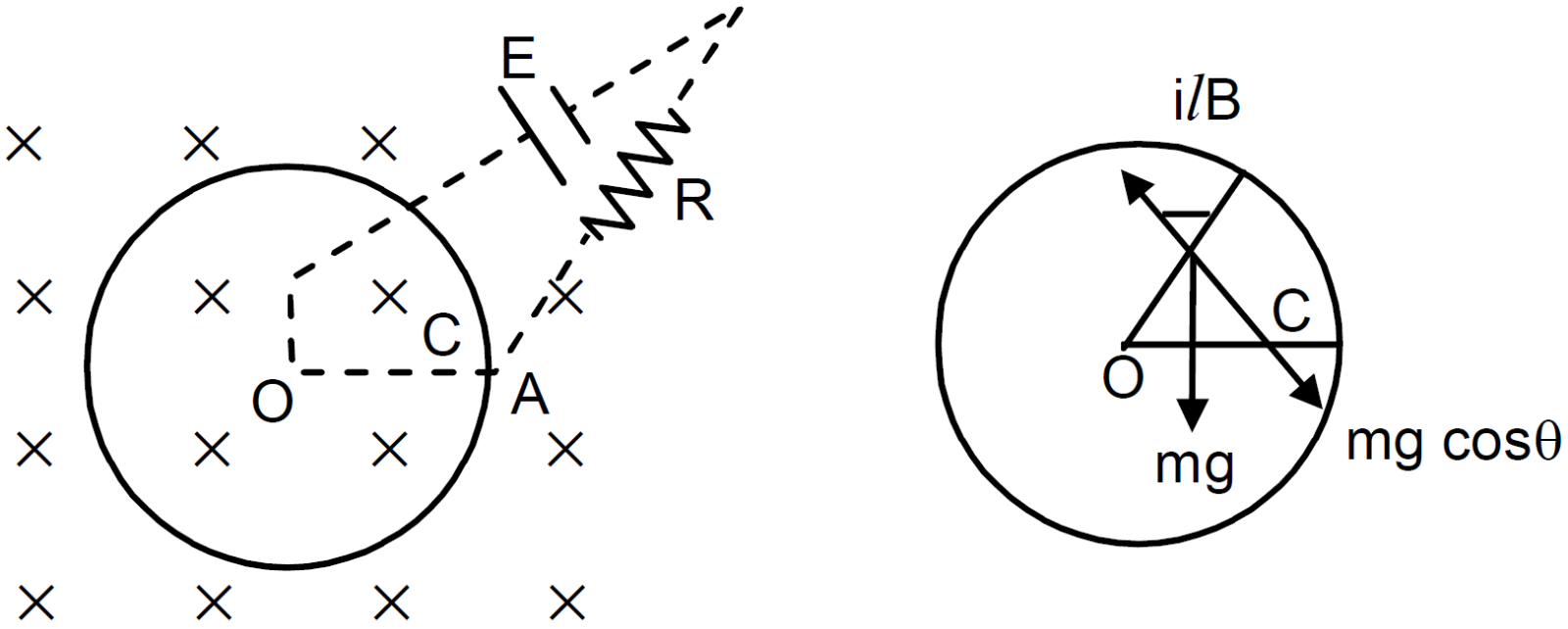
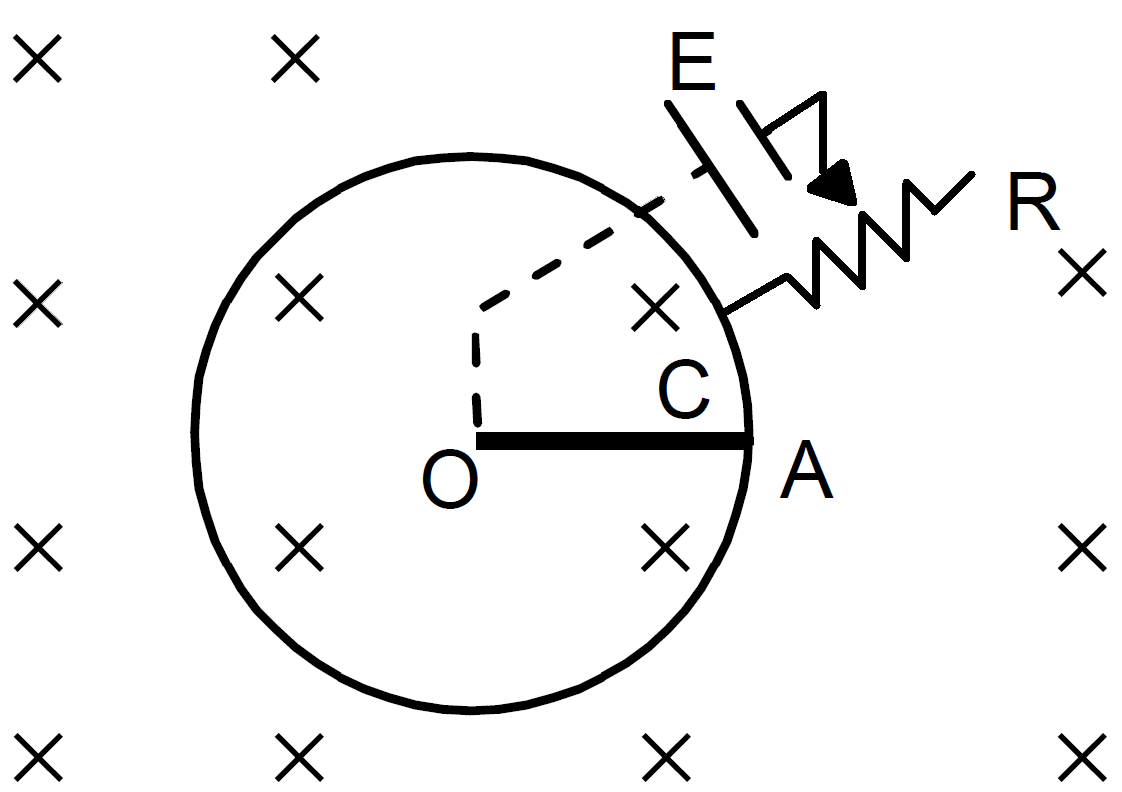
Figure shows a situation similar to the previous problem. All parameters are the same except that a battery of emf $\in$ and a variable resistance R are connected between O and C. The connecting wires have zero resistance. No external force is applied on the rod (except gravity, forces by the magnetic field and by the pivot). In what way should the resistance R be changed so that the rod may rotate with uniform angular velocity in the clockwise direction? Express your answer in terms of the given quantities and the angle $\theta$ made by the rod OA with the horizontal.
Answer


$\text{emf}=\frac{1}{2}\text{B}\omega\text{a}^2$ [from previous problem]

Current $= \frac{\text{e}+\text{E}}{\text{R}}=\frac{\frac{1}{2}\times\text{B}\omega\text{a}^2+\text{E}}{\text{R}}$

$=\frac{\text{B}\omega\text{a}^2 +2\text{E}}{2\text{R}}$

$\Rightarrow \text{mg} \cos \theta =\text{ilB}$ [Net force acting on the rod is O]

$\Rightarrow \text{mg}\cos\theta =\frac{\text{B}\omega\text{a}^2+2\text{E}}{2\text{R}}\text{a}\times\text{B}$

$\Rightarrow \text{R}=\frac{\big(\text{B}\omega\text{a}^2+2\text{E}\big)\text{ab}}{2\text{mg}\cos\theta}$

Need a full question paper?

Generate a complete, print-ready paper with questions like this in minutes — across 16+ boards, with answer keys.

Start Generating Free

Similar questions

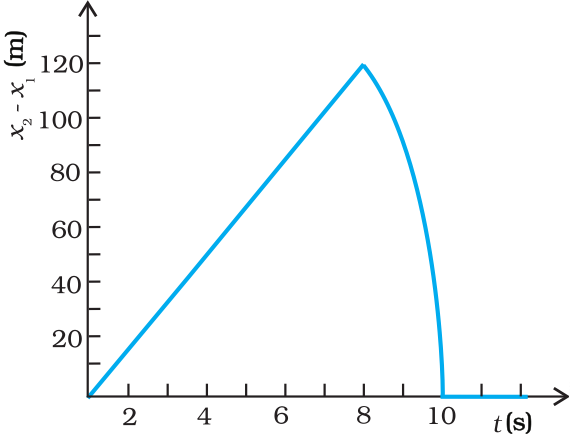
Two stones are thrown up simultaneously from the edge of a cliff 200m high with initial speeds of 15m s–1 and 30m s–1. Verify that the graph shown in correctly represents the time variation of the relative position of the second stone with respect to the first. Neglect air resistance and assume that the stones do not rebound after hitting the ground. Take g = 10m s–2. Give the equations for the linear and curved parts of the plot.

Explain fluid pressure.
When the sun is directly overhead, the surface of the earth receives 1.4 × 10³ W m-2 of sunlight. Assume that the light is monochromatic with average wavelength 500nm and that no light is absorbed in between the sun and the earth's surface. The distance between the sun and the earth is 1.5 × 10¹¹m.
  1. Calculate the number of photons falling per second on each square metre of earth's surface directly below the sun.
  2. How many photons are there in each cubic metre near the earth's surface at any instant?
  3. How many photons does the sun emit per second?
1 gram of water at 373K is converted into steam at the same temperature. The volume of 1cm3 of water becomes 1671cm3 on boiling. Calculate change in internal energy of the system, if heat of vapourisation is 540cal g-1. Given standard atmospheric pressure is 1.013 × 10% Nm-2.
Explain why.
There is no atmosphere on moon.
The current in a conductor and the potential difference across its ends are measured by an ammeter and a voltmeter. The meters draw negligible currents. The ammeter is accurate but the voltmeter has a zero error (that is, it does not read zero when no potential difference is applied). Calculate the zero error if the readings for two different conditions are 1.75A, 14.4V and 2.75A, 22.4V.
A bullet of mass 25g is fired horizontally into a ballistic pendulum of mass 5.0kg and gets embedded in it. If the centre of the pendulum rises by a distance of 10cm, find the speed of the bullet.
A boy has a bag of sand of mass 20 kg. First of all, he keeps the bag on his head and moves 10m. Second time, he drags the bag through 10m on a frictionless surface with coefficient of friction u = 0.1. In which case, he does more work?
A girl riding a bicycle along a straight road with a speed of 5m s–1 throws a stone of mass 0.5kg which has a speed of 15m s–1 with respect to the ground along her direction of motion. The mass of the girl and bicycle is 50kg. Does the speed of the bicycle change after the stone is thrown? What is the change in speed, if so?
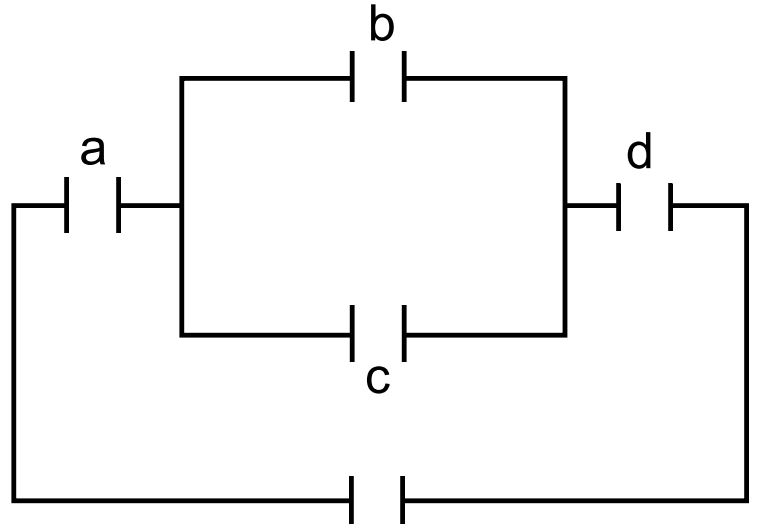
Each capacitor in figure has a capacitance of $10\mu\text{F}.$ The emf of the battery is 100V. Find the energy stored in each of the four capacitors.