Question
The current in a conductor and the potential difference across its ends are measured by an ammeter and a voltmeter. The meters draw negligible currents. The ammeter is accurate but the voltmeter has a zero error (that is, it does not read zero when no potential difference is applied). Calculate the zero error if the readings for two different conditions are 1.75A, 14.4V and 2.75A, 22.4V.
Answer

Let the voltmeter reading when, the voltage is 0 be X.

$\frac{\text{l}_1\text{R}}{\text{l}_2\text{R}}=\frac{\text{V}_1}{\text{V}_2}$

$\Rightarrow\frac{1.75}{2.75}=\frac{14.4-\text{V}}{22.4-\text{V}}$

$\Rightarrow\frac{0.35}{0.55}=\frac{14.4-\text{V}}{22.4-\text{V}}$

$\Rightarrow\frac{0.07}{0.11}=\frac{14.4-\text{V}}{22.4-\text{V}}$

$\Rightarrow\frac{7}{11}=\frac{14.4-\text{V}}{22.4-\text{V}}$

$\Rightarrow7(22.4-\text{V})=11(14.4-\text{V})$

$\Rightarrow156.8-7\text{V}=158.4-11\text{V}$

$\Rightarrow(7-11)\text{V}=156.8-158.4\Rightarrow-4\text{V}=-1.6$

$\Rightarrow\text{V}=0.4\text{V}.$

Need a full question paper?

Generate a complete, print-ready paper with questions like this in minutes — across 16+ boards, with answer keys.

Start Generating Free

Similar questions

Derive the formula for centripetal acceleration of a particle moving with constant speed on a plane circular path. Or Derive the formula of acceleration for a particle moving with uniform speed on a circular path and tell its direction.
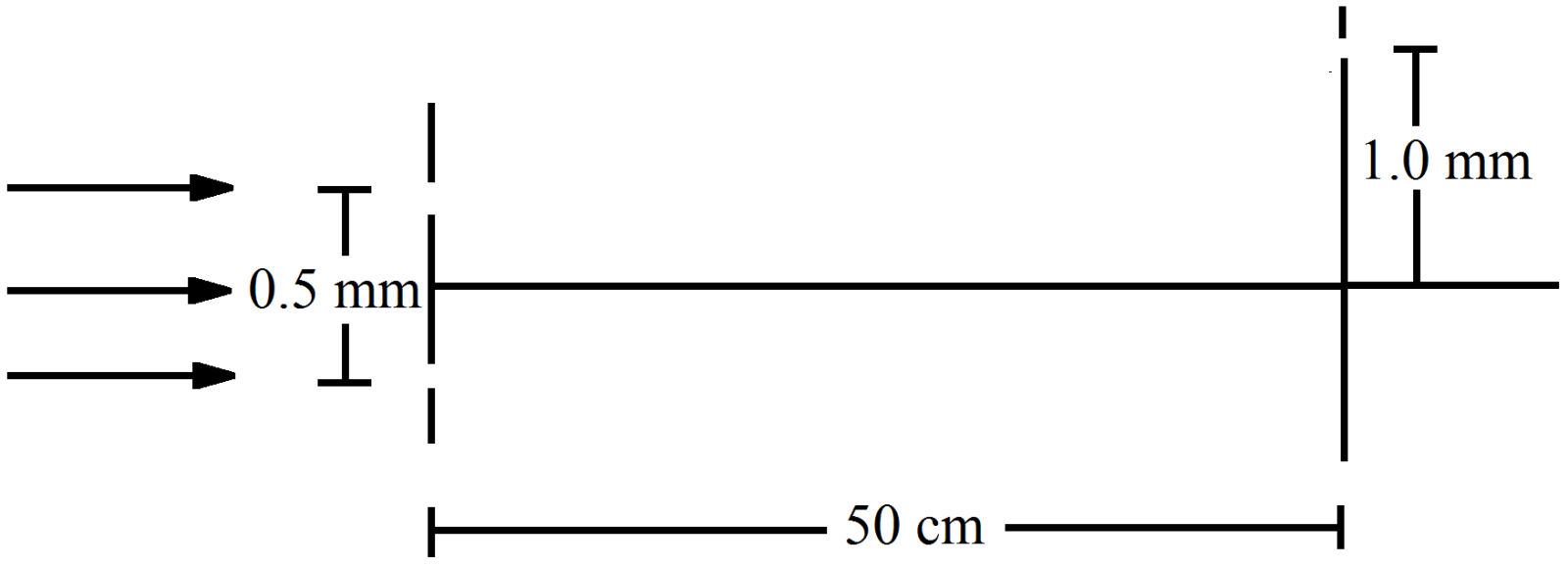
White coherent light (400nm - 700nm) is sent through the slits of a Young's double slit experiment (figure.) The separation between the slits is 0.5mm and the screen is 50cm away from the slits. There is a hole in the screen at a point 1.0mm away (along the width of the fringes) from the central line.
  1. Which wavelength (s) will be absent in the light coming from the hole?
  2. which wavelength (s) will have a strong intensity?

Verify the conservation of mechanical energy by obtaining expressions for the potential energy, kinetic energy and total energy of a particle in simple harmonic motion.
Suppose the ends of the coil in the previous problem are connected to a resistance of $100\Omega.$ Neglecting the reaiatance of the coil, find the heat produced in the circuit in one minute.
In a gamma decay process, the internal energy of a nucleus of mass M decreases, a gamma photon of energy E and linear momentum $\frac{\text{E}}{\text{c}}$ is emitted and the nucleus recoils. Find the decrease in internal energy.
The temperature and humidity of air are 27°C and 50% on a particular day. Calculate the amount of vapour that should be added to 1 cubic metre of air to saturate it. The saturation vapour pressure at 27°C = 3600Pa.
An airline passenger late for a flight walks on an airport moving sidewalk at a speed of 5.00km/ h relative to the sidewalk in the direction ofits motion. The sidewalkis moving at 3.00km/ h relative to the ground and has a total length of 135m.
  1. What is the passenger's speed relative to the ground?
  2. How long does it take him to reach the end of the sidewalk?
  3. How much of the sidewalk has he covered by the time he reaches the end?
Einstein’s mass - energy relation emerging out of his famous theory of relativity relates mass (m) to energy (E) as E = mc2, where c is speed of light in vacuum. At the nuclear level, the magnitudes of energy are very small. The energy at nuclear level is usually measured in MeV, where 1MeV = 1.6 × 10⁻¹³J; the masses are measured in unified atomic mass unit (u) where 1u = 1.67 × 10⁻²⁷kg.
  1. Show that the energy equivalent of 1u is 931.5MeV.
  2. A student writes the relation as 1u = 931.5MeV. The teacher points out that the relation is dimensionally incorrect. Write the correct relation.
A cubical block of mass 1.0kg and edge 5.0cm is heated to 227°C. It is kept in an evacuated chamber maintained at 27°C. Assuming that the block emits radiation like a blackbody, find the rate at which the temperature of the block will decrease. Specific heat capacity of the material of the block is 400Jkg-1K-1.
A capacitor of capacitance $10\mu\text{F}$ is connected to a battery of emf 2V. It is found that it takes 50ms for the charge of the capacitor to become $12.6\mu\text{C}.$ Find the resistance of the circuit.