Question
Write the upper and lower limits of interference in terms of path difference.

Answer

We know that :
Phase difference $=\frac{2 \pi}{\lambda} \times$ path difference
or $\phi=\frac{2 \pi}{\lambda} y \quad \ldots(i)$
We also know that for constructive interference to $\quad \phi=2 n \pi \ldots(ii)$
From equation (i) and (ii)
$\frac{2 \pi}{\lambda} y=2 n \pi$
or $y=2 n \cdot \frac{\lambda}{2}$
For $n$th maxima, $y=y_n$
$\underline {y_n=2 n \cdot \frac{\lambda}{2}}$
Thus, to occur the constructive interference, path difference must be even multiple of $\frac{\lambda}{2}$
For minimum intensity $\quad \phi=(2 n+1) \pi$
or $\frac{2 \pi}{\lambda} y=(2 n+1) \pi$
$\therefore$ $y=(2 n+1) \frac{\lambda}{2}$
For $n$th minima : $y=y_n$
$\therefore$$y_n=(2 n+1) \frac{\lambda}{2}$
Thus, for destructive interference, path difference must be odd multiple of $\frac{\lambda}{2}$.

Need a full question paper?

Generate a complete, print-ready paper with questions like this in minutes — across 16+ boards, with answer keys.
Start Generating Free

Similar questions

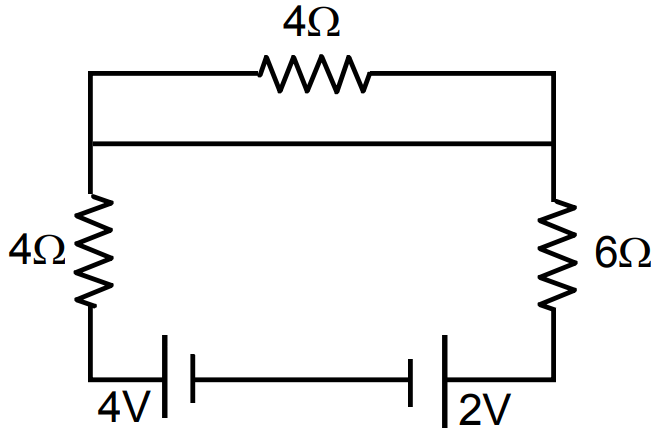
Find the currents through the three reaiators shown in figure.

A biconvex thick lens is constructed with glass $(\mu=1.50)$ Each of the surfaces has a radius of 10cm and the thickness at the middle is 5cm. Locate the image of an object placed far away from the lens.
  1. Describe briefly, with the help of a diagram, the role of the two important processes involved in the formation of a p-n junction.
  2. Name the device which is used as a voltage regulator. Draw the necessary circuit diagram and explain its working.
Suppose we want to verify the analogy between electrostatic and magnetostatic by an explicit experiment. Consider the motion of (i) electric dipole p in an electrostatic field E and (ii) magnetic dipole m in a magnetic field B. Write down a set of conditions on E, B, p, m so that the two motions are verified to be identical. (Assume identical initial conditions.)
Explain equations of Maxwell in detail.
A solid wire of radius 10cm carries a current 5.0A distributed uniformly over its cross-section. Find the magnetic field B at a point at a distance (a) 2cm (b) 10cm and (c) 20cm away from the axis. Sketch a graph of B versus x for 0 < x < 20cm.
A rod of negligible heat cafacity has length 20cm, area of cross section 1.0cm and thermal conductivity 200Wm-1°C-1. The temperature of one end is maintained at 0°C and that of the other end is slowly and linearly varied from 0°C to 60°C in 10 minutes. Assuming no loss of heat through the sides, find the total heat transmitted through the rod in these 10 minutes.
  1. Draw the ray diagram of an astronomical telescope when the final image is formed at infinity. Write the expression for the resolving power of the telescope.
  2. An astronomical telescope has an objective lens of focal length 20m and eyepiece of focal length 1cm.
  1. Find the angular magnification of the telescope.
  2. If this telescope is used to view the Moon, find the diameter of the image formed by the objective lens. Given the diameter of the Moon is 3.5 × 10⁶m and radius of lunar orbit is 3.8 × 10⁸m.
Lenses are constructed by a material of refractive index 1.50. The magnitude of the radii of curvature are 20cm and 30cm. Find the focal lengths of the possible lenses with the above specifications.
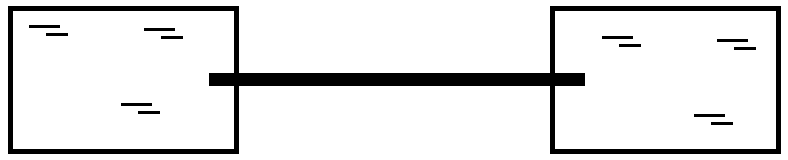
Figure, shows two adiabatic vessels, each containing a mass m of water at different temperatures. The ends of a metal rod of length L, area of cross section A and thermal conductivity K, are inserted in the water as shown in the figure. Find the time taken for the difference between the temperatures in the vessels to become half of the original value. The specific heat capacity of water is s. Neglect the heat capacity of the rod and the container and any loss of heat to the atmosphere.