MCQ
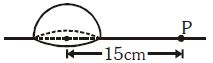
Figure shows a solid hemisphere with a charge of $5\ nC$ distributed uniformly through its volume. The hemisphere lies on a plane and point $P$ is located on this plane, along a radial line from the centre of curvature at distance $15\ cm$. The electric potential at point $P$ due to the hemisphere, is .....$V$
  • A
    $150$
  • $300$
  • C
    $450$
  • D
    $600$

Answer

Correct option: B.
$300$
b
Total charge $=\mathrm{5\;nc}=5 \times 10^{-9} \mathrm{\,c}$

${V=\frac{K q}{r}=\frac{9 \times 10^{9} \times 5 \times 10^{-9}}{15 \times 10^{-2}}} $

${V=300 \mathrm{\,V}}$

Need a full question paper?

Generate a complete, print-ready paper with questions like this in minutes — across 16+ boards, with answer keys.

Start Generating Free

Similar questions

The energy and capacity of a charged parallel plate capacitor are $U$ and $C$ respectively. Now a dielectric slab of $\in _r = 6$ is inserted in it then energy and capacity becomes  (Assume charge on plates remains constant)
The unit of electric field is not equivalent to
Magnetic field intensity is defined as
Temperature coefficient at $0\,^oC$ is $0.00125\,^oC^{-1}$. At a temperature of $25\,^oC$ its resistance is $1\,\Omega $. Find the temperature at which resistance is $1.2\,\Omega $
What length of the wire of specific resistance $48\times 10^{-8}\Omega m$  is needed to make a resistance of $4.2\Omega$  (diameter of wire = 0.4 mm)
An object is placed at a distance u from a simple microscope of focal length f. The angular magnification obtained depends:
Which of the following phenomenon cannot take place with longitudinal waves (e.g., sound waves)?
Compton effect supports that
Two capacitors of capacities $2 {C}$ and ${C}$ are joined in parallel and charged up to potential ${V}$. The battery is removed and the capacitor of capacity $C$ is filled completely with a medium of dielectric constant ${K}$. The potential difference across the capacitors will now be
A potentiometer having the potential gradient of $2\, mV/cm$ is used to measure the difference of potential across a resistance of $10 \,\Omega$. If a length of $50\, cm$ of the potentiometer wire is required to get the null point, the current passing through the $10 \,\Omega$ resistor is (in $mA$)