Question
Figure, shows a source of sound moving along the X-axis at a speed of 22m/s continuously emitting a sound of frequency 2.0kHz which travels s in air at a speed of 330m/s. A listener Q stands on the Y-axis at a distance of 330 m from the origin. At t = 0, the source crosses the origin P.
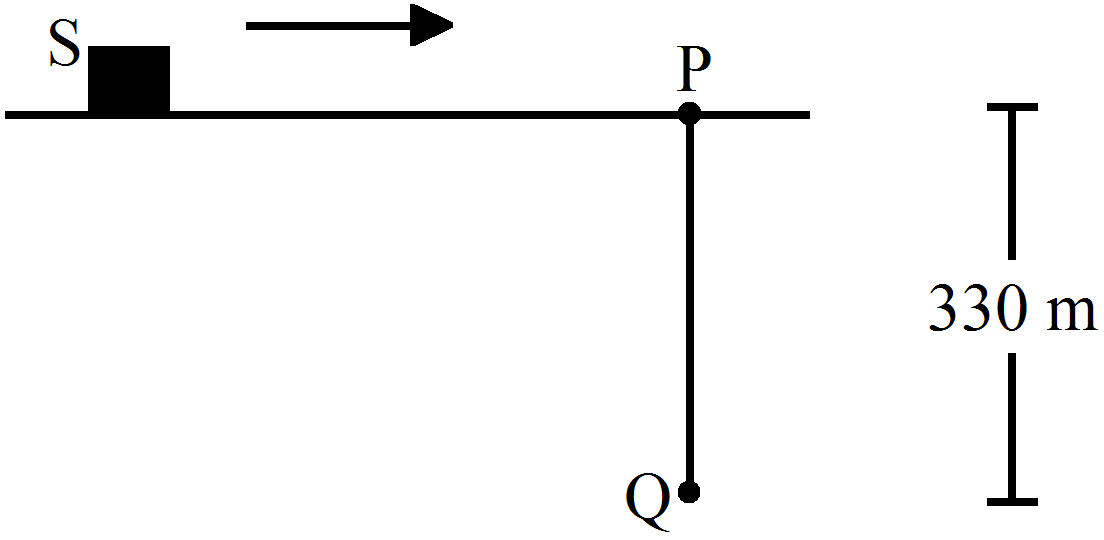
  1. When does the sound emitted from the source at P reach the listener Q?
  2. What will be the frequency heard by the listener at this instant?
  3. Where will the source be at this instant?
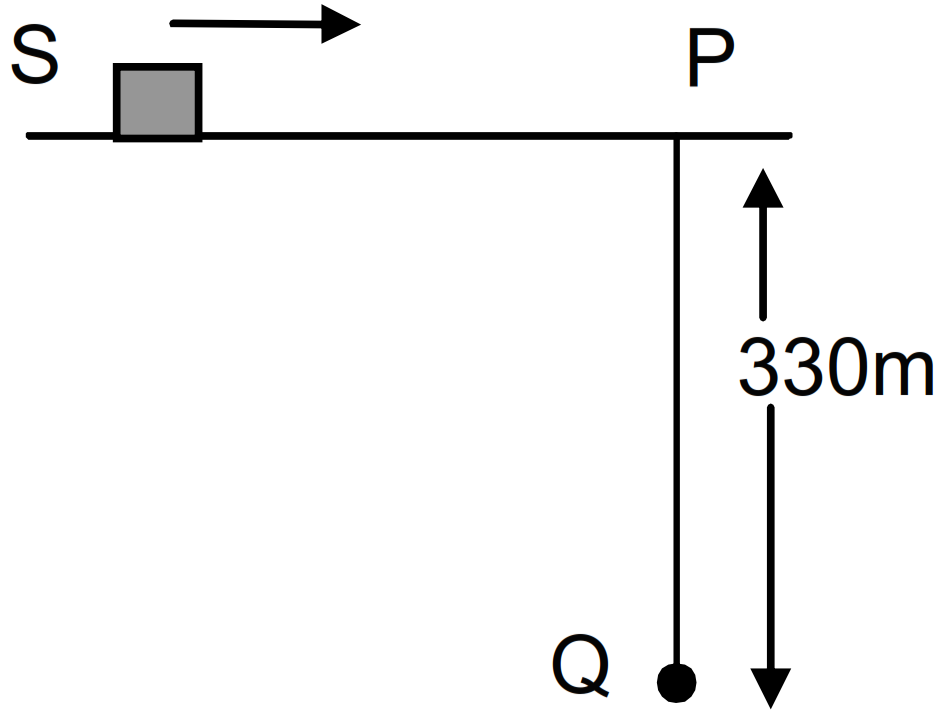
Answer


$\text{f}=2\text{KHz}, \text{v}=330\text{m/s},\ \text{u}=22\text{m/s}$
At t = 0, the source crosses P
  1. Time taken to reach at Q is
$\text{t}=\frac{\text{S}}{\text{v}}=\frac{330}{330}=1\text{sec}$
  1. The frequency heard by the listner is
$\text{f}'=\text{f}\Big(\frac{\text{v}}{\text{v}-\text{u}\cos\theta}\Big)$
since, $\theta=90^\circ$
$\text{f}'=2\times\Big(\frac{\text{v}}{\text{u}}\Big)=2\text{KHz}.$
  1. After 1sec, the source is at 22m from P towards right.

Need a full question paper?

Generate a complete, print-ready paper with questions like this in minutes — across 16+ boards, with answer keys.

Start Generating Free

Similar questions

Two pendulums with identical bobs and lengths are suspended from a common support such that in rest position the two bobs are in contact. One of the bobs is released after being displaced by $10°$ so that it collides elastically head-on with the other bob.
  1. Describe the motion of two bobs.
  2. Draw a graph showing variation in energy of either pendulum with time, for where T is the period of each pendulum.
The moment of inertia of a solid flywheel about its axis is $0.1kg-m^2$. A tangential force of $2kg/ wt$ is applied round the circumference of the flywheel with the help of a string and mass arrangement as shown in Fig. If the radius of the wheel is $0.1m$, find the acceleration of the mass.
​​​​​​​
In Millikan’s oil drop experiment, what is the terminal speed of an uncharged drop of radius $2.0 \times 10^{–5}m$ and density $1.2 \times 10^3 kg m^{–3}$. Take the viscosity of air at the temperature of the experiment to be $1.8 \times 10^{–5} Pa\ s$. How much is the viscous force on the drop at that speed ? Neglect buoyancy of the drop due to air.
A ball of mass $50g$ moving at a speed of $2.0m/s$ strikes a plane surface at an angle of incidence $45^\circ$ . The ball is reflected by the plane at equal angle of reflection with the same speed. Calculate
  1. The magnitude of the change in momentum of the ball.
  2. The change in the magnitude of the momentum of the ball.
Derive expression for velocity of a car on a banked circular road having coefficient of frictions. Hence write the expression for optimum velocity.
The two blocks in an Atwood machine have masses $2.0kg$ and $3.0kg$. Find the work done by gravity during the fourth second after the system is released from rest.
Lenses are constructed by a material of refractive index $1.50$. The magnitude of the radii of curvature are $20cm$ and $30cm$. Find the focal lengths of the possible lenses with the above specifications.
A cylindrical log of wood of height h and area of cross-section A floats in water. It is pressed and then released. Show that the log would execute S.H.M. with a time period.$\text{T}=2\pi\sqrt{\frac{\text{m}}{\text{A}\rho\text{g}}}$
where m is mass of the body and ρ is density of the liquid.
Suppose a hole was drilled completely through the earth along a diameter. Show that the force on a mass m at a distance r from the centre of the earth is $ \text{F}= \frac{-\text{mgr}}{\text{R}}$ assuming that the density of the earth is uniform.
An artificial satellite of mass $1000kg$ revolves around the earth in circular orbit of radius $6500km$. Calculate,
  1. Orbital velocity.
  2. Orbital kinetic energy.
  3. Gravitational potential energy.
  4. Total energy in the orbit. [Mass of the earth = $6 \times 1024kg, G = 6.67 \times 10-11 Nm^2/ kg]$