Question
Lenses are constructed by a material of refractive index $1.50$. The magnitude of the radii of curvature are $20cm$ and $30cm$. Find the focal lengths of the possible lenses with the above specifications.
Answer

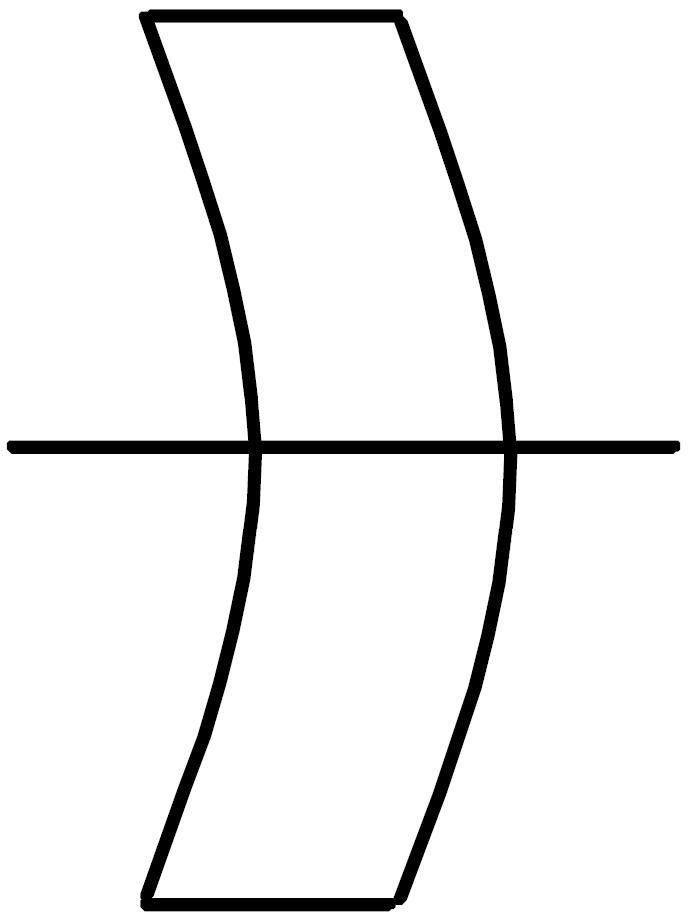
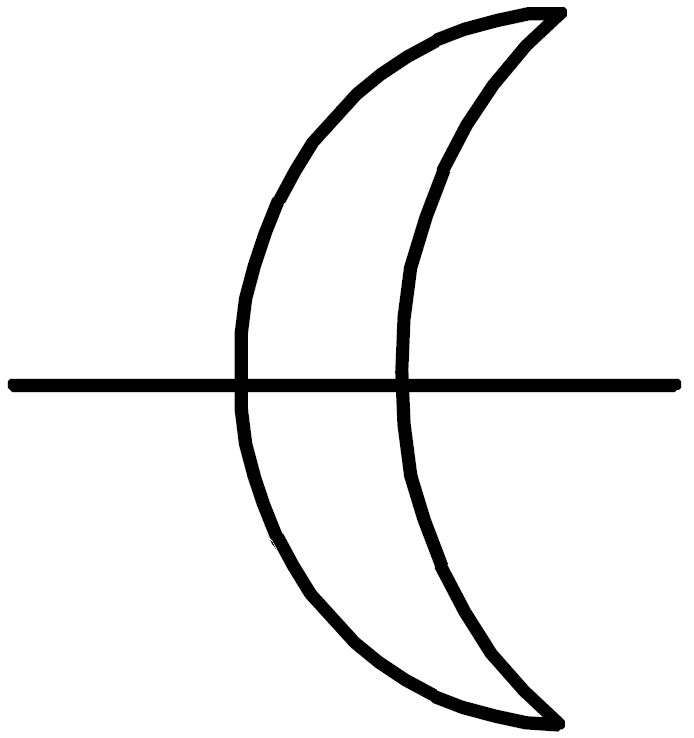
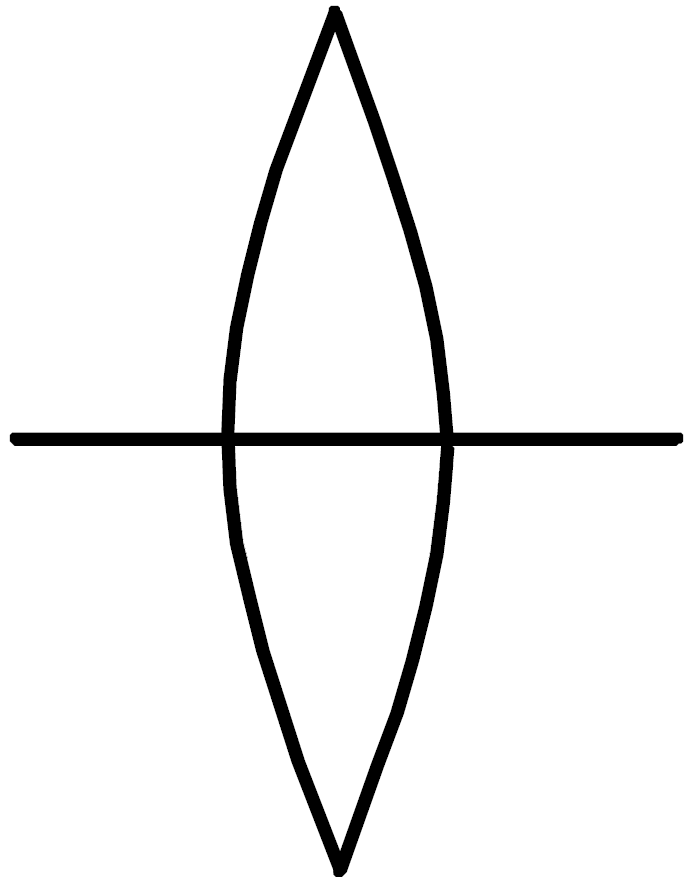
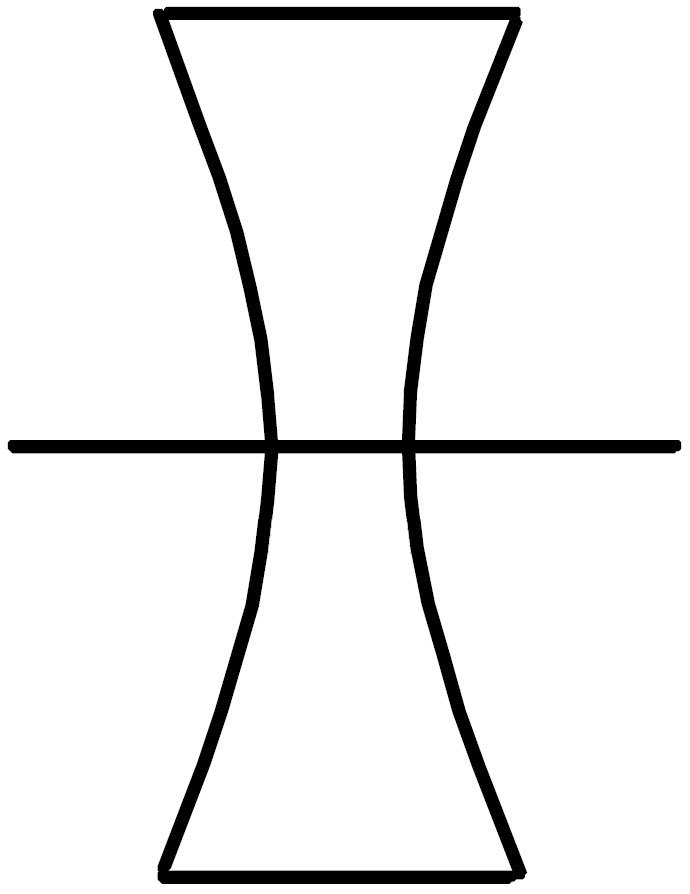
Given $\mu=1.5$ Magnitude of radii of curvatures = 20cm and 30cm The 4types of possible lens are as below.$\frac{1}{\text{f}}=(\mu-1)\Big(\frac{1}{\text{R}_1}-\frac{1}{\text{R}_2}\Big)$
Case (1): (Double convex) $[R_1 = +ve, R_2 = -ve]\frac{1}{\text{f}}=(15-1)\Big(\frac{1}{20}-\frac{1}{30}\Big)\Rightarrow\text{f}=24\text{cm}$

 Case (2): (Double concave) $[R_1 = -ve, R_2 = +ve]\frac{1}{\text{f}}=(15-1)\Big(\frac{-1}{20}-\frac{1}{30}\Big)\Rightarrow\text{f}=-24\text{cm}$

 Case (3): (Concave concave) $[R_1 = -ve, R_2 = -ve]\frac{1}{\text{f}}=(15-1)\Big(\frac{1}{-20}-\frac{1}{-30}\Big)\Rightarrow\text{f}=-120\text{cm}$

Case (4): (Concave convex) $[R_1 = +ve, R_2 = +ve]\frac{1}{\text{f}}=(15-1)\Big(\frac{1}{20}-\frac{1}{30}\Big)\Rightarrow\text{f}=+120\text{cm}$

Need a full question paper?

Generate a complete, print-ready paper with questions like this in minutes — across 16+ boards, with answer keys.

Start Generating Free

Similar questions

For the above problem, the direction of the gravitational intensity at an arbitrary point P is indicated by the arrow (i) d, (ii) e, (iii) f, (iv) g.
Assume that the thermal conductivity of copper is four times that of brass. Two rods of copper and brass of the same length, and cross-section are joined end to end. The free end of the copper rod is kept at 0°C and the free end of the brass rod at 100°C. Calculate the temperature at the junction of the two rods at equilibrium. (Ignore radiation losses.)
A vector has both magnitude and direction. Does it mean that anything that has magnitude and direction is necessarily a vector? The rotation of a body can be specified by the direction of the axis of rotation, and the angle of rotation about the axis. Does that make any rotation a vector?
Prove the result that the velocity v of translation of a rolling body (like a ring, disc, cylinder or sphere) at the bottom of an inclined plane of a height h is given by $\text{v}^2=\frac{2\text{gh}}{\Big(\frac{1+\text{k}^2}{\text{R}^2}\Big)}$ using dynamical consideration (i.e. by consideration of forces and torques).
Note: k is the radius of gyration of the body about its symmetry axis, and R is the radius of the body. The body starts from rest at the top of the plane.
The motion of a particle executing simple harmonic motion is described by the displacement function, $x ( t )= A$ $\cos \left(\omega_t+\omega\right)$.
If the initial $(t=0)$ position of the particle is 1 cm and its initial velocity is $\omega cm / s$, what are its amplitude and initial phase angle? The angular frequency of the particle is $\pi s ^{-1}$. If instead of the cosine function, we choose the sine function to describe the $SHM : x = B \sin (\omega t+a)$, what are the amplitude and initial phase of the particle with the above initial conditions.
What do you mean by interference of waves? Distinguish between constructive and destructive interference.
Standing waves are produced by the superposition of two waves
$\text{y}_1=0.05\sin(3\pi\text{t}-2\text{x})$ and $\text{y}_2=0.05\sin(3\pi\text{t}+2\text{x})$
where y and x are measured in metres and t in seconds. Find the amplitude of a particle at x = 0.5m.
Two metre scales, one of steel and the other of aluminium, agree at $20^{\circ} \mathrm{C}$. Calculate the ratio aluminium-centimetre/ steel-centimetre at:
a. $0^{\circ} \mathrm{C}$,
b. $40^{\circ} \mathrm{C}$
c. $100 \mathrm{C} . \alpha$ for steel $=1.1 \times 10^{-5}{ }^{\circ} \mathrm{C}{ }^{-1}$ and for aluminium $=2.3 \times 10^{-5}{ }^{\circ} \mathrm{C}^{-1}$.
Explain why?
  1. Inspite of formula $\nu=\sqrt{\frac{\gamma\text{P}}{\rho}},$ the speed of sound in air independent of pressure.
Where $\gamma=$ ratio of specific heats i.e., $\gamma =\frac{\text{C}_\text{p}}{\text{C}_\nu},$ $\rho=$ density, P = pressure.
  1. Bats can ascertain distances, directions, nature and the size of the obstacles without any "eyes”.
A beam of white light is incident normally on a plane surface absorbing 70% of the light and reflecting the rest. If the incident beam carries 10W of power, find the force exerted by it on the surface.
A spaceship is stationed on Mars. How much energy must be expended on the spaceship to launch it out of the solar system? Mass of the space ship $= 1000kg;$ mass of the sun $= 2 \times 10^{30}kg;$ mass of mars $= 6.4 \times 10^{23}kg;$ radius of mars = 3395km; radius of the orbit of mars $= 2.28 \times 10^8km;\ G = 6.67 \times 10^{-11}N\ m^2\ kg^{-2}.$