Question
The velocity of sound $v$ in the air depends on the air pressure, P and density of air $d$. Establish the possible formula by dimensional method :
$
v= K \sqrt{\frac{ P }{d}}
$

Answer

 We know that velocity of sound $v$ depends on the density $d$ and air pressure P . There we can write :
$v \propto P ^x d^y$
Where $x$ and $y$ are the dimensions of pressure and density respectively. If K is constant then :
$v = K P ^x d^y$
Dimension of left side $(v)=\left[ M ^0 L^1 T^{-1}\right]$
Dimension of Pressure $=\left[ M ^1 L^{-1} T^{-2}\right]$
K is dimensionless.
$\therefore$ Dimension of right side
$
\begin{array}{l}
=\left[M^1 L^{-1} T^{-2}\right]^x \times\left[M^1 L^{-3} T^0\right]^y \\
=\left[M^{x+y} L^{-x-3 y} T^{-2 x}\right]
\end{array}
$
On comparing the powers of $M , L$ and T on both sides,
$
\begin{aligned}
x+y & =0 \\
-x-3 y & =1 \\
-2 x & =-1 \\
x & =\frac{1}{2}
\end{aligned}
$
Put value of $x$ in equation (2)
$
y=-\frac{1}{2}
$
By putting values of $x$ and $y$ in equation (1)
$
\begin{array}{l}
v=K P^{\frac{1}{2}} d^{-\frac{1}{2}} \\
v=K \sqrt{\frac{P}{d}}
\end{array}
$
By dimensional method, value of K can't be determined.

Need a full question paper?

Generate a complete, print-ready paper with questions like this in minutes — across 16+ boards, with answer keys.
Start Generating Free

Similar questions

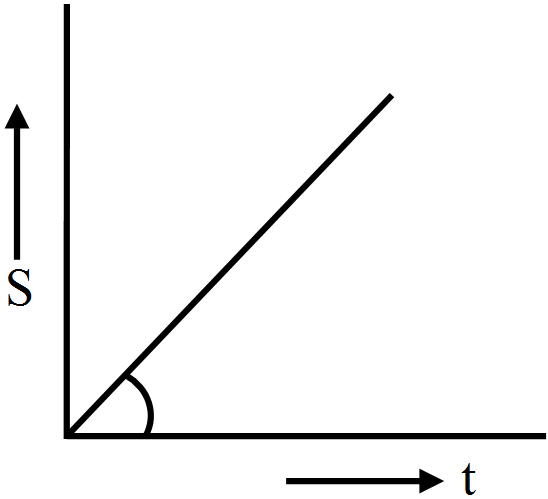
A body starts from a point $A$ and moves to $B$. If it returns to the same point, find the :
  1. Displacement.
  2. Distance.
  3. Velocity.
  4. Average speed.
$[$Given: $AB = s,$ velocity $= v]$
Prove that Newton's second law of motion is the real law of motion.
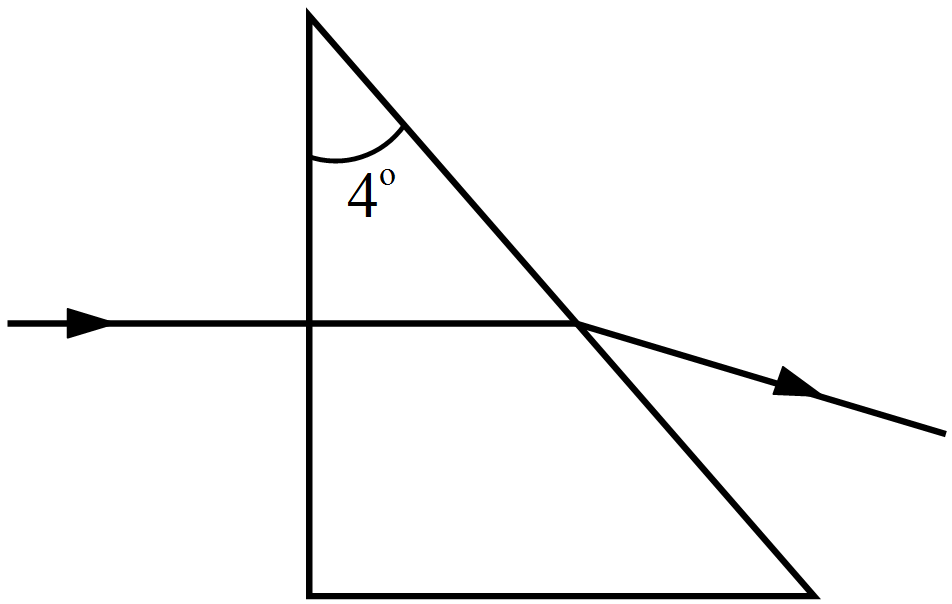
Find the angle of deviation suffered by the light ray shown in figure. The refractive index $\mu=1.5$ for the prism material.
Why length, mass and time are chosen as base quantities in mechanics?
The volume of a liquid flowing out per second of a pipe of length l and radius r is written by a student as, $\text{v}=\frac{\pi}{8}\frac{\text{Pr}^4}{\eta\text{l}}$ where P is the pressure difference between the two ends of the pipe and $\eta$ is coefficent of viscosity of the liquid having dimensional formula $ML^{-1} T^{-1}$. Check whether the equation is dimensionally correct.
A body is suspended by a string of length 1m and is projected horizontally with velocity $4m/ s$. Calculate the tangential and radial accelerations when the string rises by $60°$ from its initial position. Also find the difference in velocity.
Define centripetal acceleration. Give two examples.
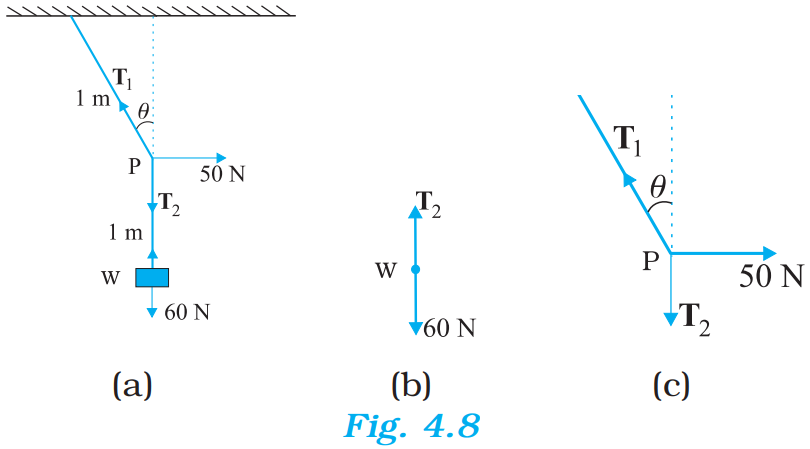
See Fig. $4.8.$ A mass of $6 \ kg$ is suspended by a rope of length $2 m$ from the ceiling. A force of $50 N$ in the horizontal direction is applied at the midpoint $P$ of the rope, as shown. What is the angle the rope makes with the vertical in equilibrium? $($Take $g=10 m s ^{-2} )$. Neglect the mass of the rope.
Image
Sketch velocity-time graph in following situations:
i. $\mathrm{v}_0>0 ; \mathrm{a}<0 \mid \mathrm{al} \rightarrow$ constant
ii. $v_0<0 ; a>0|a| \rightarrow$ is increasing uniformly.
a : acceleration, $\mathrm{v}_0$ : initial velocity
OR
  1. Displacement$-$time graph of any object is shown in the figure:

Draw the velocity$-$time graph for this motion.
  1. What does the area under acceleration$-$time graph represent?
Derive an expression for work done against gravity.