Question
Can X-rays be used for photoelectric effect?

Answer

Yes, X-rays can be use for photoelectric effect. Photoelectric effect is the emission of electrons from a metal surface when the frequency of radiation is greater than the threshold frequency of the metal. For photoelectric effect using X-rays, the energy of the incoming X-ray photon should be greater than the work-function of the metal used.

Need a full question paper?

Generate a complete, print-ready paper with questions like this in minutes — across 16+ boards, with answer keys.
Start Generating Free

Similar questions

Should the internal energy of a system necessarily increase if heat is added to it?
A light ray falling at an angle of 45° with the surface of a clean slab of ice of thickness 1m is refracted into it at an angle of 30°. Calculate the time taken by the light rays, to cross the slab. Speed of light in vacuum = 3 × 10⁸m/s
Show that it is not possible for a photon to be completely absorbed by a free electron.
A beam of monochromatic radiation is incident on a photosensitive surface. Answer the following questions giving reasons.
i. Do the emitted photoelectrons have the same kinetic energy?
ii. Does the kinetic energy of the emitted electrons depend on the intensity of incident radiation?
iii. On what factors does the number of emitted photoelectrons depend?
Calculate the maximum kinetic energy of the beta particle emitted in the following decay scheme:
$\text{ }^{12}\text{N}\rightarrow{ }^{12}\text{C}^*+\text{e}^++\text{v}$
$\text{ }^{12}\text{C}^*\rightarrow\text{ }^{12}\text{C}+\gamma(4.43\text{MeV}).$
The atomic mass of 12N is 12.018613u.
A convex lens made up of glass of refractive index 1.5 is dipped, in turn, in (i) a medium of refractive index 1.65, (ii) a medium of refractive index 1.33.
  1. Will it behave as a converging or a diverging lens in the two cases?
  2. How will its focal length change in the two media?
a. Using the Bohr's model, calculate the speed of the electron in a hydrogen atom in the n = 1, 2 and 3 levels.
b. Calculate the orbital period in each of these levels.
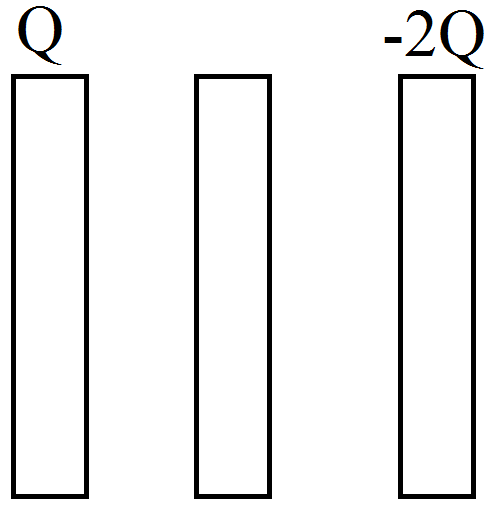
Three identical metal plates with large surface areas are kept parallel to each other as shown in figure. The leftmost plate is given a charge Q, the rightmost a charge -2Q and the middle one remains neutral. Find the charge appearing on the outer surface of the rightmost plate.

A man is sitting on the shore of a river. He is in the line of a 1.0m long boat and is 5.5m away from the centre of the boat. He wishes to throw an apple into the boat. If he can throw the apple only with a speed of 10m/s, find the minimum and maximum angles of projection for successful shot. Assume that the point of projection and the edge of the boat are in the same horizontal level.
The magnifying power of a simple microscope is given by $1+\frac{\text{D}}{\text{f}},$ where D is the least distance for clear vision. For farsighted persons, D is greater than the usual. Does it mean that the magnifying power of a simple microscope is greater for a farsighted person as compared to a normal person? Does it mean that a farsighted person can see an insect more clearly under a microscope than a normal person?