MCQ
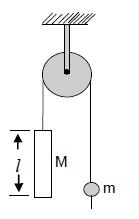
Figure shows an arrangement of a rod of length $l$ and mass $M$ and a bead of mass $m$ attached to a weightless string passing over a frictionless pulley. At $t = 0$ , the bead is in level with the lower end of the rod. The bead slides down the string with considerable friction and is opposite to the other end of the rod after $T\ second$ . Assuming friction between the beadand the string to be constant all through, the frictional force is
  • $\frac{{2Mm}}{{\left( {M - m} \right)}}\,\frac{l}{{{t^2}}}$
  • B
    $\frac{{\left( {M - m} \right)}}{{2Mm}}\,\frac{l}{{{t^2}}}$
  • C
    $\frac{{2Mm}}{{\left( {M + m} \right)}}\,\frac{l}{{{t^2}}}$
  • D
    $\frac{{\left( {M + m} \right)}}{{2Mm}}\,\frac{l}{{{t^2}}}$
Answer

Correct option: A.
$\frac{{2Mm}}{{\left( {M - m} \right)}}\,\frac{l}{{{t^2}}}$
a
Let $a_{1}$ and $a_{2}$ be the accelerations of $M$ and $m$ respectively. Then

$M g-F=M a_{1}$            $...(i)$

$m g-F=m a_{2}$             $...(ii)$

Now, $\quad 1+\frac{1}{2} a_{2} t^{2}=\frac{1}{2} a_{1} t^{2}$

or      $a_{1}=\frac{2 l}{t^{2}}+a_{2}$             $...(iii)$

Solving equations $( i ), (ii)\, and \,(iii),$ we get;

$F=\frac{2 M m}{(M-m)} \frac{l}{t^{2}}$

Need a full question paper?

Generate a complete, print-ready paper with questions like this in minutes — across 16+ boards, with answer keys.

Start Generating Free

Similar questions

A sphere is rolling without slipping on a fixed horizontal plane surface. In the figure $A$ is the point of contact, $B$ is the centre of sphere and $C$ is its topmost point, then

$(i){\vec V_C} - {\vec V_A} = 2\left( {{{\vec V}_B} - {{\vec V}_C}} \right)$

$(ii){\vec V_C} - {\vec V_B} = {\vec V_B} - {\vec V_A}$

$(iii)\left| {{{\vec V}_C} - {{\vec V}_A}} \right| = 2\left| {{{\vec V}_B} - {{\vec V}_C}} \right|$

$(iv)\left| {{{\vec V}_C} - {{\vec V}_A}} \right| = 4\left| {{{\vec V}_B}} \right|$

What is the relation between displacement, time and acceleration in case of a body having uniform acceleration
A liquid of density $\rho $ is coming out of a hose pipe of radius $a$ with horizontal speed $v$ and hits a mesh. $50\%$ of the liquid passes through the mesh unaffected. $25\%$ looses all of its momentum and $25\%$ comes back with the same speed. The resultant pressure on the mesh will be
One quarter sector is cut from a uniform circular disc of radius $R$.  This sector has mass $M$. It is made to rotate about a line perpendicular to its plane and passing through the centre of the original disc.  Its moment of inertia about the axis of rotation is
A solid disc of radius $'a'$ and mass $'m'$ rolls down without slipping on an inclined plane making an angle $\theta$ with the horizontal. The acceleration of the disc will be $\frac{2}{ b } g \sin \theta$ where $b$ is $........$. (Round off to the Nearest Integer)

$( g =$ acceleration due to gravity)

$(\theta=$ angle as shown in figure $)$

If ${C_V} = 4.96cal/mole\, K$, then increase in internalenergy when temperature of $2$ moles of this gas is increased from $340 K$ to $342 K$ ....... $cal$
If a glass prism is dipped in water, its dispersive power:
If vm is the velocity of sound in moist air, vd is the velocity of sound in dry air, under identical conditions of pressure and temperature
A mass of $1\, kg$ is hanging from a spring of spring constant $1\, N/m$. If Saroj pulls the mass down by $2\,m$. The work done by Saroj is......$J$
The equivalent capacitance of the combination shown in figure is: