MCQ
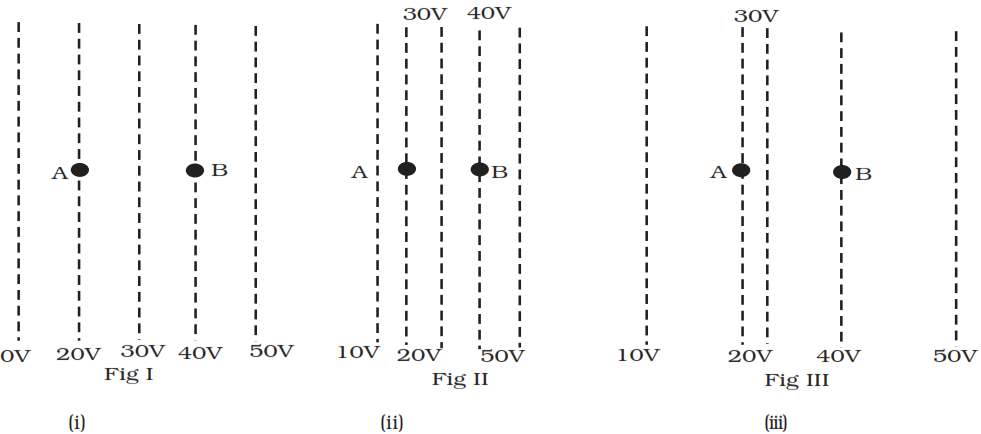
Figure shows some equipotential lines distributed in space. A charged object is moved from point $A$ to point $B.$
  • A
    The work done in Fig. $(i)$ is the greatest.
  • B
    The work done in Fig. $(ii)$ is least.
  • The work done is the same in Fig. $(i)$ Fig. $(ii)$ and Fig. $(iii).$
  • D
    The work done in Fig. $(iii)$ is greater than Fig. $(ii)$ but equal to that in Fig. $(i).$
Answer

Correct option: C.
The work done is the same in Fig. $(i)$ Fig. $(ii)$ and Fig. $(iii).$
Key concept: For a given charge distribution, locus of all points or regions for which the electric potential has a constant value are called equipotential regions. Such equipotential can be surfaces, volumes or lines. Regarding equipotential surface the following points should be kept in mind:

  1. The density of the equipotential lines gives an idea about the magnitude of electric field. Higher the density, larger the field strength.
  2. The direction of electric field is perpendicular to the equipotential surfaces or lines.
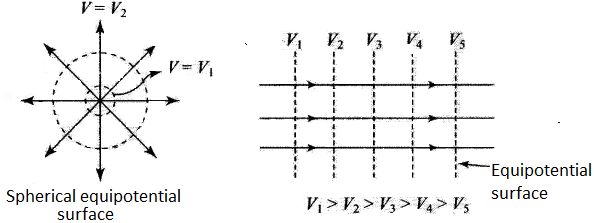
  3. The equipotential surfaces produced by a point charge or a spherically charge distribution are a family of concentric spheres.
  4. For a uniform electric field, the equipotential surfaces are a family of plane perpendicular to the field lines.
  5. A metallic surface ofany shape is an equipotential surface.
  6. Equipotential surfaces can never cross each other.
  7. The work done in moving a charge along an equipotential surface is always zero.
As the direction of electric field is always perpendicular to one equipotential surface maintained at high electrostatic potential than other equipotential surface maintained at low electrostatic potential. Hence direction of electric field is from $B$ to $A$ in all three cases.
The positively charged particle experiences electrostatic force along the direction of electric field, hence moves in the direction opposite to electric field. Thus, the work done by the electric field on the charge will be negative. We know
$\text{W}_\text{electrical}=-\Delta\text{U}=-\text{q}\Delta\text{V}=\text{q}(\text{V}_\text{Intial}-\text{V}_\text{final})$
Here initial and final potentials are same in all three cases and same charge is moved, so work done is same in all three cases.

Need a full question paper?

Generate a complete, print-ready paper with questions like this in minutes — across 16+ boards, with answer keys.

Start Generating Free

Similar questions

$10$ wires (same length, same area, same material) are connected in parallel and each has $1$ $\Omega$ resistance, then the equivalent resistance will be .............. $\Omega$
$X-$ray from a Coolidge tube is incident on a thin aluminium foil. The intensity of the $X-$ray transmitted by the foil is found to be $I_0$. The heating current is increased to increase the temperature of the filament. The intensity of the $X-$ray transmitted by the foil will be:
Instead of angular momentum quantisation a student gives predicts that energy is quantised as $E=\frac{-E_{\bullet}}{n},\left(E_{0}>0\right)$ and $n$ is a positive integer. Which of the following options is correct?
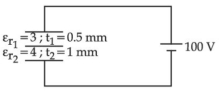
A composite parallel plate capacitor is made up of two different dielectric materials with different thickness $\left(t_{1}\right.$ and $\left.t_{2}\right)$ as shown in figure. The two different dielectric material are separated by a conducting foil $F$. The voltage of the conducting foil is $.....V$
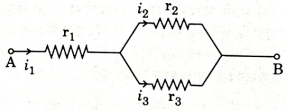
Three resistors having resistances $\mathrm{r}_{1}, \mathrm{r}_{2}$ and $\mathrm{r}_{3}$ are connected as shown in the given circuit. The ratio $\frac{i_{3}}{i_{1}}$ of currents in terms of resistances used in the circuit is :
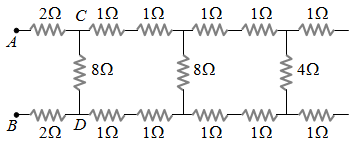
In the figure shown, the total resistance between A and B is
In a beryllium atom, if $a_0$ be the radius of the first orbit, then the radius of the second orbit will be in general
A proton is moves on circular path with its constant angular speed then correct relation between its magnetic moment and angular momentum 
The bottom of a container filled with liquid appear slightly raised because of
A lamp is hanging $1 \,m$ above the centre of a circular table of diameter $1\,m$. The ratio of illuminaces at the centre and the edge is