MCQ
A proton is moves on circular path with its constant angular speed then correct relation between its magnetic moment and angular momentum 
  • A
    $\vec M =  - \frac{{e\vec L}}{{2{m_p}}}$
  • $\vec M =   \frac{{e\vec L}}{{2{m_p}}}$
  • C
    $\vec M =  \left( {\frac{{2e}}{{{m_p}}}} \right)\vec L$
  • D
    $\vec M =  - \left( {\frac{{2e}}{{{m_p}}}} \right)\vec L$
Answer

Correct option: B.
$\vec M =   \frac{{e\vec L}}{{2{m_p}}}$
b

Need a full question paper?

Generate a complete, print-ready paper with questions like this in minutes — across 16+ boards, with answer keys.

Start Generating Free

Similar questions

In Millikan’s oil drop experiment, an oil drop of mass $16 \times {10^{ - 6}}kg$ is balanced by an electric field of ${10^6}V/m.$ The charge in coulomb on the drop, assuming $g = 10\,m/{s^2}$ is
A $10\,\mu C$ charge is divided into two parts and placed at $1\,cm$ distance so that the repulsive force between them is maximum. The charges of the two parts are :
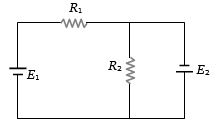
Two resistances ${R_1}$ and ${R_2}$ are joined as shown in the figure to two batteries of $e.m.f.$ ${E_1}$ and ${E_2}$. If ${E_2}$ is short-circuited, the current through ${R_1}$ is
In an experiment for determination of refractive index of glass of a prism by $i - \delta$ , plot it was found thata ray incident at angle $35 ^o $, suffers a deviation of $40 ^o $ and that it emerges at angle $7 9 ^o $. In that case which of the following is closest to the maximum possible value of the refractive index?
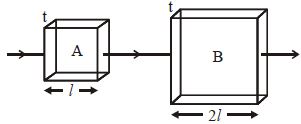
Two square metal plates $A$ and $B$ are of the same thickness and material. The side of $B$ is twice that of $A$. These are connected as shown in series. If the resistances of $A$ and $B$ are denoted by $R_A$ and $R_B,$ then $(R_A/R_B)$ is
In photoelectric experiment energy of $2.48 \mathrm{eV}$ irradiates a photo sensitive material. The stopping potential was measured to be $0.5 \mathrm{~V}$. Work function of the photo sensitive material is:
The impact of an image on the retina remains for......$sec$
In double slit experiment, the angular width of the fringes is $0.20^o $ for the sodium light ($\lambda =5890 Å$). In order to increase the angular width of the fringes by $10\%$, the necessary change in the wavelength is
If an emitter current is changed by $4\, mA ,$ the collector current changes by $3.5\, mA$. The value of $\beta$ will be
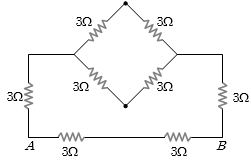
Equivalent resistance between $A$ and $B$ will be ............ $ohm$