Question
Figure shows three equidistant slits being illuminated by a monochromatic parallel beam of light.
Let $\text{BP}_0-\text{AP}=\frac{\lambda}{3}$ and $\text{D}>\lambda.$
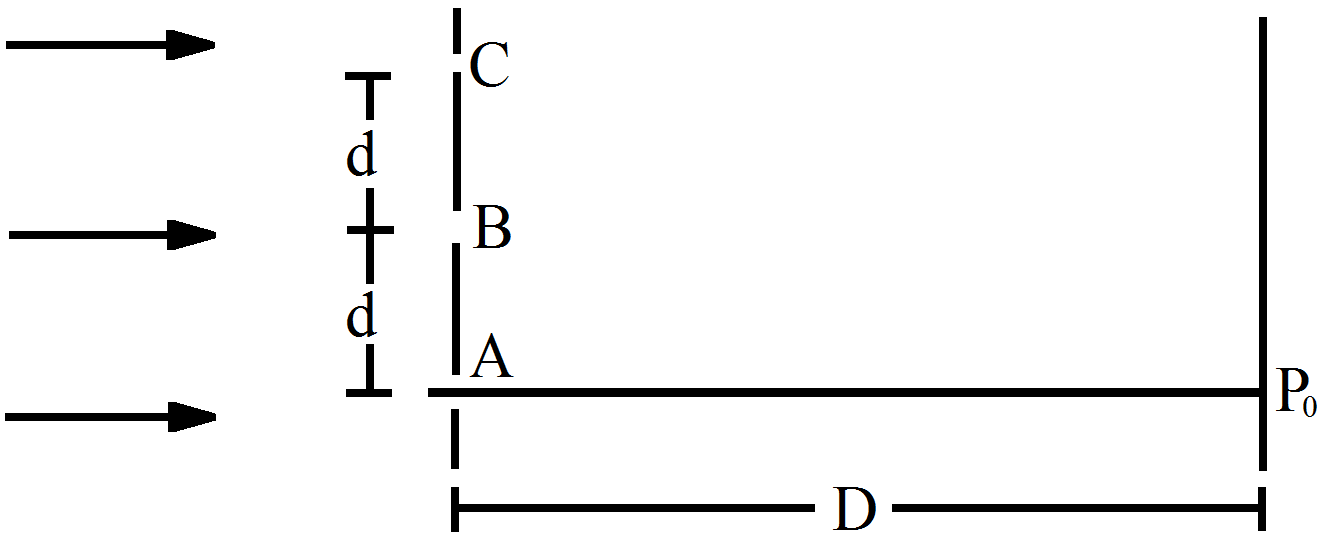
  1. Show that in this case $\text{d}=\sqrt{\frac{2\lambda\text{D}}{3}}.$
  2. Show that the intensity at $P,$ is three times the intensity due to any of the three slits individually.

Answer

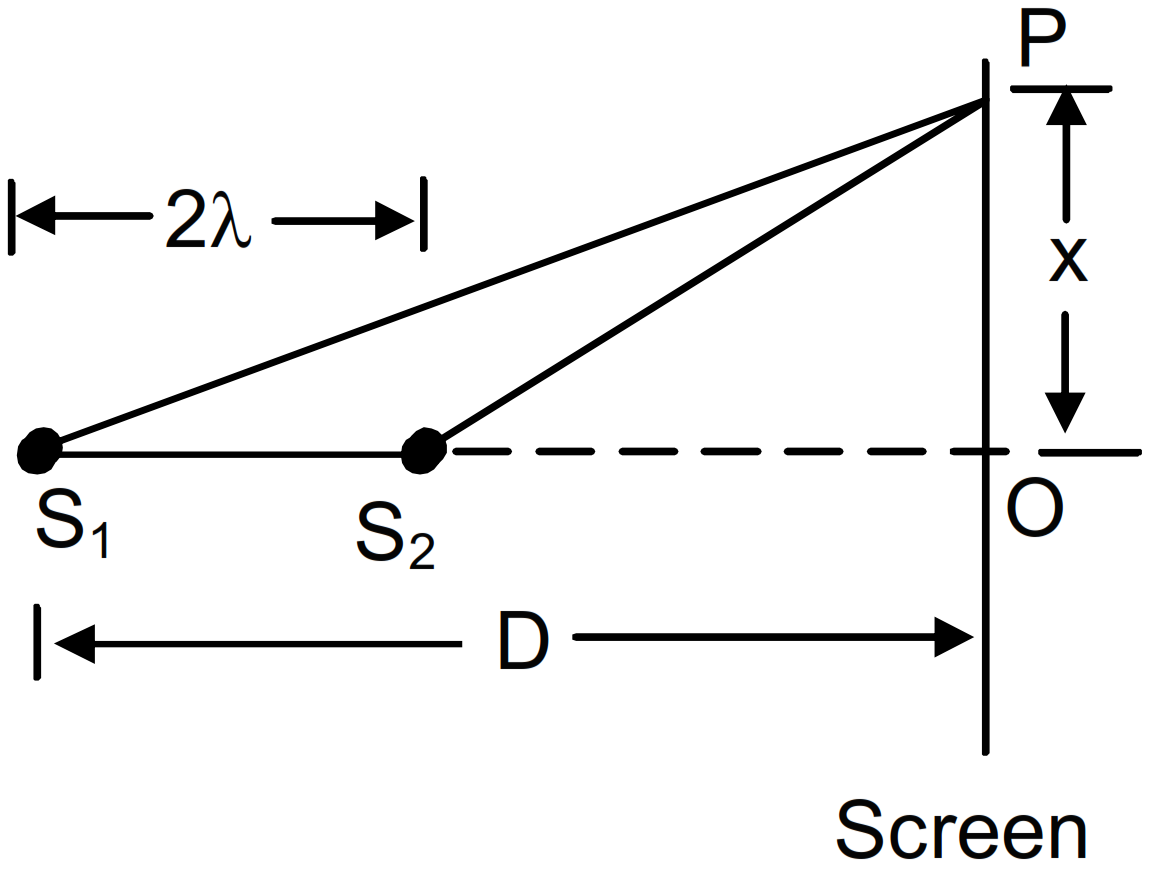
Since $S_1, S_2$ are in same phase, at $O$ there will be maximum intensity. Given that, there will be a maximum intensity at $P.$
$ ⇒$ path difference $=\Delta\text{x}=\text{n}\lambda$ From the figure,$(\text{S}_1\text{P})^2-(\text{S}_2\text{P})^2=\Big(\sqrt{\text{D}^2+\text{X}^2}\Big)^2-\Big(\sqrt{(\text{D}-2\lambda)^2+\text{X}^2}\Big)^2$
$=4\lambda\text{D}-4\lambda^2=4\lambda\text{D}$ ($\lambda^2$ is so small and can be neglected)
$\Rightarrow\text{S}_1\text{P}-\text{S}_2\text{P}=\frac{4\lambda\text{D}}{2\sqrt{\text{x}^2+\text{D}^2}}=\text{n}\lambda$
$\Rightarrow\frac{2\text{D}}{\sqrt{\text{x}^2+\text{D}^2}}=\text{v}$
$\Rightarrow\text{n}^2(\text{X}^2+\text{D}^2)=4\text{D}^2=\Delta\text{X}=\frac{\text{D}}{\text{n}}\sqrt{4-\text{n}^2}$
when $\text{n}=1,\text{x}=\sqrt{3}\text{D} (1^{st}$ order$)\text{n}=2,\text{x}=0 (2^{nd}$ order$)$
$\therefore$ When $\text{X}=\sqrt{3}\text{D},$ at $P$ there will be maximum intensity.

Need a full question paper?

Generate a complete, print-ready paper with questions like this in minutes — across 16+ boards, with answer keys.

Start Generating Free

Similar questions

$i$. Derive lens maker’s formula for a biconvex lens.
$ii$. A point object is placed at a distance of $12 \ cm$ on the principal axis of a convex lens of focal length $10 \ cm$. A convex mirror is placed coaxially on the other side of the lens at a distance of $10 \ cm$. If the final image coincides with the object, sketch the ray diagram, and find the focal length of the convex mirror.
The volume of an ideal gas $(\gamma=1.5)$ is changed adiabatically from $4.00$ litres to $3.00$ litres. Find the ratio of,
  1. The final pressure to the initial pressure.
  2. The final temperature to the initial temperature.
The count rate of nuclear radiation coming from a radiation coming from a radioactive sample containing $^{128}I$ varies with time as follows.
Time $t($minute$)$ : $0$ $25$ $50$ $75$ $100$
Ctount rate $R(10^9s^{-1})$ : $30$ $16$ $8.0$ $3.8$ $2.0$
  1. Plot In $\Big(\frac{\text{R}_0}{\text{R}}\Big)$ against $t$.
  2. From the slope of the best straight line through the points, find the decay constant $\lambda.$
  3. Calculate the half$-$life $\text{t}_{\frac{1}{2}}.$
Two balls having masses m and $2\ m$ are fastened to two light strings of same length $(l)$. The other ends of the strings are fixed at $O$. The strings are kept in the same horizontal line and the system is released from rest. The collision between the balls is elastic.
  1. Find the velocities of the balls just after their collision.
  2. How high will the balls rise after the collision?
Two cells of emf $1.5V$ and $2V$ and internal resistance $1\Omega$ and $2\Omega$ respectively are connected in parallel to pass a current in the same direction through an external resistance of $5\Omega.$
  1. Draw the circuit diagram.
  2. Using Kirchhoff’s laws, calculate the current through each branch of the circuit and potential difference across $5\Omega$ resistor.
A group of students while coming from the school noticed a box marked "Danger H.T. 2200 V" at a substation in the main street. They did not understand the utility of such a high voltage, while they argued, the supply was only 220 V.They asked their teacher this question the next day. The teacher thought it to be an important question and therefore explained to the whole class.
Answer the following questions:
  1. What device is used to bring the high voltage down to low voltage of a.c. Current and what is the principle of its working?
  2. Is it possible to use this device for bringing down the high d.c. Voltage to the low voltage? Explain.
  3. Write the values displayed by the students and the teacher.
The friction coefficient between the horizontal surface and each of the blocks shown in figure is $0.20$. The collision between the blocks is perfectly elastic. Find the separation between the two blocks when they come $O$ rest. Take $g = 10 m/s^2$.
A parallel $-$ plate capacitor having plate area $20\ cm^2$ and separation between the plates $1.00\ mm$ is connected to a battery of $12.0V$. The plates are pulled apart to increase the separation to $2.0\ mm$.
  1. Calculate the charge flown through the circuit during the process.
  2. How much energy is absorbed by the battery during the process?
  3. Calculate the stored energy in the electric field before and after the process.
  4. Using the expression for the force between the plates, find the work done by the person pulling the plates apart.
  5. Show and justify that no heat is produced during this transfer of charge as the separation is increased.
$a$ . Derive an expression for the potential energy of an electric dipole in a uniform electric field. Explain conditions for stable and unstable equilibrium.
$b$ . Is the electrostatic potential necessarily zero at a point where the electric field is zero? Give an example to support your answer.
What is the minimum energy that must be given to a $H$ atom in ground state so that it can emit an $\text{H}_\gamma$ line in Balmer series. If the angular momentum of the system is conserved, what would be the angular momentum of such $\text{H}_\gamma$ photon?