Question
Figure shows three equidistant slits being illuminated by a monochromatic parallel beam of light. Let $\text{BP}_0-\text{AP}=\frac{\lambda}{3}$ and $\text{D}>\lambda.$
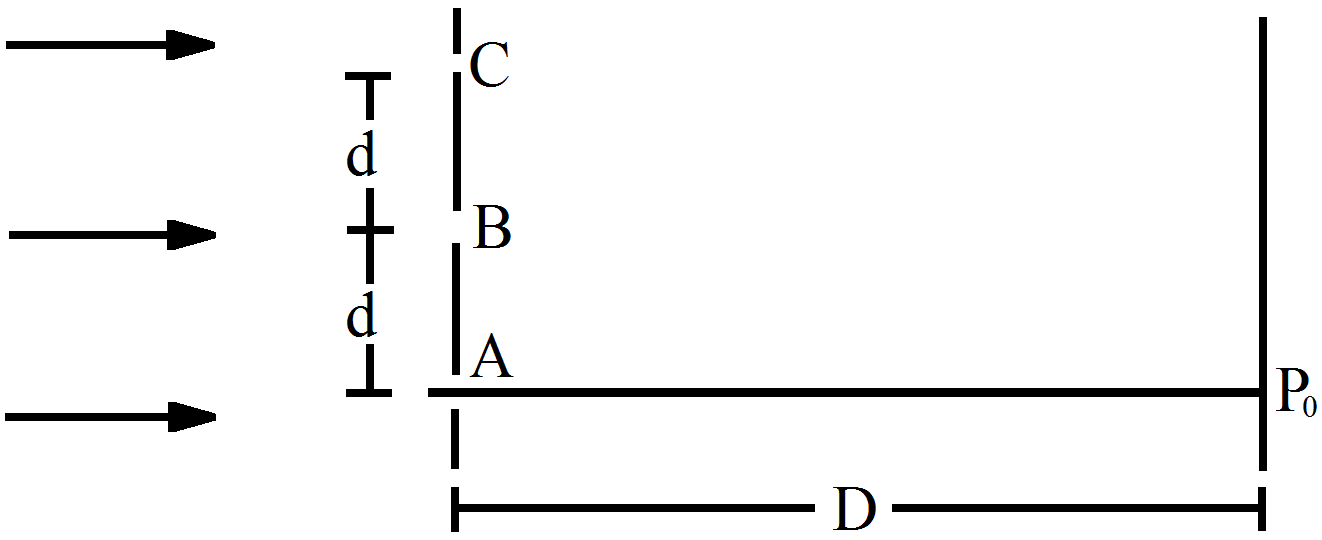
  1. Show that in this case $\text{d}=\sqrt{\frac{2\lambda\text{D}}{3}}.$
  2. Show that the intensity at P, is three times the intensity due to any of the three slits individually.
Answer

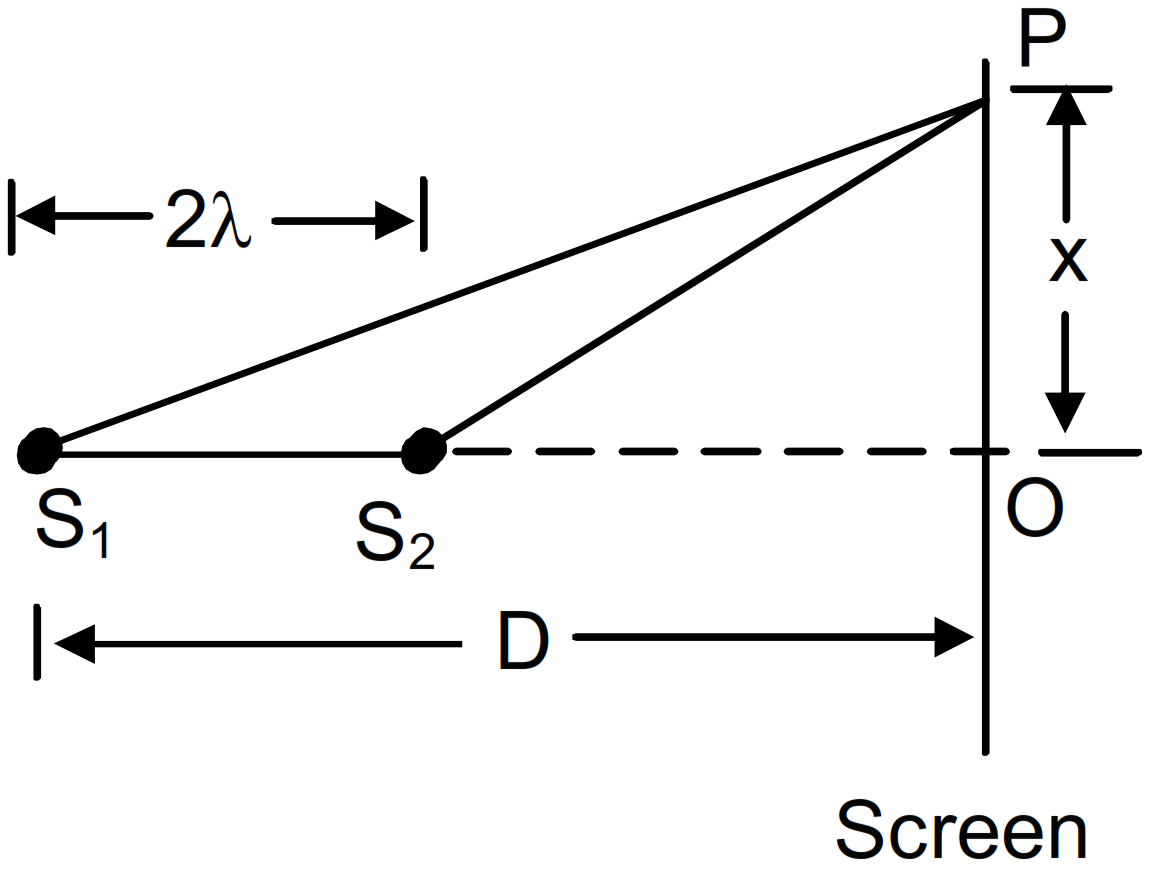
Since S1, S2 are in same phase, at O there will be maximum intensity.

Given that, there will be a maximum intensity at P.

⇒ path difference $=\Delta\text{x}=\text{n}\lambda$

From the figure,

$(\text{S}_1\text{P})^2-(\text{S}_2\text{P})^2=\Big(\sqrt{\text{D}^2+\text{X}^2}\Big)^2-\Big(\sqrt{(\text{D}-2\lambda)^2+\text{X}^2}\Big)^2$

$=4\lambda\text{D}-4\lambda^2=4\lambda\text{D}$ ($\lambda^2$ is so small and can be neglected)

$\Rightarrow\text{S}_1\text{P}-\text{S}_2\text{P}=\frac{4\lambda\text{D}}{2\sqrt{\text{x}^2+\text{D}^2}}=\text{n}\lambda$

$\Rightarrow\frac{2\text{D}}{\sqrt{\text{x}^2+\text{D}^2}}=\text{v}$

$\Rightarrow\text{n}^2(\text{X}^2+\text{D}^2)=4\text{D}^2=\Delta\text{X}=\frac{\text{D}}{\text{n}}\sqrt{4-\text{n}^2}$

when $\text{n}=1,\text{x}=\sqrt{3}\text{D}$ (1st order)

$\text{n}=2,\text{x}=0$ (2nd order)

$\therefore$ When $\text{X}=\sqrt{3}\text{D},$ at P there will be maximum intensity.

Need a full question paper?

Generate a complete, print-ready paper with questions like this in minutes — across 16+ boards, with answer keys.

Start Generating Free

Similar questions

In a CE transistor amplifier there is a current and voltage gain associated with the circuit. In other words there is a power gain. Considering power a measure of energy, does the circuit voilate conservation of energy?
A uniform chain of mass M and length L is held vertically in such a way that its lower end just touches the horizontal floor. The chain is released from rest in this position. Any portion that strikes the floor comes to rest. Assuming that the chain does not form a heap on the floor, calculate the force exerted by it on the floor when a length x has reached the floor.
  1. Describe briefly, with the help of a diagram, the role of the two important processes involved in the formation of a p-n junction.
  2. Name the device which is used as a voltage regulator. Draw the necessary circuit diagram and explain its working.
Sunil and his parents were travelling to their village in their car. On the way his mother noticed some grey coloured panels installed on the roof of a low building. She enquired from Sunil what those panels were and Sunil told his mother that those were solar panels.
  1. What were the values displayed by Sunil and his mother? State one value for each.
  2. In what way would the use of solar panels prove to be very useful?
  3. Name the semiconductor device used in solar panels. Briefly explain with the help of a diagram, how this device works.
Suppose all the electrons of 100g water are lumped together to form a negatively charged particle and all the nuclei are lumped together to form a positively charged particle. If these two particles are placed 10.0cm away from each other, find the force of attraction between them. Compare it with your weight.
How many is energy states are present in one mole of sodium vapour? Are they all filled in normal conditions? "How many 3s energy states are present in one mole of sodium vapour? Are they all filled in normal conditions?
Define induction coefficient. Explain the phenomenon of mutual inductance with the help of an experiment. Obtain an expression for mutual inductance coefficient of two solenoids and prove that $M=\sqrt{L_1 L_2}$.
  1. Draw a labelled diagram of a moving coil galvanometer. Describe briefly its principle and working.
  2. Answer the following:
  1. Why is it necessary to introduce a cylindrical soft iron core inside the coil of a galvanometer?
  2. Increasing the current sensitivity of a galvanometer may not necessarily increase its voltage sensitivity. Explain, giving reason.
Is the formula you employ in (a) valid for calculating radius of the path of a 20 MeV electron beam? If not, in what way is it modified?
The equation of motion of a particle started at t = 0 is given by $\text{x}=5\sin\big(20\text{t}+\frac{\pi}{3}\big)$ where x is in centimetre and t in second. When does the particle.
  1. First come to rest.
  2. First have zero acceleration.
  3. First have maximum speed?