$\Rightarrow\lambda=\frac{2\times1.33\times1\times10^{-6}}{\text{n}}=\frac{2660\times10^{-9}}{\text{n}}\text{m}$
When, $\text{n}=4,\lambda_1=665\text{nm}$$\text{n}=5,\lambda_2=532\text{nm}$
$\text{n}=6,\lambda_3=443\text{nm}$
14 questions · timed · auto-graded
$\Rightarrow\lambda=\frac{2\times1.33\times1\times10^{-6}}{\text{n}}=\frac{2660\times10^{-9}}{\text{n}}\text{m}$
When, $\text{n}=4,\lambda_1=665\text{nm}$$\text{n}=5,\lambda_2=532\text{nm}$
$\text{n}=6,\lambda_3=443\text{nm}$
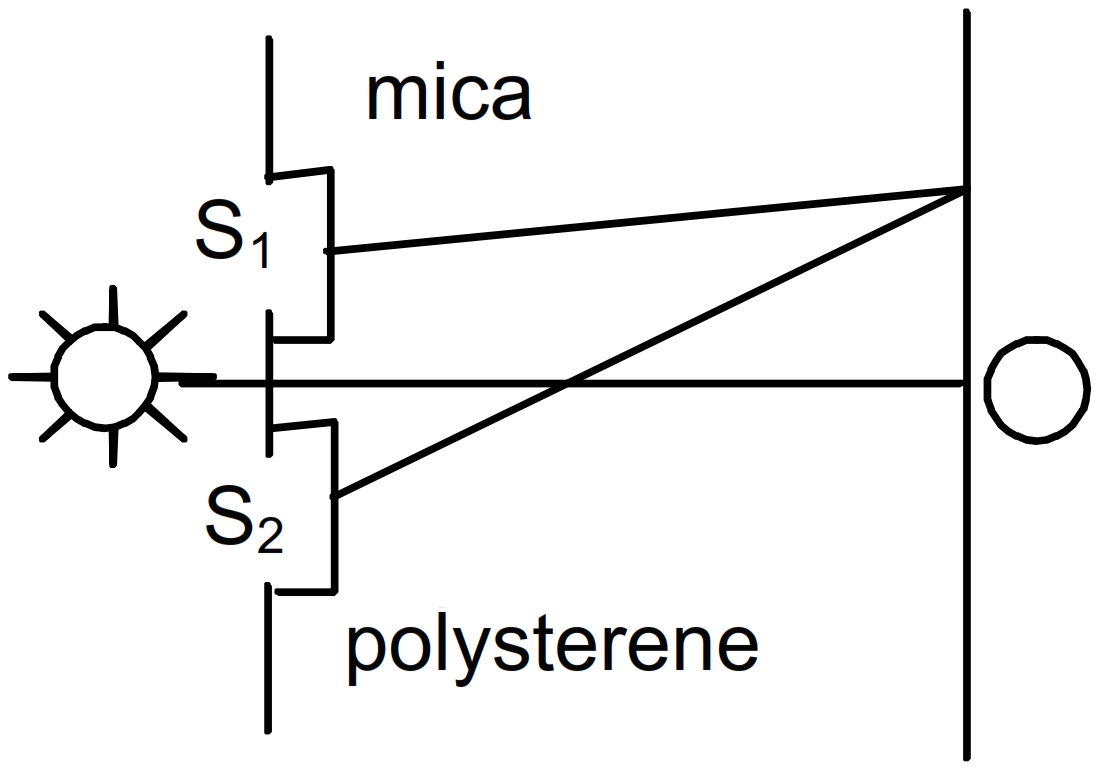
Given that, t1 = t2 = 0.5mm = 0.5 × 10⁻³m, $\mu_\text{m}=1.58$ and $\mu_\text{p}=1.55,$
$\lambda=590\text{nm}=590\times 10^{-9}\text{m}, \text{d}=0.12\text{cm},\\ \mu_{\text{m}}=1.58\text{ and }\mu_{\text{p}}=1.55,$
Fringe width $=\frac{\text{D}\lambda}{\text{d}}=\frac{1\times590\times10^{-9}}{12\times10^{-4}}=4.91\times10^{-4}\text{m}.$
When both the strips are fitted, the optical path changes by
$\Delta\text{x}=(\mu_\text{m}-1)\text{t}_1-(\mu_\text{p}-1)\text{t}_2=(\mu_\text{m}-\mu_\text{p})\text{t}$
$=(1.58-1.55)\times(0.5)(10^{-3})=0.015\times10^{-13}\text{m}$
So, No. of fringes shifted $=\frac{0.015\times10^{-3}}{590\times10^{-3}}=25.43$
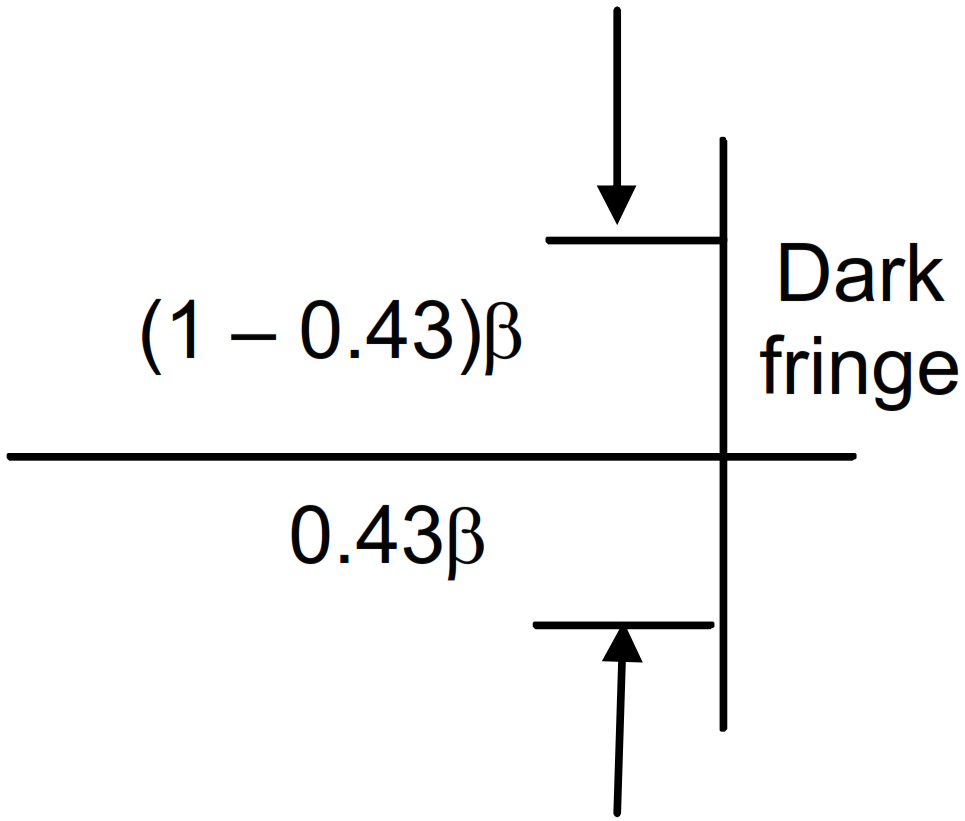
⇒ There are 25 fringes and 0.43 th of a fringe.
⇒ There are 13 bright fringes and 12 dark fringes and 0.43 th of a dark fringe.
So, position of first maximum on both sides will be given by,
$\therefore$ x = 0.43 × 4.91 × 10-4 = 0.021cm
x' = (1 - 0.43) × 4.91 × 10-4 = 0.028cm (since, fringe width = 4.91 × 10⁻⁴m)
$\Rightarrow\frac{4\text{a}^2\cos^2\big(\frac{\phi}{2}\big)}{4\text{a}^2}=\frac{1}{2}$
$\Rightarrow\cos^2\Big(\frac{\phi}{2}\Big)=\frac{1}{2}\Rightarrow\cos\Big(\frac{\phi}{2}\Big)=\frac{1}{\sqrt{2}}$
$\Rightarrow\frac{\phi}{2}=\frac{\pi}{4}\Rightarrow\phi=\frac{\pi}{2}$
$\Rightarrow$ Path difference, $\text{x}=\frac{\lambda}{4}$
$\Rightarrow\text{y}=\frac{\text{xD}}{\text{d}}=\frac{\lambda\text{D}}{4\text{d}}$
$\Rightarrow\frac{4\text{a}^2\cos^2\Big(\frac{\phi}{2}\Big)}{4\text{a}^2}=\frac{1}{4}$
$\Rightarrow\cos^2\Big(\frac{\phi}{2}\Big)=\frac{1}{4}\Rightarrow\cos\Big(\frac{\phi}{2}\Big)=\frac{1}{2}$
$\Rightarrow\frac{\phi}{2}=\frac{\pi}{3}\Rightarrow\phi=\frac{2\pi}{3}$
$\Rightarrow$ Path difference, $\text{x}=\frac{\lambda}{3}$
$\Rightarrow\text{y}=\frac{\text{xD}}{\text{d}}=\frac{\lambda\text{D}}{3\text{d}}$
$\Rightarrow\frac{\text{I}_1}{\text{I}_2}=\frac{9}{4}\Rightarrow\frac{\text{r}_1}{\text{r}_2}=\frac{3}{2}\ [\because\text{I}\propto\text{r}^2]$
where, r1 and r2 are corresponding amplitudes.
So, $\frac{\text{I}_\text{max}}{\text{I}_\text{min}}=\frac{(\text{r}_1+\text{r}_2)^2}{(\text{r}_1-\text{r}_2)^2}=25:1$
No. of fringes that will cross the origin is given by,
$\text{n}=\frac{(\mu-1)\text{t}}{\lambda}=\frac{(1.45-1)\times0.02\times10^{-3}}{600\times10^{-9}}=15.$

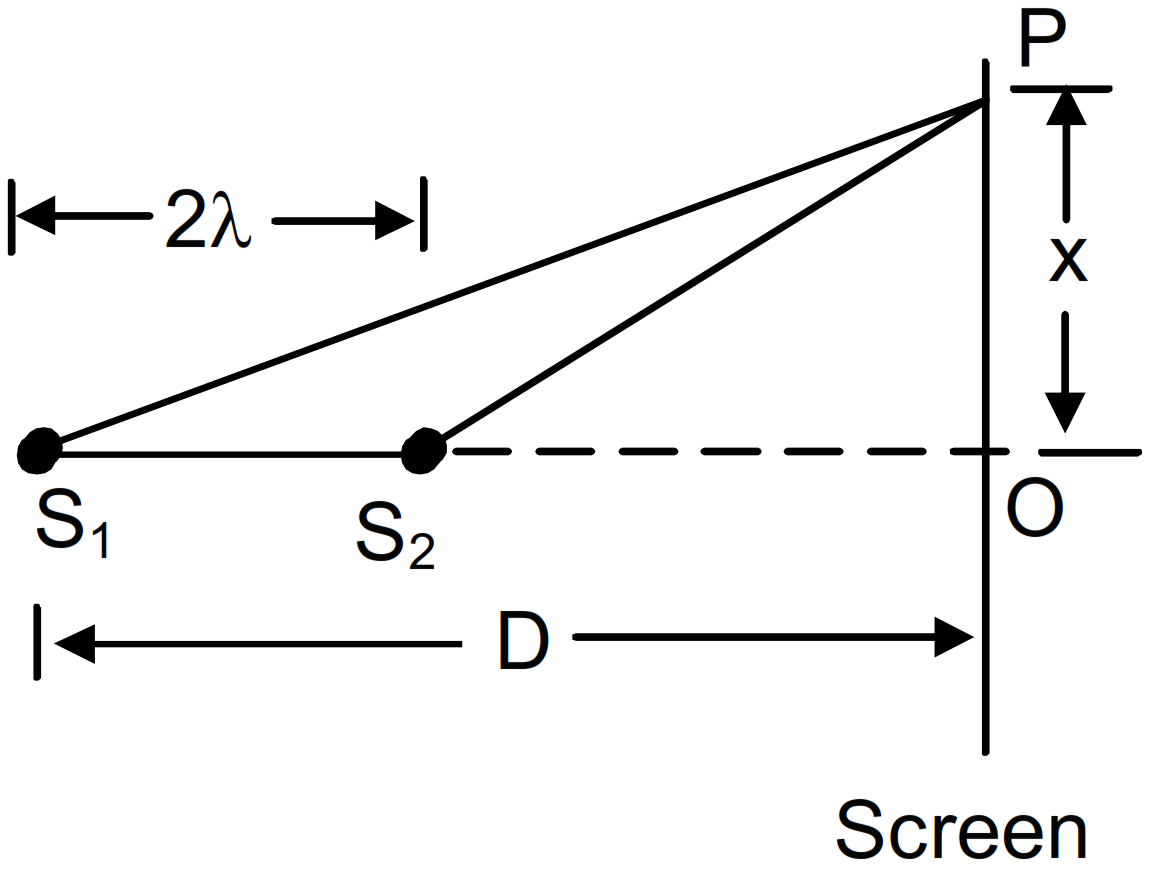
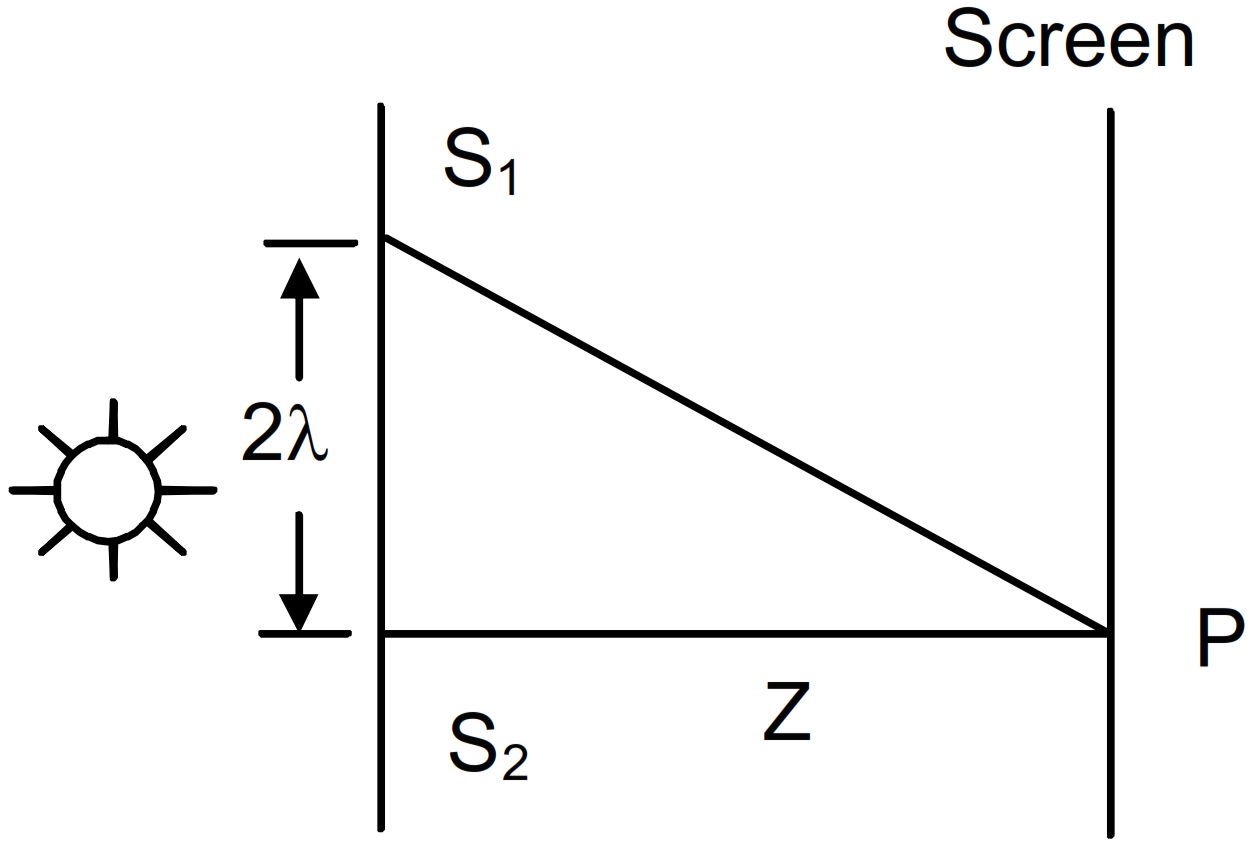
⇒ path difference $=\Delta\text{x}=\text{n}\lambda$ From the figure, $(\text{S}_1\text{P})^2-(\text{S}_2\text{P})^2=\Big(\sqrt{\text{D}^2+\text{X}^2}\Big)^2-\Big(\sqrt{(\text{D}-2\lambda)^2+\text{X}^2}\Big)^2$
$=4\lambda\text{D}-4\lambda^2=4\lambda\text{D}$ ($\lambda^2$ is so small and can be neglected)
$\Rightarrow\text{S}_1\text{P}-\text{S}_2\text{P}=\frac{4\lambda\text{D}}{2\sqrt{\text{x}^2+\text{D}^2}}=\text{n}\lambda$
$\Rightarrow\frac{2\text{D}}{\sqrt{\text{x}^2+\text{D}^2}}=\text{v}$
$\Rightarrow\text{n}^2(\text{X}^2+\text{D}^2)=4\text{D}^2=\Delta\text{X}=\frac{\text{D}}{\text{n}}\sqrt{4-\text{n}^2}$
when $\text{n}=1,\text{x}=\sqrt{3}\text{D}$ (1st order)$\text{n}=2,\text{x}=0$ (2nd order)
$\therefore$ When $\text{X}=\sqrt{3}\text{D},$ at P there will be maximum intensity.
$\therefore\text{S}_1\text{P}-\text{S}_2\text{P}=\text{x}=(2\text{n}+1)\frac{\lambda}{2}$
From the figure, we get,$\Rightarrow\sqrt{\text{X}^2+(2\lambda)^2}-\text{Z}=(2\text{n}+1)\frac{\lambda}{2}$
$\Rightarrow\text{Z}^2+4\lambda^2=\text{Z}^2+(2\text{n}+1)^2\frac{\lambda^2}{4}+\text{Z}(2\text{n}+1)\lambda$
$\Rightarrow\text{Z}=\frac{4\lambda^2-(2\text{n}+1)^2\Big(\lambda^2{4}\Big)}{(2\text{n}+1)\lambda}=\frac{16\lambda^2-(2\text{n}+1)^2\lambda^2}{4(2\text{n}+1)\lambda}\ ...(1)$
Putting, $\text{n}=0\Rightarrow\text{Z}=\frac{15\lambda}{4}$$\text{n}=-1\Rightarrow\text{Z}=\frac{-15\lambda}{4}$
$\text{n}=1\Rightarrow\text{Z}=\frac{7\lambda}{12}$
$\text{n}=2\Rightarrow\text{Z}=\frac{-9\lambda}{20}$
$\therefore\text{Z}=\frac{7\lambda}{12}$ is the smallest distance for which there will be minimum intensity.
$\text{z}=\frac{\lambda\text{D}}{2\text{d}}$
$\frac{\lambda\text{D}}{\text{d}}$
$\frac{\lambda\text{D}}{4\text{d}}$

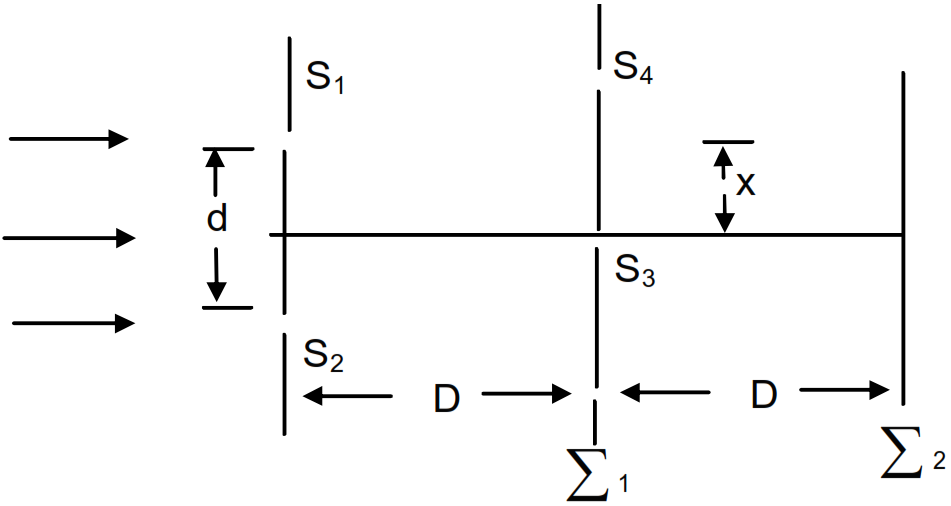
⇒ Amplitude = 0,
At S3, path difference = 0
⇒ Maximum intensity occurs.
⇒ Amplitude = 2r.
So, on $\sum_2$ screen,
$\frac{\text{I}_\text{max}}{\text{I}_\text{min}}=\frac{(2\text{r}+0)^2}{(2\text{r}-0)^2}=1$
⇒ Amplitude = 0.
At S3, path difference = 0
⇒ Maximum intensity occurs.
⇒ Amplitude = 2r.
So, on $\sum_2$ screen,
$\frac{\text{I}_\text{max}}{\text{I}_\text{min}}=\frac{(2\text{r}+2\text{r})^2}{(2\text{r}-0)^2}=\infty$
⇒ Amplitude $=\sqrt{2\text{r}}$
$\therefore$ At S3, intensity is maximum
⇒ Amplitude = 2r
$\therefore\frac{\text{I}_\text{max}}{\text{I}_\text{min}}=\frac{(2\text{r}+\sqrt{2\text{r}})^2}{(2\text{r}-\sqrt{2\text{r}})^2}=34.$
$\text{d}=1\times10^{-4}\text{cm}=10^{-6}\text{m},$ $\mu_{\text{oil}}=1.25\ \text{and}\ \mu_\text{x}=1.50$
$\lambda=\frac{2\mu\text{d}}{\Big(\text{n}+\frac{1}{2}\Big)}\frac{2\times10^{-6}\times1.25\times2}{2\text{n}+1}=\frac{5\times10^{-6}\text{m}}{2\text{n}+1}$
$\Rightarrow\lambda=\frac{5000\text{nm}}{2\text{n}+1}$
For the wavelengths in the region (400nm - 750nm) When, $\text{n}=3,\lambda=\frac{5000}{2\times3+1}=\frac{5000}{7}=714.3\text{nm}$ When, $\text{n}=4,\lambda=\frac{5000}{2\times4+1}=\frac{5000}{9}=555.6\text{nm}$ When, $\text{n}=5,\lambda=\frac{5000}{2\times5+1}=\frac{5000}{11}=454.5\text{nm}$
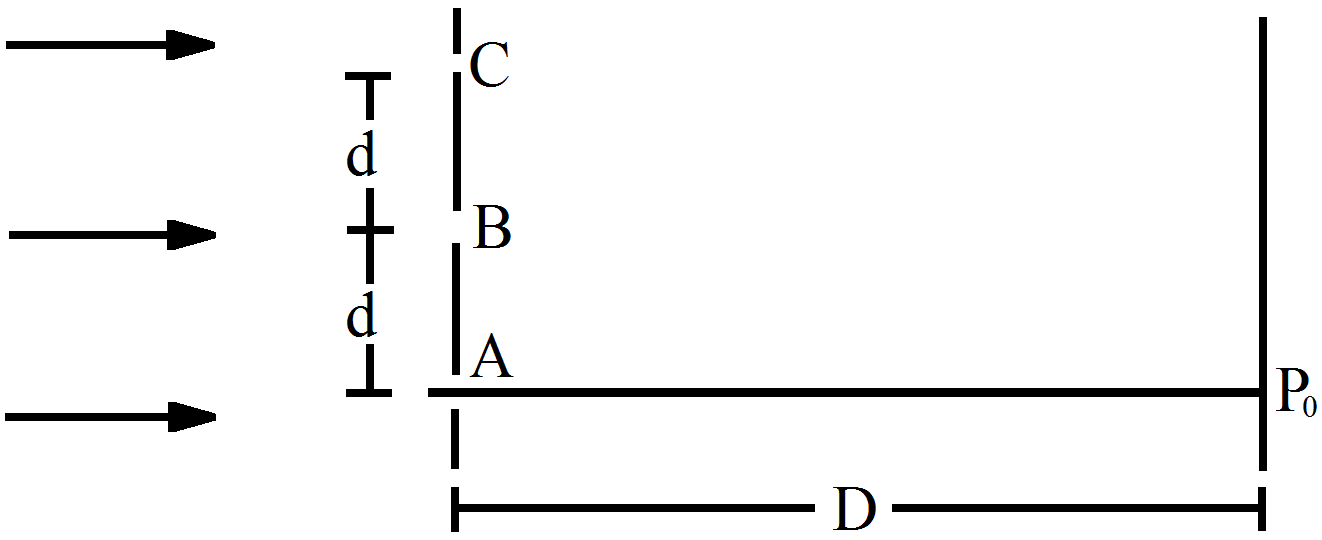
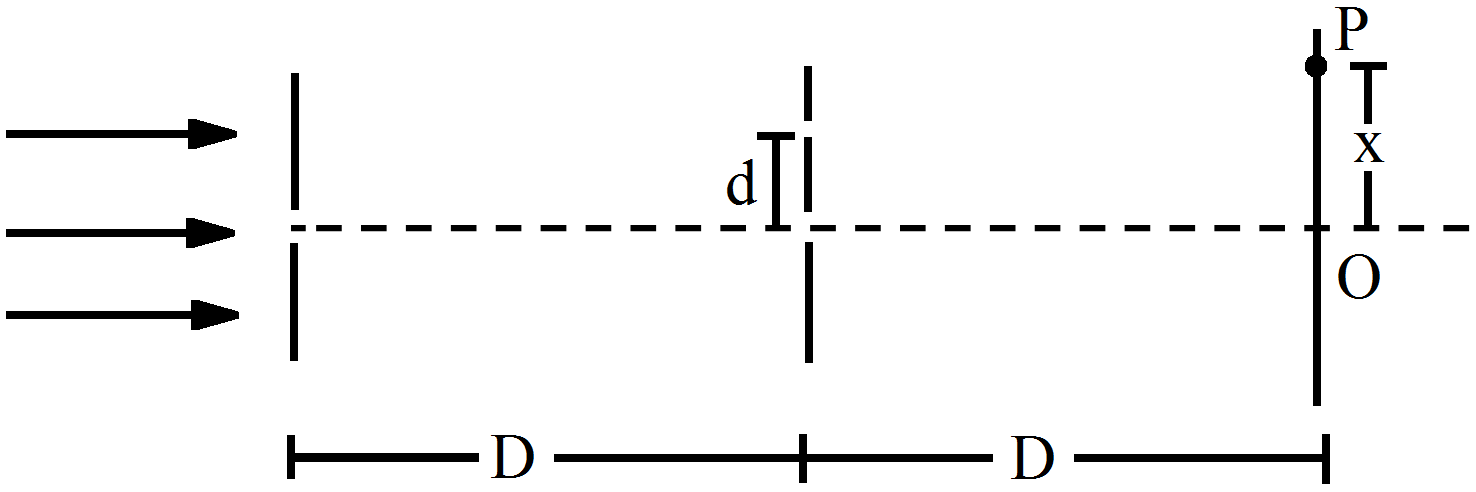
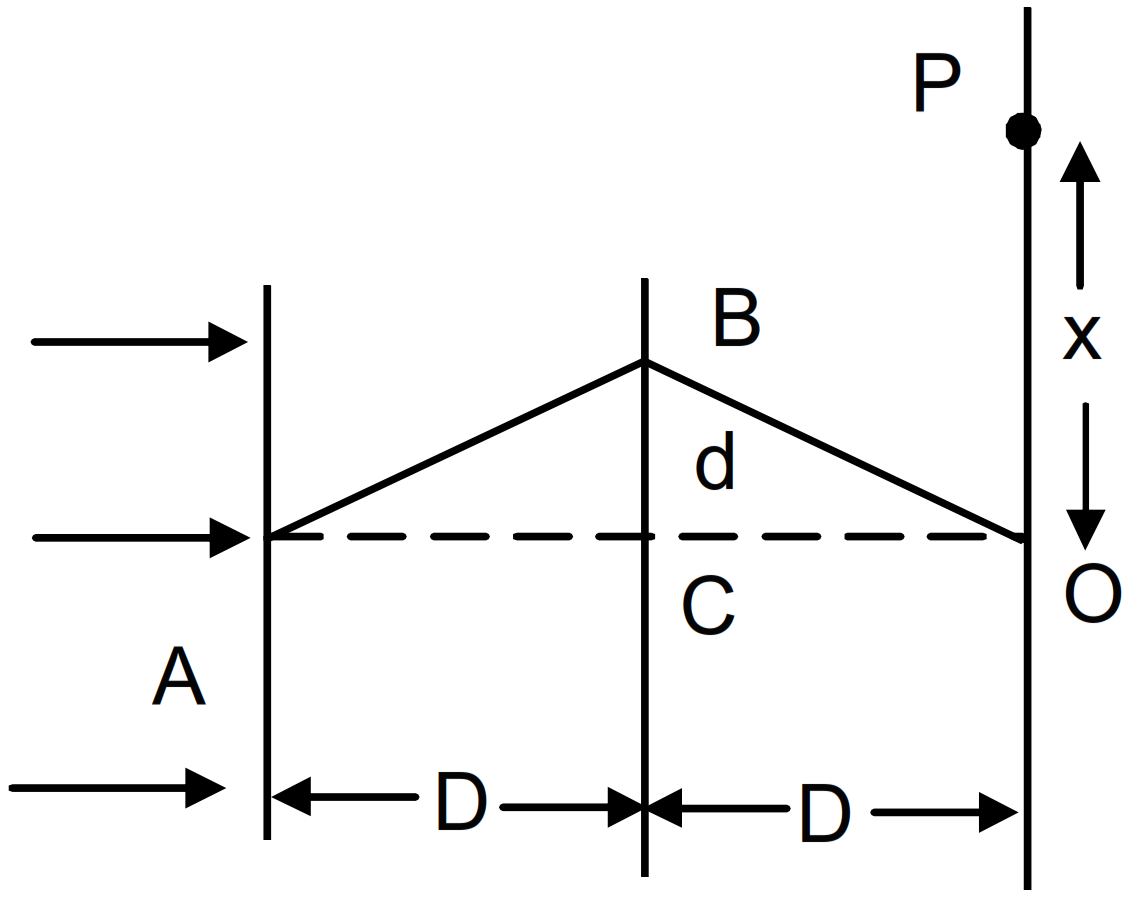
Path difference = (AB + BO) - (AC + CO) = 2(AB - AC) [Since, AB = BO and AC = CO] $=2\Big(\sqrt{\text{d}^2+\text{D}^2}-\text{D}\Big)$ For dark fringe, path difference should be odd multiple of $\frac{\lambda}{2}.$ So, $2\Big(\sqrt{\text{d}^2+\text{D}^2}-\text{D}\Big)=(2\text{n}+1)\Big(\frac{\lambda}{2}\Big)$ $\Rightarrow\sqrt{\text{d}^2+\text{D}^2}=\text{D}+(2\text{n}+1)\Big(\frac{\lambda}{4}\Big)$
$\Rightarrow\text{D}^2+\text{d}^2=\text{D}^2+(2\text{n}+1)^2\frac{\lambda^2}{16}+(2\text{n}+1)\frac{\lambda\text{D}}{2}$
Neglecting, $(2\text{n}+1)^2\frac{\lambda^2}{16},$ as it is very small We get, $\text{d}=\sqrt{(2\text{n}+1)\frac{\lambda\text{D}}{2}}$ For minimum ‘d’, putting $\text{n}=0\Rightarrow\text{d}_\text{min}=\sqrt{\frac{\lambda\text{D}}{2}}.$$\phi=\frac{2\pi\text{x}}{\lambda}=\frac{2\pi\times5\times10^{-6}}{6\times10^{-7}}\Rightarrow\frac{50\pi}{3}=16\pi+\frac{2\pi}{3}\Rightarrow\phi=\frac{2\pi}{3}$
So, the amplitude of the resulting wave at the point y = 0.5cm is,$\text{A}=\sqrt{\text{r}^2+\text{r}^2+2\text{r}^2\cos(\frac{2\pi}{3})}=\sqrt{\text{r}^2+\text{r}^2-\text{r}^2}=\text{r}$
$\frac{\text{I}}{\text{I}_\text{max}}=\frac{\text{A}^2}{(2\text{r})^2}$ [since, maximum amplitude = 2r]
$\Rightarrow\frac{\text{I}}{0.2}=\frac{\text{A}^2}{4\text{r}^2}=\frac{\text{r}^2}{4\text{r}^2}$
$\Rightarrow\text{I}=\frac{0.2}{4}=0.05\text{W/ m}^2.$
$\mu=1.6,$ t = 1.964 micron = 1.964 × 10⁻⁶m
We know, number of fringes shifted $=\frac{(\mu-1)\text{t}}{\lambda}$ So, the corresponding shift = No.of fringes shifted × fringe width$=\frac{(\mu-1)\text{t}}{\lambda}\times\frac{\lambda\text{D}}{\text{d}}=\frac{(\mu-1)\text{tD}}{\text{d}}\ ...(1)$
Again, when the distance between the screen and the slits is doubled, Fringe width $=\frac{\lambda(2\text{D})}{\text{d}}\ ...(2)$ From (1) and (2), $\frac{(\mu-1)\text{tD}}{\text{d}}=\frac{\lambda(2\text{D})}{\text{d}}$$\Rightarrow\lambda=\frac{(\mu-1)\text{t}}{\lambda}$
$=\frac{(1.6-1)\times(1.964)\times10^{-6}}{2}=589.2\times10^{-9}=589.2\text{nm}.$

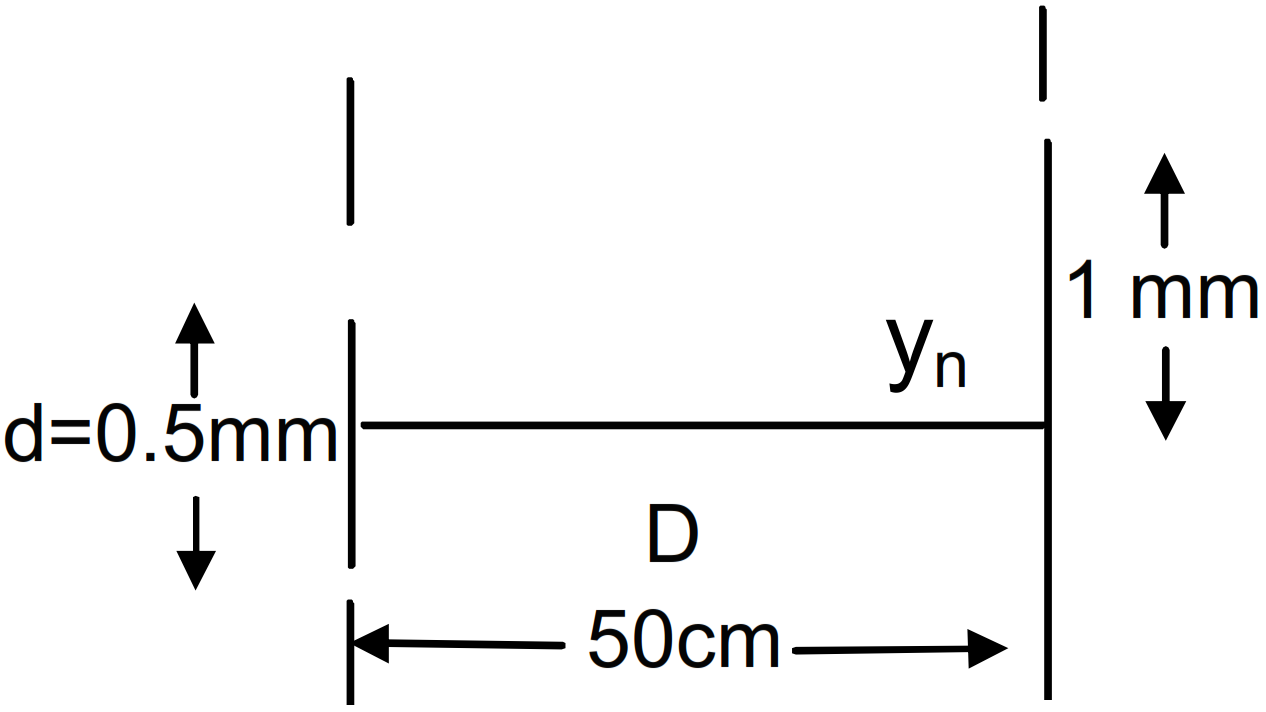
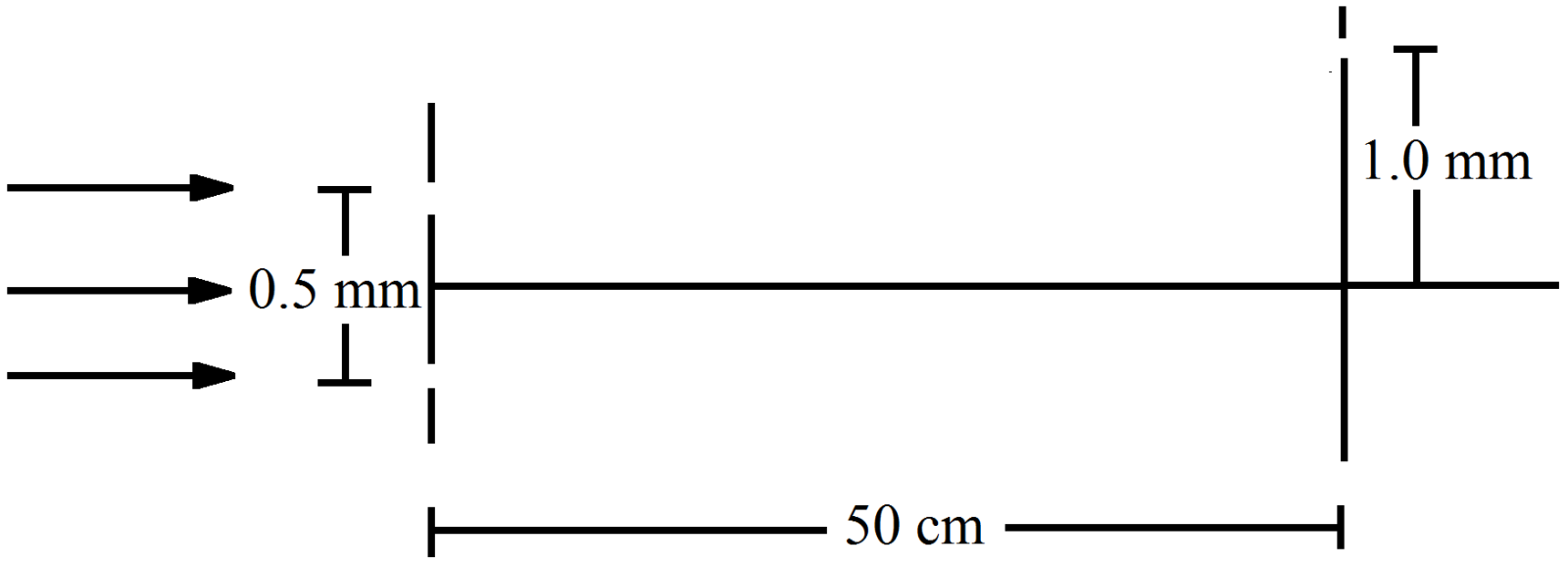
Given that, $\lambda= (400\text{nm to } 700\text{nm}),$ d = 0.5mm = 0.5 × 10⁻³m,
D = 50cm = 0.5m and on the screen yn = 1mm = 1 × 10⁻³m
$\text{y}_\text{n}=\Big(\frac{2\text{n}+1}{2}\Big)\frac{\lambda_\text{n}\text{D}}{\text{d}}$ where n = 0, 1, 2, ...
$\Rightarrow\lambda_\text{n}=\frac{2}{(2\text{n}+1)}\frac{\lambda_\text{n}\text{d}}{\text{D}}=\frac{2}{2\text{n}+1}\times\frac{10^{-3}\times0.5\times10^{-3}}{0.5}$
$\Rightarrow\frac{2}{(2\text{n}+1)}\times10^{-6}\text{m}=\frac{2}{(2\text{n}+1)}\times10^3\text{nm}$
If $\text{n}=1,\lambda_1=\Big(\frac{2}{3}\Big)\times1000=667\text{nm}$
If $\text{n}=1,\lambda_2=\Big(\frac{2}{5}\Big)\times1000=400\text{nm}$
So, the light waves of wavelengths 400nm and 667nm will be absent from the out coming light.
$\text{y}_\text{n}=\frac{\text{n}\lambda_\text{n}\text{D}}{\text{d}}\Rightarrow\lambda_\text{n}=\frac{\text{y}_\text{n}\text{d}}{\text{nD}}$
When, $\text{n}=1,\lambda_1=\frac{\text{y}_\text{n}\text{d}}{\text{D}}$
$=\frac{10^{-3}\times0.5\times10^{-3}}{0.5}=10^{-6}\text{m}=1000\text{nm}.$
1000nm is not present in the range 400nm - 700nm
Again, where $\text{n}=2,\lambda_2=\frac{\text{y}_\text{n}\text{d}}{2\text{D}}=500\text{nm}$
So, the only wavelength which will have strong intensity is 500nm.
$\text{f}_\text{a}=\frac{3\times10^8}{589\times10^{-9}}=5.09\times10^{14}\sec\Big[\because\text{f}=\frac{\text{c}}{\lambda}\Big]$
$\frac{\mu_\text{a}}{\mu_\text{w}}=\frac{\lambda_\text{w}}{\lambda_\text{a}}\Rightarrow\frac{1}{1.33}=\frac{\lambda_\text{w}}{589\times10^{-9}}\Rightarrow\lambda _\text{w}=443\text{nm}$
$\text{f}_\text{w}=\text{f}_\text{a}=5.09\times10^{14}\sec^{-1}$ [Frequency does not change]
$\frac{\mu_\text{a}}{\mu_\text{w}}=\frac{\text{v}_\text{w}}{\text{v}_\text{a}}\Rightarrow\text{v}_\text{w}=\frac{\mu_\text{a}\text{v}_\text{a}}{\mu_\text{w}}=\frac{3\times10^{10^8}}{1.33}=2.25\times10^8\text{m/sec}.$
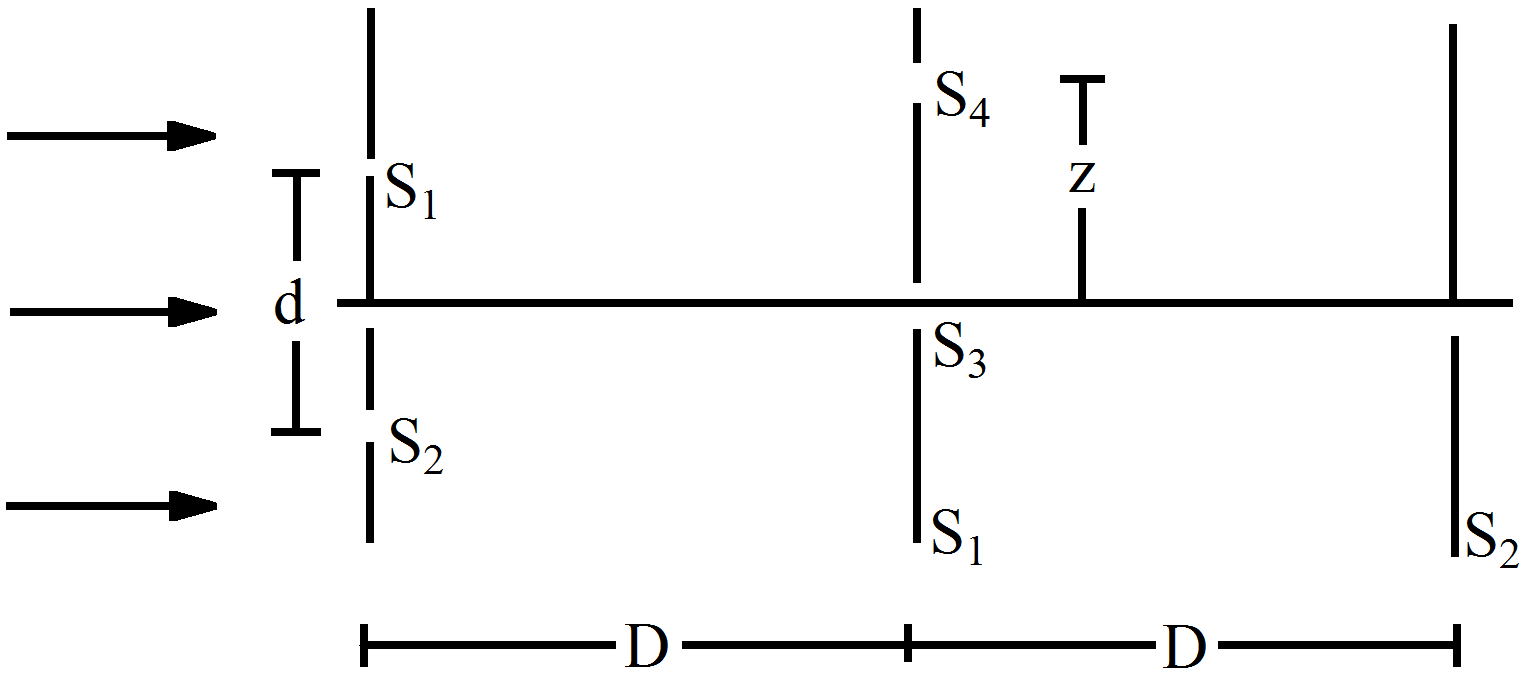
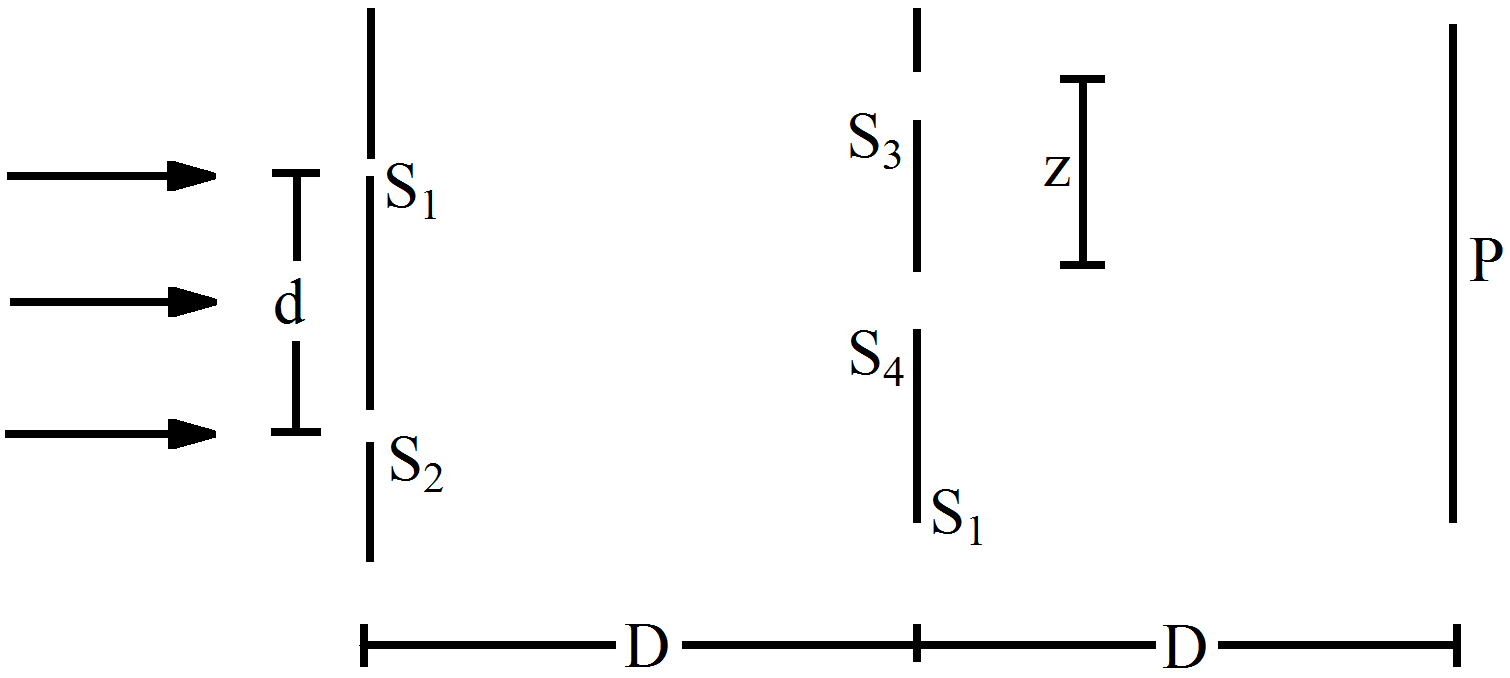
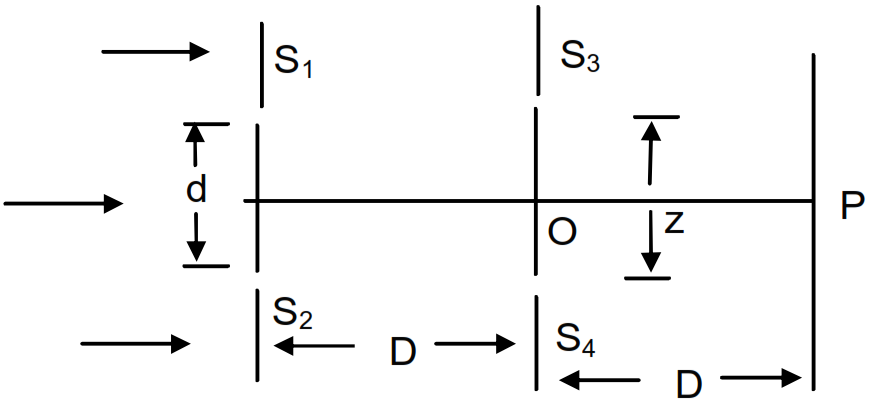
of S1S2 and S3S4. When $\text{z}=\frac{\text{D}\lambda}{2\text{d}},$ intensity measured at P is I. Find this intensity when z is equal to: $\frac{\text{D}\lambda}{\text{d}}$
$\frac{3\text{D}\lambda}{2\text{d}}$
$\frac{2\text{D}\lambda}{\text{d}}$
So, $\text{OS}_3=\text{OS}_4=\frac{\text{D}\lambda}{2\text{d}}$
⇒ Dark fringe at S3 and S4.
⇒ At S3, intensity at S3 = 0 ⇒ I1 = 0
At S4, intensity at S4 = 0 ⇒ I2 = 0
At P, path difference = 0 ⇒ Phase difference = 0.
$\Rightarrow\text{I}=\text{I}_1+\text{I}_2+\sqrt{\text{I}_1\text{I}_2}\cos0^\circ=0+0+0=0$
⇒ Intensity at P = 0.
Here, $\text{OS}_3=\text{OS}_4=\text{y}=\frac{\text{D}\lambda}{4\text{d}}$
$\therefore\phi=\frac{2\pi\text{x}}{\lambda}=\frac{2\pi}{\lambda}\times\frac{\text{yd}}{\text{D}}=\frac{2\pi}{\lambda}\times\frac{\text{D}\lambda}{4\text{d}}\times\frac{\text{d}}{\text{D}}=\frac{\pi}{2}.$
$\Big[$Since, x = path difference $=\frac{\text{yd}}{\text{D}}\Big]$
Let, intensity at S3 and S4 = I'
$\therefore$ At P, phase difference = 0
So, $\text{I}'+\text{I}'+2\text{I}'\cos0^\circ=\text{I}$
$\Rightarrow4\text{I}'=\text{I}\Rightarrow\text{I}'=\frac{1}{4}$
When, $\text{z}=\frac{3\text{D}\lambda}{2\text{d}},\Rightarrow\text{y}=\frac{3\text{D}\lambda}{4\text{d}}$
$\therefore\phi=\frac{2\pi\text{x}}{\lambda}=\frac{2\pi}{\lambda}\times\frac{\text{yd}}{\text{D}}=\frac{2\pi}{\lambda}\times\frac{3\text{D}\lambda}{4\text{d}}\times\frac{\text{d}}{\text{D}}=\frac{3\pi}{2}$
Let, I'' be the intensity at S3 and S4 when, $\phi=\frac{3\pi}{2}$
Now comparing,
$\frac{\text{I}"}{\text{I}}=\frac{\text{a}^2+\text{a}^2+2\text{a}^2\cos\Big(\frac{3\pi}{2}\Big)}{\text{a}^2+\text{a}^2+2\text{a}^2\cos\frac{\pi}{2}}=\frac{2\text{a}^2}{2\text{a}^2}=1$ $\Rightarrow\text{I}"=\text{I}'=\frac{\text{I}}{4}$
$\therefore$ Intensity at $\text{P}=\frac{\text{I}}{4}+\frac{\text{I}}{4}+2\times\Big(\frac{\text{I}}{4}\Big)\cos0^\circ=\frac{\text{I}}{2}+\frac{\text{I}}{2}=1$
$\Rightarrow\text{y}=\text{OS}_3=\text{OS}_4=\frac{\text{D}\lambda}{\text{d} }$
$\therefore\phi=\frac{2\pi\text{X}}{\lambda}=\frac{2\pi}{\lambda}\times\frac{\text{yd}}{\text{D}}=\frac{2\pi}{\lambda}\times\frac{\text{D}\lambda}{\text{d}}\times\frac{\text{d}}{\text{D}}=2\pi.$
Let, I"' = intensity at S3 and S4 when, $\phi=2\pi.$
$\frac{\text{I}'''}{\text{I}'}=\frac{\text{a}^2+\text{a}^2+2\text{a}^2\cos2\pi}{\text{a}^2+\text{a}^2+2\text{a}^2\cos\frac{\pi}{2}}=\frac{4\text{a}^2}{2\text{a}^2}=2$
$\Rightarrow\text{I}'''=2\text{I}'=2\Big(\frac{\text{I}}{4}\Big)=\frac{\text{I}}{2}$
At P, Iresultant $=\frac{\text{I}}{2}+\frac{\text{I}}{2}+2\Big(\frac{\text{I}}{2}\Big)\cos0^\circ=\text{I}+\text{I}=2\text{I}$
So, the resultant intensity at P will be 2I.