Question
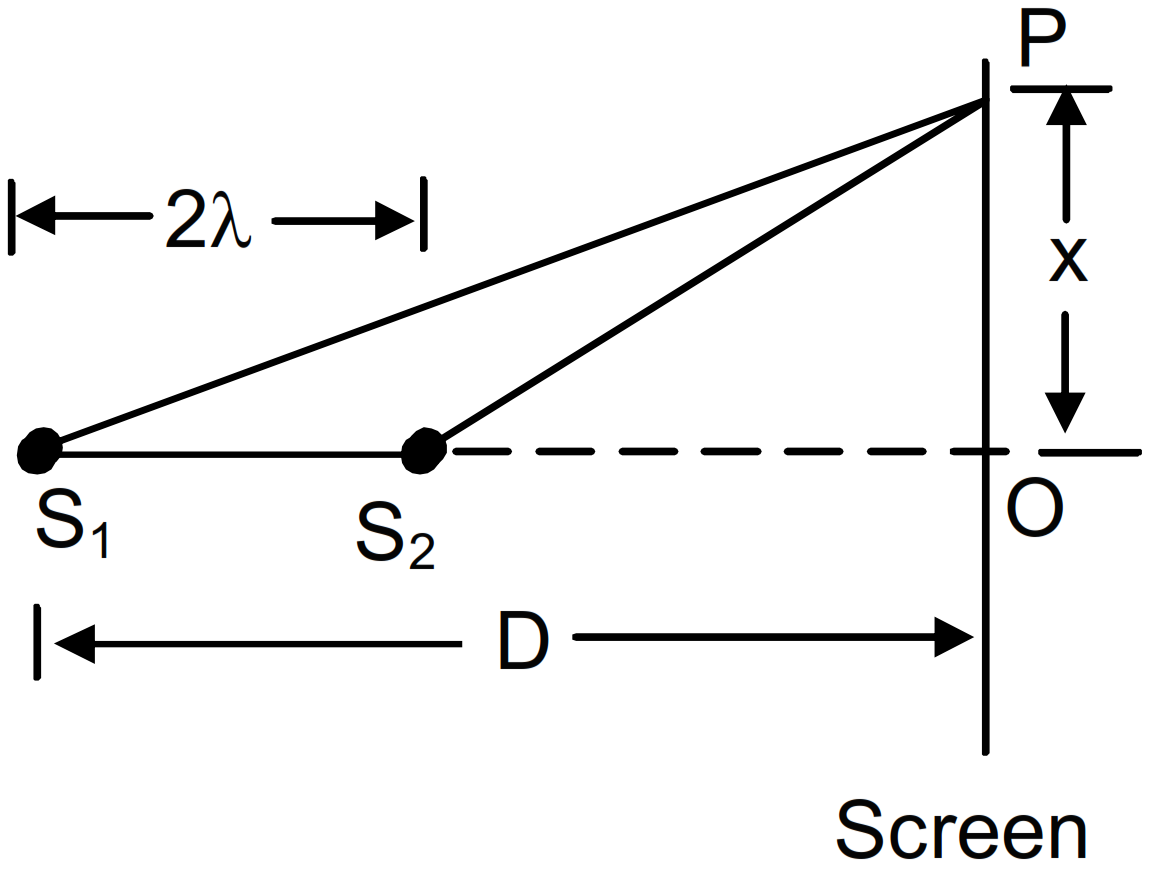
Figure shows three equidistant slits being illuminated by a monochromatic parallel beam of light. Let $\text{BP}_0-\text{AP}=\frac{\lambda}{3}$ and $\text{D}>\lambda.$
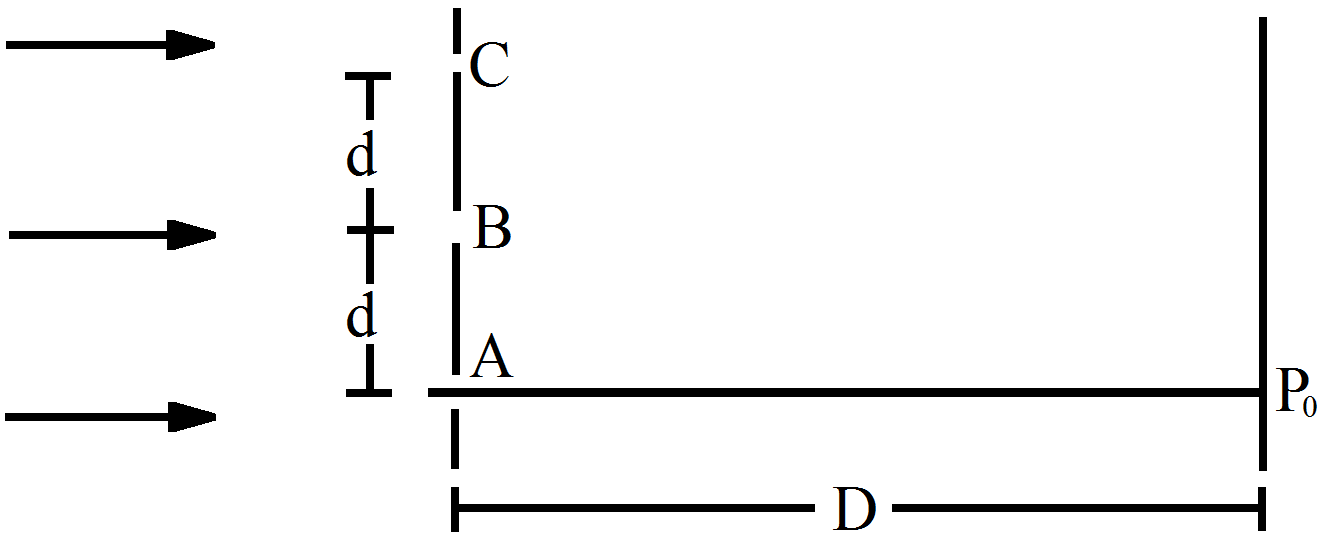
  1. Show that in this case $\text{d}=\sqrt{\frac{2\lambda\text{D}}{3}}.$
  2. Show that the intensity at P, is three times the intensity due to any of the three slits individually.
Answer

Since $S_1, S_2$ are in same phase, at O there will be maximum intensity. Given that, there will be a maximum intensity at P.
 ⇒ path difference $=\Delta\text{x}=\text{n}\lambda$ From the figure,$(\text{S}_1\text{P})^2-(\text{S}_2\text{P})^2=\Big(\sqrt{\text{D}^2+\text{X}^2}\Big)^2-\Big(\sqrt{(\text{D}-2\lambda)^2+\text{X}^2}\Big)^2$
$=4\lambda\text{D}-4\lambda^2=4\lambda\text{D}$ ($\lambda^2$ is so small and can be neglected)
$\Rightarrow\text{S}_1\text{P}-\text{S}_2\text{P}=\frac{4\lambda\text{D}}{2\sqrt{\text{x}^2+\text{D}^2}}=\text{n}\lambda$
$\Rightarrow\frac{2\text{D}}{\sqrt{\text{x}^2+\text{D}^2}}=\text{v}$
$\Rightarrow\text{n}^2(\text{X}^2+\text{D}^2)=4\text{D}^2=\Delta\text{X}=\frac{\text{D}}{\text{n}}\sqrt{4-\text{n}^2}$
when $\text{n}=1,\text{x}=\sqrt{3}\text{D}$ ($1^{st}$ order)$\text{n}=2,\text{x}=0$ ($2^{nd}$ order)
$\therefore$ When $\text{X}=\sqrt{3}\text{D},$ at P there will be maximum intensity.

Need a full question paper?

Generate a complete, print-ready paper with questions like this in minutes — across 16+ boards, with answer keys.

Start Generating Free

Similar questions

Two bodies A and B of masses 5kg and 10kg in contact with each other rest on a table against a rigid wall (Fig.). The coefficient of friction between the bodies and the table is 0.15. A force of 200N is applied horizontally to A. What are (a) the reaction of the partition (b) the action-reaction forces between A and B? What happens when the wall is removed? Does the answer to (b) change, when the bodies are in motion? Ignore the difference between $µ_s$ and $µ_k$.
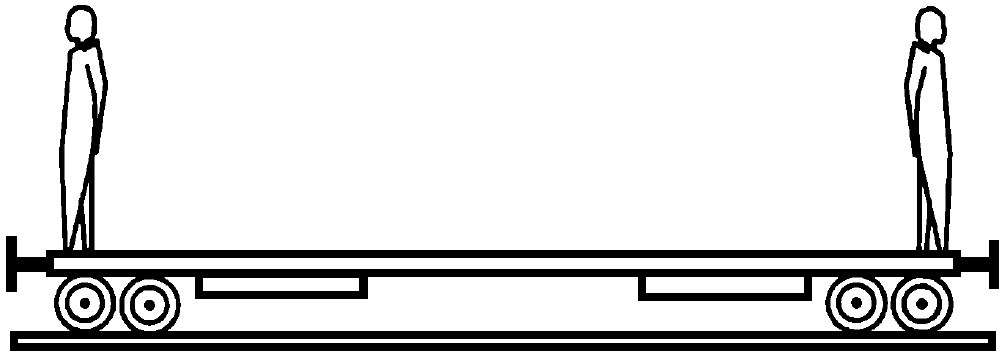
Two persons each of mass m are standing at the two extremes of a railroad car of mass M resting on a smooth track. The person on left jumps to the left with a horizontal speed u with respect to the state of the car before the jump. Thereafter, the other person jumps to the right, again with the same horizontal speed u with respect to the state of the car before his jump. Find the velocity of the car after both the persons have jumped off.
Draw velocity$-$time graph of uniformly accelerated motion in one dimension. From the velocity time graph of uniform accelerated motion, deduce the equations of motion in distance and time.
A particle of mass $0.2kg$, has an initial speed of $5ms^{-1}$ at the bottom of a rough inclined plane of inclination $30^\circ$ and vertical height $0.5m$. What is the speed of the particle as it reaches the top of the inclived plane? [Take $\mu=\frac{1}{\sqrt{3}}$] $\text{ g}=10\text{m/ s}^{-2}$
  1. State Pascal's law. Explain the working of hydraulic lift.
  2. Find out the height of atmosphere if the density of the atmosphere at sec level is $1.29km/ m^3$. Assume that it does not change with altitude.
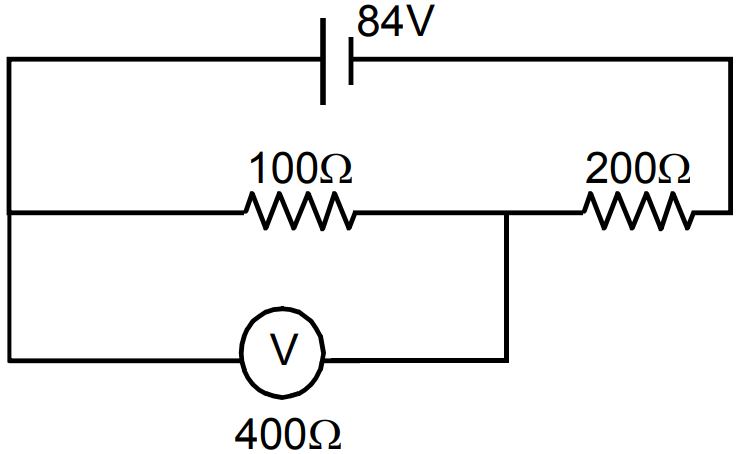
A voltmeter of resistance $400\Omega$ is used to measure the potential difference across the $100\Omega$ resistor in the circuit shown in the figure. (a) What will be the reading of the voltmeter? (b) What was the potential difference across $100\Omega$ before the voltmeter was connected?
The motion of a particle executing simple harmonic motion is described by the displacement function,$\text{x(t)}=\text{A}\cos(\omega\text{t}+\phi).$
If the initial (t = 0) position of the particle is 1cm and its initial velocity is $\omega\text{ cm/s,}$ what are its amplitude and initial phase angle? The angular frequency of the particle is $\pi\text{s}^{-1}.$ If instead of the cosine function, we choose the sine function to describe the SHM: $\text{x}=\text{B}\sin(\omega\text{t}+\alpha),$ what are the amplitude and initial phase of the particle with the above initial conditions.
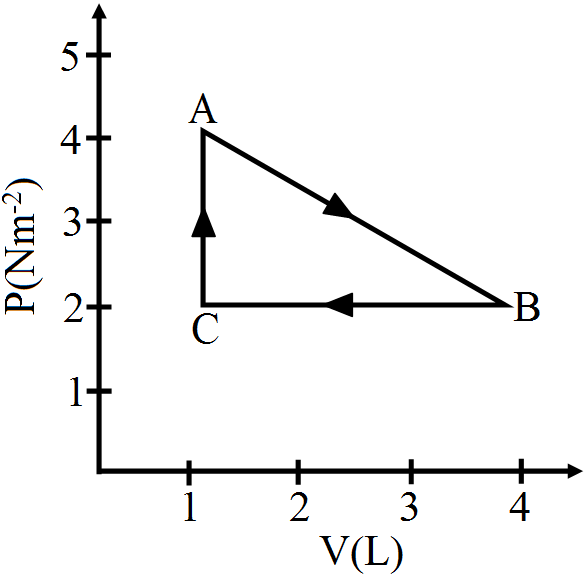
The P-V diagram for a cyclic process is a triangle ABC drawn in order. The co-ordinates of A, B, C are $(4,1),(2,4)$ and $(2,1)$. The co-ordinates are in the order ( $\mathrm{P}-\mathrm{V}$ ). Pressure is in $\mathrm{Nm}^{-2}$ and volume is in litre. Calculate work done during the process from A to $\mathrm{B}, \mathrm{B}$ to C and C to A . Also, calculate work done in the complete cycle.
An artificial satellite of mass $1000kg$ revolves around the earth in circular orbit of radius $6500km$. Calculate,
  1. Orbital velocity.
  2. Orbital kinetic energy.
  3. Gravitational potential energy.
  4. Total energy in the orbit. [Mass of the earth = $6 \times 1024kg, G = 6.67 \times 10-11 Nm^2/ kg]$
A 45 kg boy whose leg bones are $5 \mathrm{~cm}^2$ in area and 50 cm long falls through a height of 2 m without breaking his leg bones. If the bones can withstand a stress of $0.9 \times 10^8 \mathrm{~N} / \mathrm{m}^2$, calculate the Young's modulus for the material of the bone. Use, $g=10 \mathrm{~ms}^{-2}$.