Question
The P-V diagram for a cyclic process is a triangle ABC drawn in order. The co-ordinates of A, B, C are $(4,1),(2,4)$ and $(2,1)$. The co-ordinates are in the order ( $\mathrm{P}-\mathrm{V}$ ). Pressure is in $\mathrm{Nm}^{-2}$ and volume is in litre. Calculate work done during the process from A to $\mathrm{B}, \mathrm{B}$ to C and C to A . Also, calculate work done in the complete cycle.
Answer

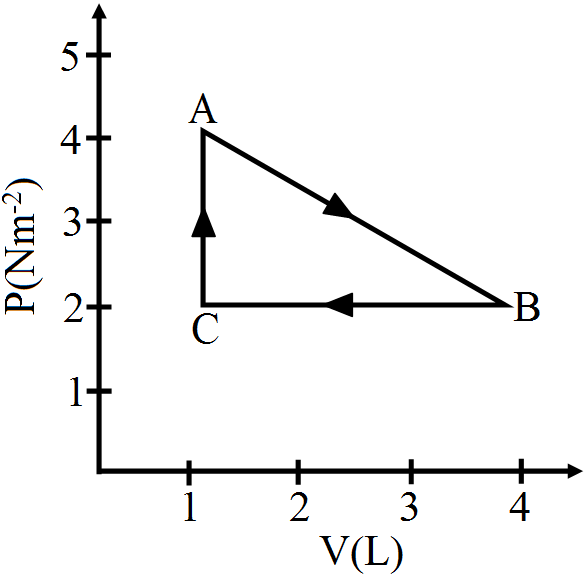
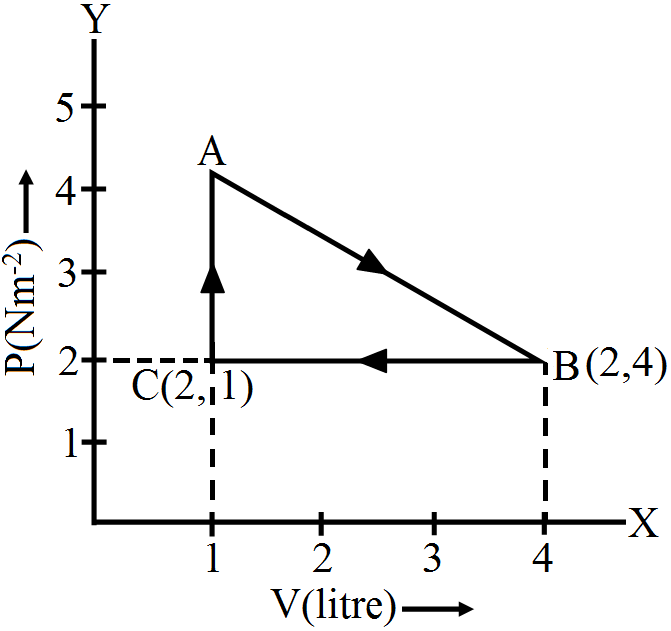
The P-V diagram drawn as per the question is show in figure (adjacent).
  1. Work done during the process from A to B (expansion),
$\text{W}_{\text{AB}}=+\text{area ABKLA}$
= area of $\Delta\text{ABC}+\text{area or rectangle BCLK}$
$\text{W}_{\text{AB}}=\frac{1}{2}\text{BC}\times\text{AC}+\text{KL}\times\text{LC}$
Now, BC = KC = 4 - 1 = 3 litre
$= 3 \times 10^{-3}m^3$
$AC = 4 - 2 = 2 Nm^{-2}$
$LC = 2 - 0 = 2 Nm^{-2}$
$\therefore\text{W}_{\text{AB}}=\frac{1}{2}\times3\times10^{-3}\times2+3\times10^{-3}\times2$
$\text{W}_{\text{AB}}=9\times10^{-3}\text{J}$
  1. Work done during the process from B to C (compression) is,
$\text{W}_{\text{BC}}=-\text{area BCLK}=-\text{KL}\times\text{LC}$
$=-3\times10^{-3}\times2=-6\times10^{-3}\text{J}$
  1. Work done during the process from C to A. As there is no change in volume of the gas in this process, therefore,
$\text{W}_{\text{CA}}=0.$
Net work done in the complete cycle,
$\text{W}=\text{W}_{\text{AB}}+\text{W}_\text{BC}+\text{W}_\text{CA}$
$=9\times10^{-3}+(-6\times10^{-3})+0$
$=3\times10^{-3}\text{J}$

Need a full question paper?

Generate a complete, print-ready paper with questions like this in minutes — across 16+ boards, with answer keys.

Start Generating Free

Similar questions

Explain with the suitable example that a reversible process must be carried slowly and a fast process is necessarily irreversible.
A satellite orbits the earth at a height of 400 km above the surface. How much energy must be expended to rocket the satellite out of the earth's gravitational influence? Mass of the satellite $=200 \mathrm{~kg}$; mass of the earth $=6.0 \times$ $10^{24} \mathrm{~kg}$; radius of the earth $=6.4 \times 10^6 \mathrm{~m} ; \mathrm{G}=6.67 \times 10^{-11} \mathrm{~N} \mathrm{~m}^2 \mathrm{~kg}^{-2}$.
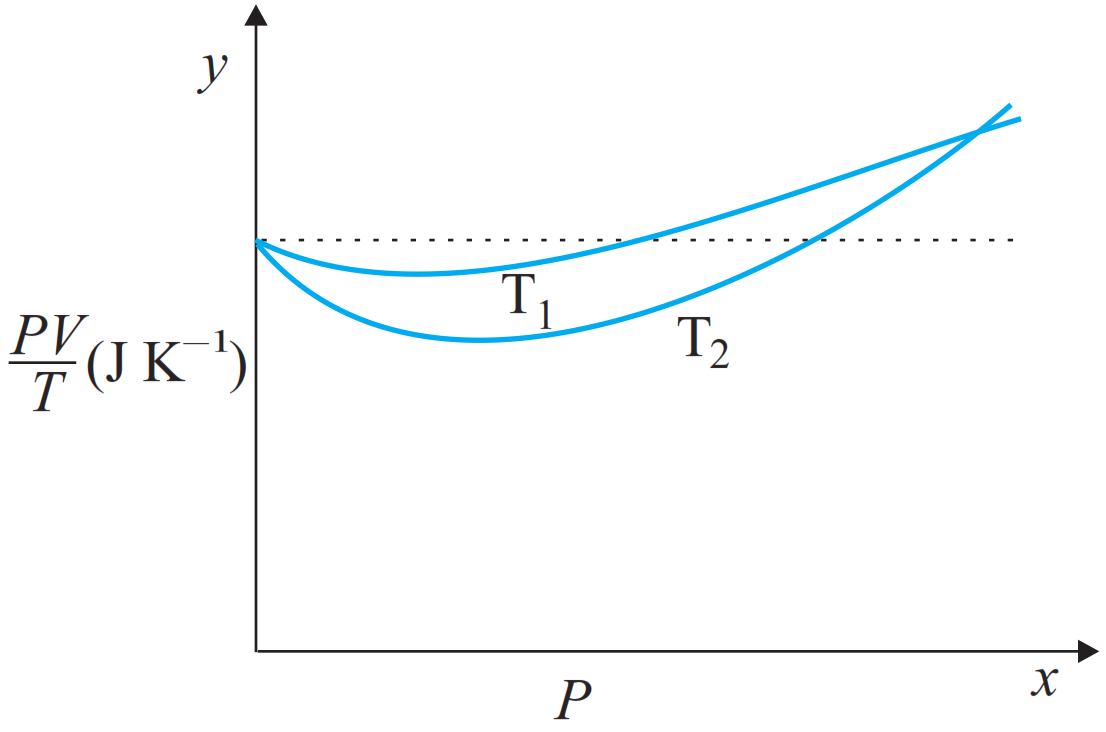
Shows plot of $\frac{\text{PV}}{\text{T}}$ versus P for $1.00 \times 10^{-3}kg$ of oxygen gas at two different temperatures: What is the value of $\frac{\text{PV}}{\text{T}}$ where the curves meet on the y-axis?
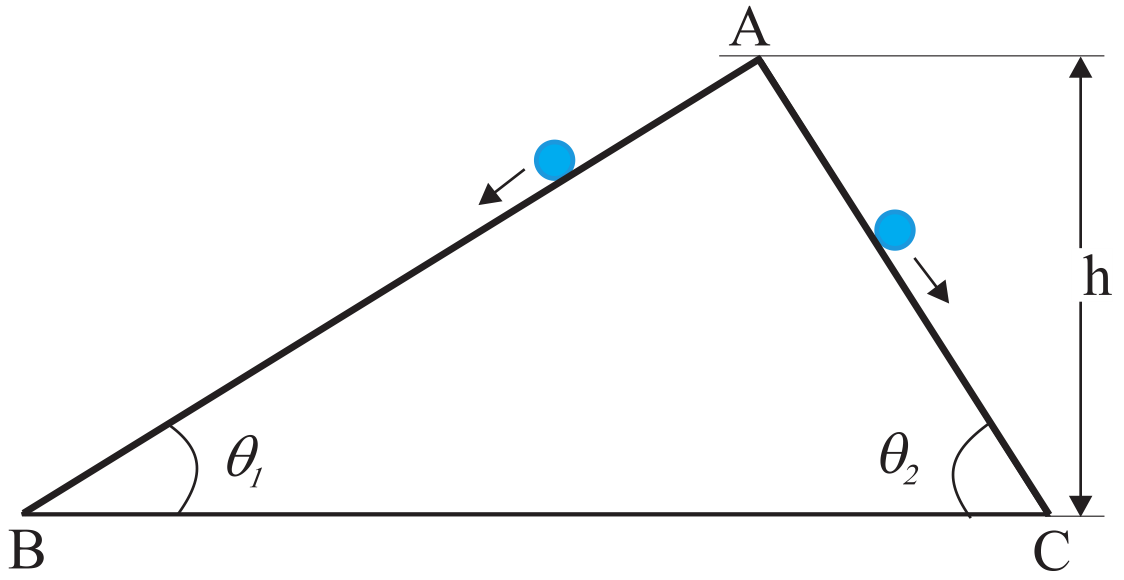
Two inclined frictionless tracks, one gradual and the other steep meet at A from where two stones are allowed to slide down from rest, one on each track. Will the stones reach the bottom at the same time? Will they reach there with the same speed? Explain. Given $\theta_1= 300,\theta_2= 600 ,$ and h = 10m, what are the speeds and times taken by the two stones?
  1. State the laws of limiting friction.
  2. Calculate the amount of work done in moving a body up a rough inclined plane. (The object is moved very slowly.)
OR
  1. Why has a horse to pull a cart harder during the first few steps of its motion?
  2. How does banking of roads reduces wear and tear of the tyres?
  3. Find the maximum speed at which a car can take turn round a curve of $30m$ radius on a level road, if the coefficient of friction between tyres and road is 0.4. $(g = 10ms^{-2})$
A body of mass $0.40kg$ moving initially with a constant speed of $10ms^{-1}$ to the north is subject to a constant force of $8.0 N$ directed towards the south for 30s. Take the instant the force is applied to be $t = 0$, the position of the body at that time to be $x = 0$, and predict its position at $t = –5s, 25s, 100s$.
What is meant by concurrent forces? What is the necessary condition for the balance of concurrent forces? Explain their conclusion also.
  1. Define critical velocity of liquid flow and state the factors affecting the critical velocity of liquid.
  2. Define terminal velocity. Establish an expression for it for a spherical body falling through a viscous medium.
A calorimeter contains $50 g$ of water at $50^{\circ} \mathrm{C}$. The temperature falls to $45^{\circ} \mathrm{C}$ in 10 minutes. When the calorimeter contains $100 g$ of water -at $50^{\circ} 0$, it takes $18$ minutes for the temperature to become $45^{\circ} \mathrm{C}$. Find the water equivalent of the calorimeter.
Describe stress-strain relationship for a loaded steel wire and hence explain the terms : Elastic limit, yield point, tensile strength.