Question
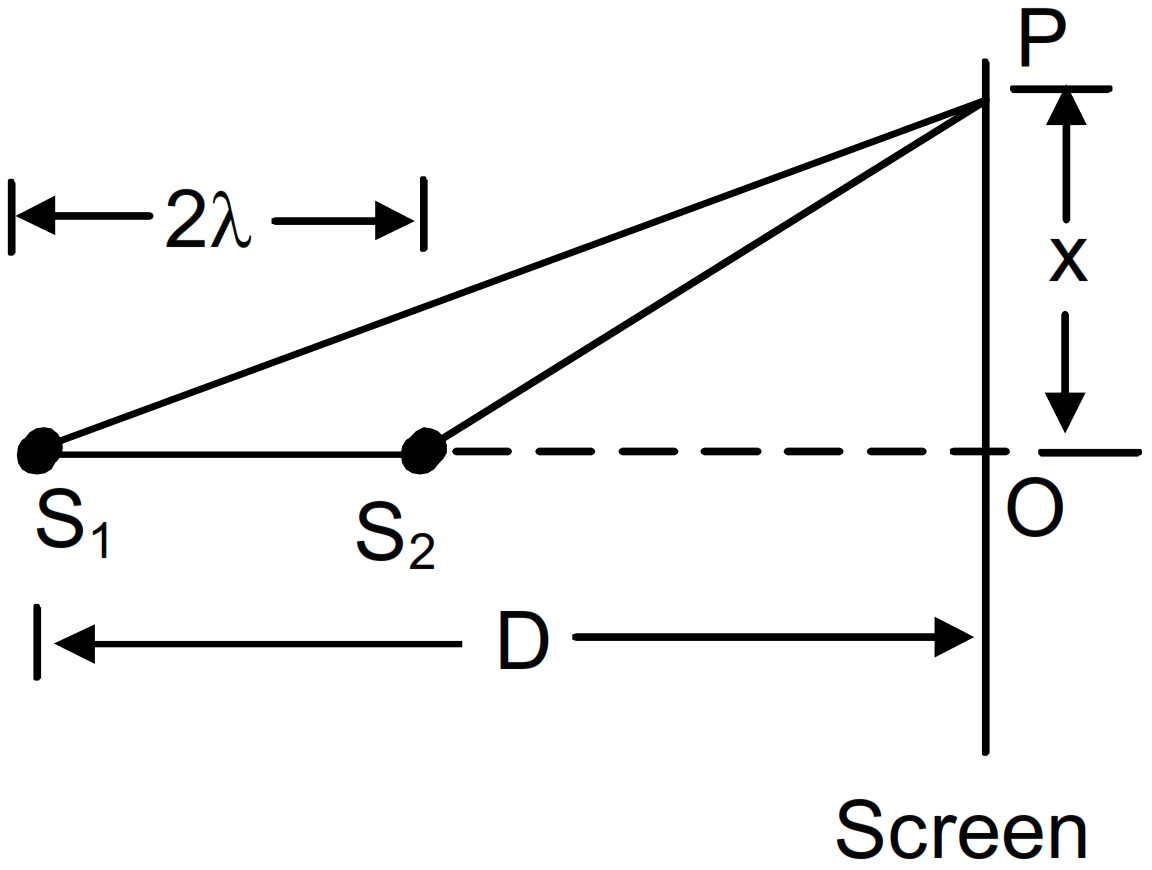
Figure shows three equidistant slits being illuminated by a monochromatic parallel beam of light. Let $\text{BP}_0-\text{AP}=\frac{\lambda}{3}$ and $\text{D}>\lambda.$
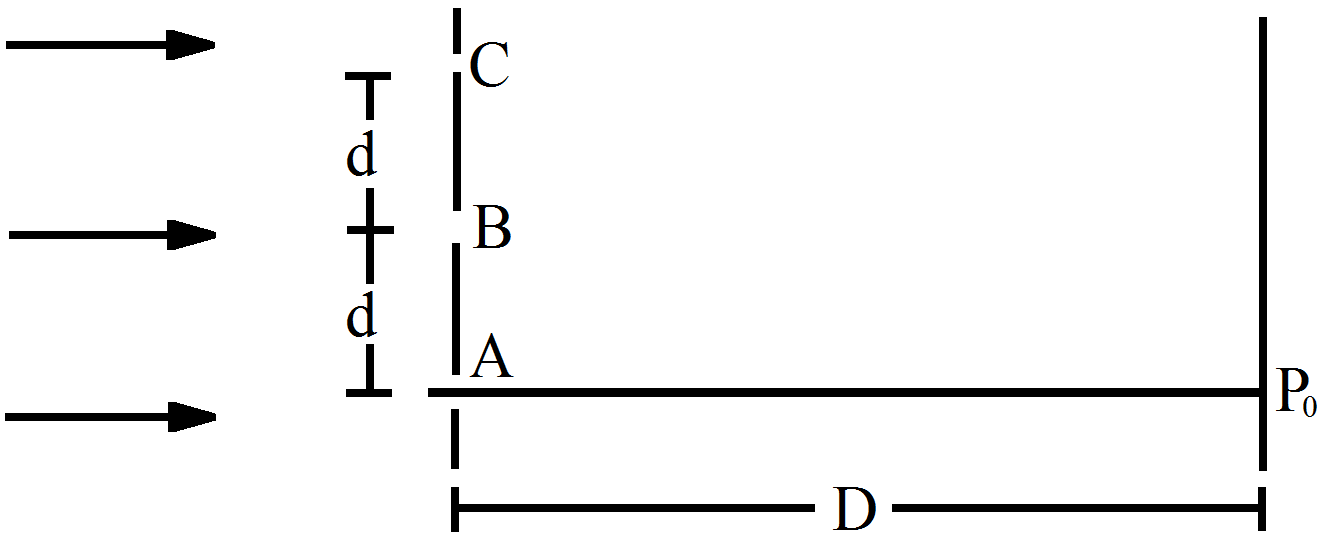
  1. Show that in this case $\text{d}=\sqrt{\frac{2\lambda\text{D}}{3}}.$
  2. Show that the intensity at P, is three times the intensity due to any of the three slits individually.
Answer

Since S1, S2 are in same phase, at O there will be maximum intensity.
Given that, there will be a maximum intensity at P.

⇒ path difference $=\Delta\text{x}=\text{n}\lambda$
From the figure,
$(\text{S}_1\text{P})^2-(\text{S}_2\text{P})^2=\Big(\sqrt{\text{D}^2+\text{X}^2}\Big)^2-\Big(\sqrt{(\text{D}-2\lambda)^2+\text{X}^2}\Big)^2$
$=4\lambda\text{D}-4\lambda^2=4\lambda\text{D}$ ($\lambda^2$ is so small and can be neglected)
$\Rightarrow\text{S}_1\text{P}-\text{S}_2\text{P}=\frac{4\lambda\text{D}}{2\sqrt{\text{x}^2+\text{D}^2}}=\text{n}\lambda$
$\Rightarrow\frac{2\text{D}}{\sqrt{\text{x}^2+\text{D}^2}}=\text{v}$
$\Rightarrow\text{n}^2(\text{X}^2+\text{D}^2)=4\text{D}^2=\Delta\text{X}=\frac{\text{D}}{\text{n}}\sqrt{4-\text{n}^2}$
when $\text{n}=1,\text{x}=\sqrt{3}\text{D}$ (1st order)
$\text{n}=2,\text{x}=0$ (2nd order)
$\therefore$ When $\text{X}=\sqrt{3}\text{D},$ at P there will be maximum intensity.

Need a full question paper?

Generate a complete, print-ready paper with questions like this in minutes — across 16+ boards, with answer keys.

Start Generating Free

Similar questions

Consider an assembly of three conducting concentric spherical shells of radii a, b and c as shown in figure. Find the capecitance of the assembly between the poima A and B

What is a voltmeter? How can a galvanometer be converted into a voltmeter of given range? Explain.
A source of sound emitting a 1200Hz note travelg along a straight line at a speed of 170m/s. A detector is placed at a distance of 200m from the line of motion of the source.
  1. Find the frequency of sound received by the detector at the instant when the source gets closest to it.
  2. Find the distance between the source and the detector at the instant it detects the frequency 1200Hz. Velocity of sound in air = 340m/s.
Solve the previous problem if the pulley has a moment of inertia I about its axis and the string does not slip over it.
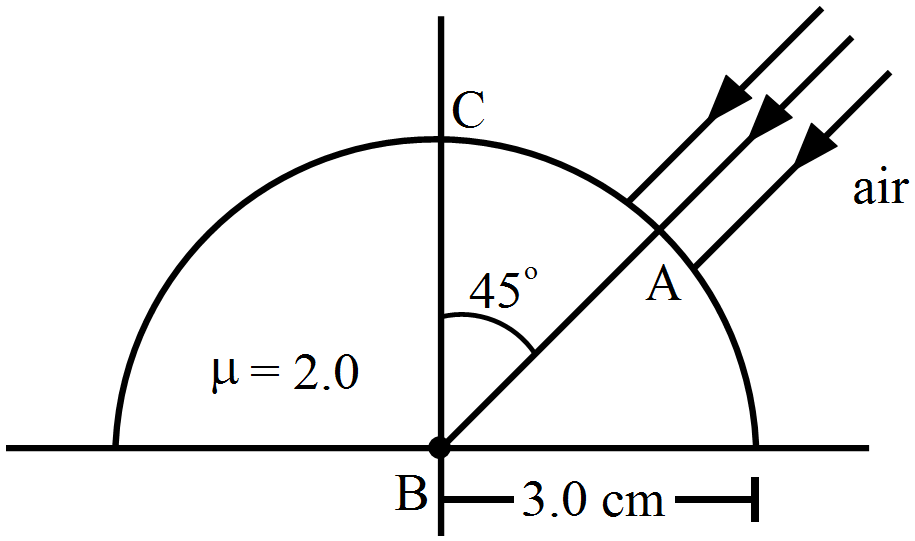
Figure shows a transparent hemisphere of radius 3.0cm made of a material of refractive index 2.0.
  1. A narrow beam of parallel rays is incident on the hemisphere as shown in the figure. Are the rays totally reflected at the plane surface?
  2. Find the image formed by the refraction at the first surface.
  3. Find the image formed by the reflection or by the refraction at the plane surface.
  4. Trace qualitatively the final rays as they come out of the hemisphere.

A turn of radius 20m is banked for the vehicles going at a speed of 36 km/h. If the coefficient of static friction between the road and the tyre is 0.4, what are the possible speeds of a vehicle so that it neither slips down nor skids up?
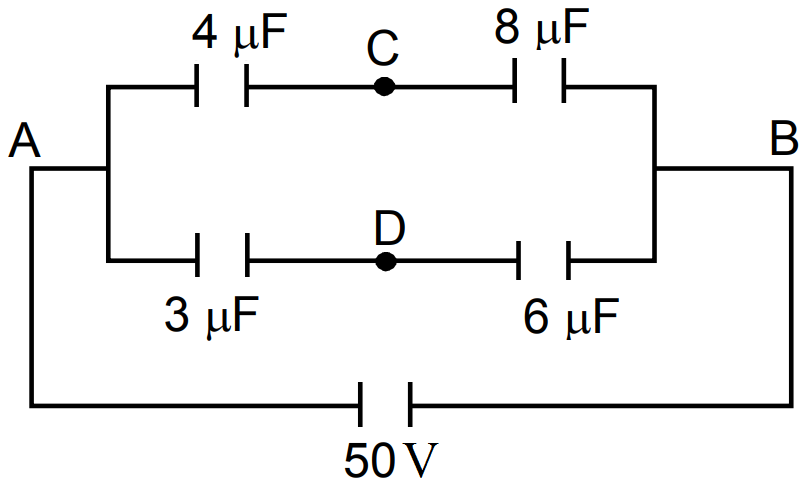
Take the potential of the point B in figure to be zero:
  1. Find the potentials at the points C and D.
  2. If a capacitor is connected between C and D, what charge will appear on this capacitor?

Do the same exercise as above with the replacement of the earlier transformer by a 40, 000-220V step-down transformer (Neglect, as before, leakage losses though this may not be a good assumption any longer because of the very high voltage transmission involved). Hence, explain why high voltage transmission is preferred?
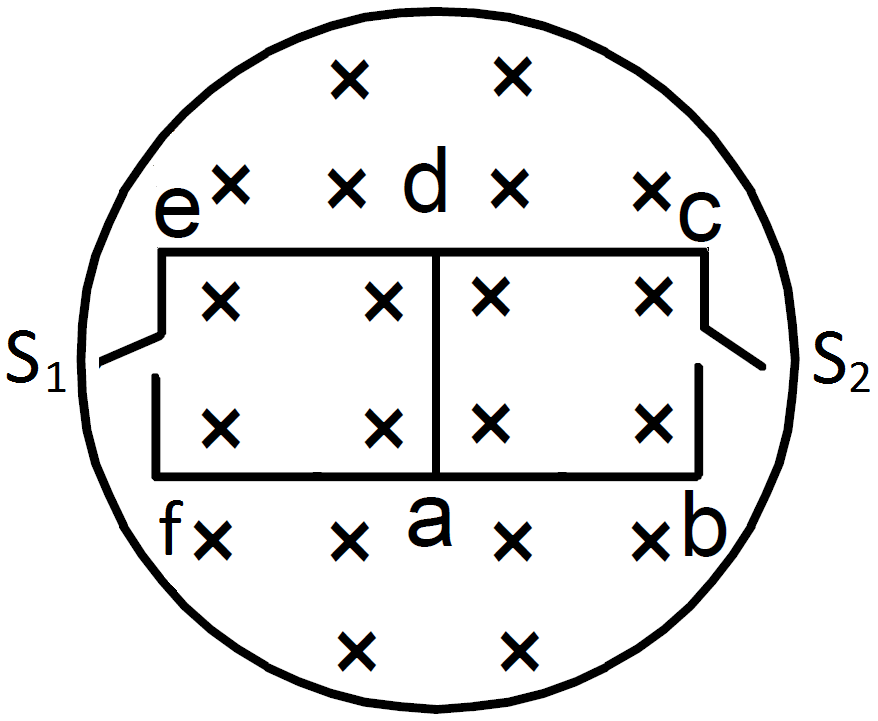
The magnetic field in the cylindrical region shown in figure increases at a constant rate of 20.0mT/s. Each side of the square loop abcd and defa has a length of 1.00cm and a resistance of $4.00\Omega.$ Find the current (magnitude and sense) in the wire ad if:

  1. The switch S1 is closed but S2 is open.
  2. S1 is open but S2 ia closed.
  3. Both S1 and S2 are open.
  4. Both S1 and S2 are closed.

a. Draw the diagram of a device which is used to decrease high ac voltage into a low ac voltage and state its working principle. Write four sources of energy loss in this device.
b. A small town with a demand of 1200 kW of electric power at 220 V is situated 20 km away from an electric plant generating power at 440 V . The resistance of the two wire line carrying power is $0.5 \Omega per km$. The town gets the power from the line through a $4000-220 V$ step-down transformer at a sub-station in the town. Estimate the line power loss in the form of heat