MCQ
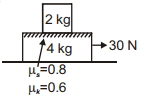
Figure shows two block system, $4 \,kg$ block rests on a smooth horizontal surface, upper surface of $4 \,kg$ is rough. A block of mass $2 \,kg$ is placed on its upper surface. The acceleration of upper block with respect to earth when $4 \,kg$ mass is pulled by a force of $30 \,N$, is ......... $m / s ^2$
  • A
    $6$
  • $5$
  • C
    $8$
  • D
    $2$

Answer

Correct option: B.
$5$
b
(b)

It both move together

$a=\frac{30}{(4+2)}=5 m / s ^2$

$2 \,kg$ will move due to frictional force

$F=m a \Rightarrow f=2(5)=10 N$

and limiting friction $f_L=(0.8)(2 g )=16 \,N$

$\Rightarrow$ Friction is sufficient to move both block together hence $a=5 \,m / s ^2$

Need a full question paper?

Generate a complete, print-ready paper with questions like this in minutes — across 16+ boards, with answer keys.

Start Generating Free

Similar questions

Certain substance emits only the wavelengths ${\lambda _1},\;{\lambda _2},\;{\lambda _3}$ and ${\lambda _4}$ when it is at a high temperature. When this substance is at a colder temperature, it will absorb only the following wavelengths
$10\, gm$ of ice at $0°C$ is mixed with $100 \,gm $ of water at $50°C.$ What is the resultant temperature of mixture........ $^oC$
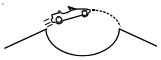
A stunt man jumps his car over a crater as shown (neglect air resistance)
Two particles of equal mass are connected to a rope $AB$ of negligible mass such that one is at end $A$ and other dividing the length of rope in the ratio $1:2$ from $B$. The rope is rotated about end $B$ in a horizontal plane. Ratio of tensions in the smaller part to the other is (ignore effect of gravity)
Out of following four dimensional quantities, which one quantity is to be called a dimensional constant
A source and an observer are moving towards each other with a speed equal to $\frac{v}{2}$ where $v$ is the speed of sound. The source is emitting sound of frequency $n$. The frequency heard by the observer will be
A copper and a steel wire of the same diameter are connected end to end. A deforming force $F$ is applied to this composite wire which causes a total elongation of $1\ cm.$ The two wires will have
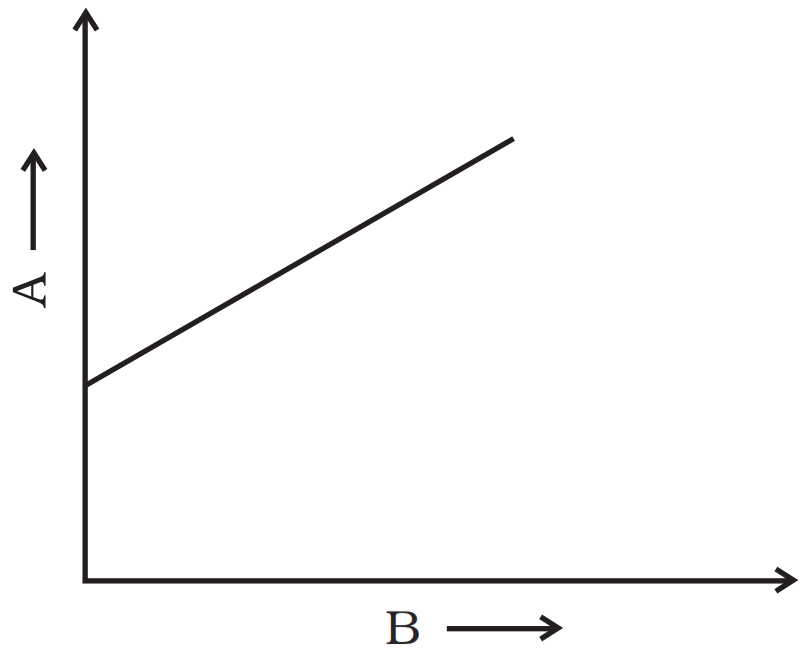
The variation of quantity $A$ with quantity $B$, plotted in Fig. describes the motion of a particle in a straight line.
A man carrying a monkey on his shoulder does cycling smoothly on a circular track of radius $9 \mathrm{~m}$ and completes $120$ revolutions in $3$ minutes. The magnitude of centripetal acceleration of monkey is (in $\mathrm{m} / \mathrm{s}^2$ ):
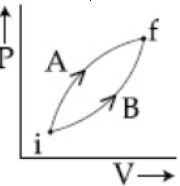
Following figure shows two processes $A$ and $B$ for a gas. If $\Delta Q_A$ and $\Delta Q_B$ are the amount of heat absorbed by the system in two cases, and $\Delta U_A$ and $\Delta U_B$ are changes in internal energies, respectively, then