MCQ
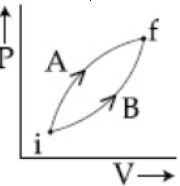
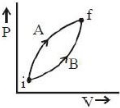
Following figure shows two processes $A$ and $B$ for a gas. If $\Delta Q_A$ and $\Delta Q_B$ are the amount of heat absorbed by the system in two cases, and $\Delta U_A$ and $\Delta U_B$ are changes in internal energies, respectively, then
  • A
    $\Delta {Q_A}\, = \,\Delta {Q_B}\,;\,\Delta {U_A} = \Delta {U_B}$
  • $\Delta {Q_A}\, > \,\Delta {Q_B}\,;\,\Delta {U_A} = \Delta {U_B}$
  • C
    $\Delta {Q_A}\, < \,\Delta {Q_B}\,;\,\Delta {U_A} < \Delta {U_B}$
  • D
    $\Delta {Q_A}\, > \,\Delta {Q_B}\,;\,\Delta {U_A} > \Delta {U_B}$
Answer

Correct option: B.
$\Delta {Q_A}\, > \,\Delta {Q_B}\,;\,\Delta {U_A} = \Delta {U_B}$
b
Initial and final states for both the processes are same,

$\therefore \Delta \mathrm{U}_{\mathrm{A}}=\Delta \mathrm{U}_{\mathrm{B}}$

Work done during process $A$ is greater than in process $B$. Because area is more

By First law of thermodynamics

$\Delta Q=\Delta U+W$

$\Rightarrow \Delta \mathrm{Q}_{\mathrm{A}}>\Delta \mathrm{Q}_{\mathrm{B}}$

Need a full question paper?

Generate a complete, print-ready paper with questions like this in minutes — across 16+ boards, with answer keys.

Start Generating Free

Similar questions

The limiting friction between two bodies in contact is independent of
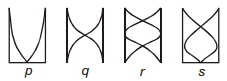
The vibrations of four air columns under identical conditions are represented in the figure below. The ratio of frequencies $n_p: n_q: n_r: n_s$ will be
A heavy stone is thrown from a cliff of height $h$ with a speed $\nu.$ The stone will hit the ground with maximum speed if it is thrown:
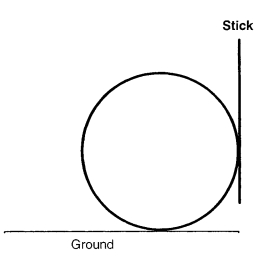
A boy is pushing a ring of mass $2 \ kg$ and radius $0.5 \ m$ with a stick as shown in the figure. The stick applies a force of $2 \ N$ on the ring and rolls it without slipping with an acceleration of $0.3 \ m / s ^2$. The coefficient of friction between the ground and the ring is large enough that rolling always occurs and the coefficient of friction between the stick and the ring is $(P / 10)$. The value of $P$ is
Inside a uniform spherical shell

$(a)$ the gravitational field is zero

$(b)$ the gravitational potential is zero

$(c)$ the gravitational field is same everywhere

$(d)$ the gravitation potential is same everywhere

$(e)$ all of the above

Choose the most appropriate answer from the options given below

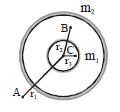
Two concentric shells of different masses $m_1$ and $m_2$ are having a sliding particle of mass $m$. The forces on the particle at position $A, B$ and $C$ are
A container is filled with $20$ moles of an ideal diatomic gas at absolute temperature $T$. When heat is supplied to gas temperature remains constant but $8$ moles dissociate into atoms. Heat energy given to gas is .........
A particle starts moving rectilinearly at time $t = 0$ such that its velocity $'v'$ changes with time $'t'$ according to the equation $v = t^2 - t$ where $t$ is in seconds and $v$ is in $m/s.$ The time interval for which the particle retards is
A $4 \,kg$ mass and a $1\, kg$ mass are moving with equal kinetic energies. The ratio of the magnitudes of their linear momenta is
By exerting a certain amountof pressure on an ice block, you