Question
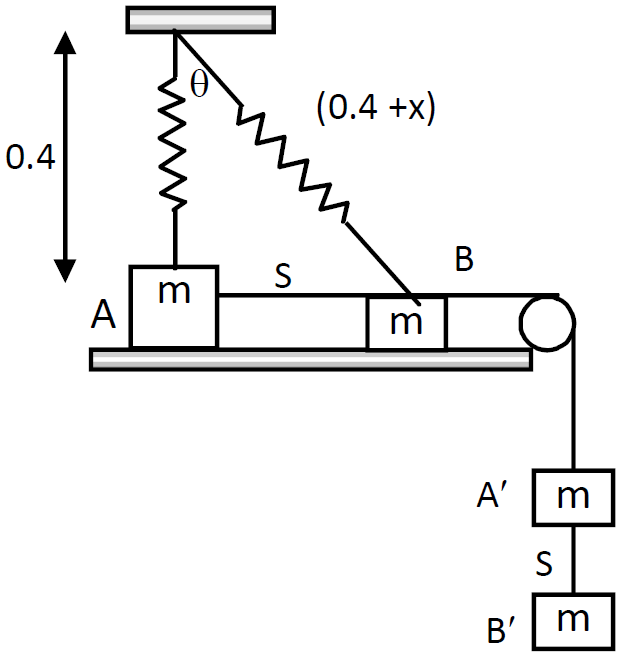
Figure shows two blocks A and B, each having a mass of 320g connected by a light string passing over a smooth light pulley. The horizontal surface on which the block A can slide is smooth. The block A is attached to a spring of spring constant 40N/m whose other end is fixed to a support 40cm above the horizontal surface. Initially, the spring is vertical and unstretched when the system is released to move. Find the velocity of the block A at the instant it breaks off the surface below it. Take g = 10m/s2.
Answer

m = 320g = 0.32kg, k = 40N/m

h = 40cm = 0.4m, g = 10 m/s2

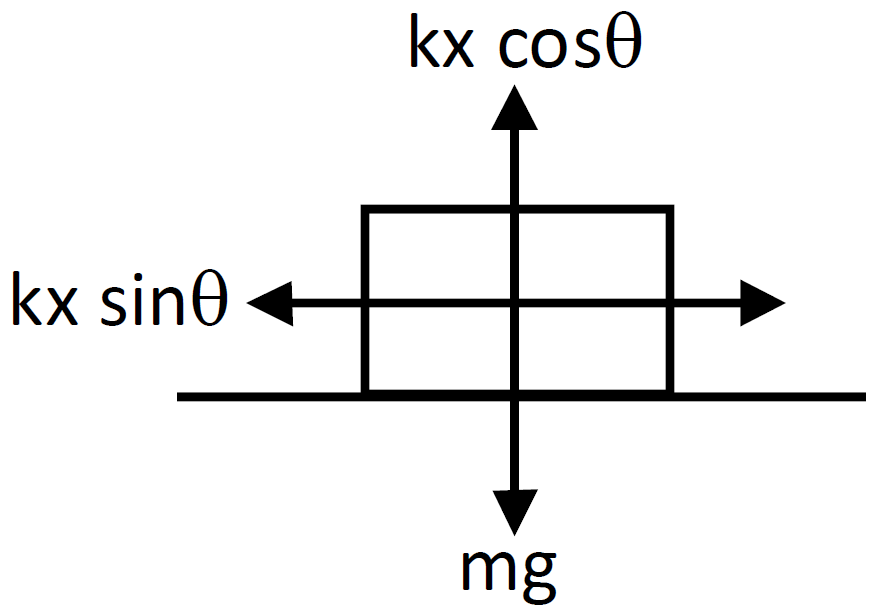
From the free body diagram,

$\text{kx}\cos\theta=\text{mg}$

(when the block breaks off R = 0)

$\Rightarrow\cos\theta=\frac{\text{mg}}{\text{kx}}$

So, $\frac{0.4}{0.4+\text{x}}=\frac{3.2}{40+\text{x}}$

$\Rightarrow16\text{x}=3.2\text{x}+1.28$

$\Rightarrow\text{x}=0.1\text{m}$

So, $\text{s}=\text{AB}$

$\Rightarrow\sqrt{(\text{h}+\text{x})^2-\text{h}^2}$

$\Rightarrow\sqrt{(0.5)^2-(0.4)^2}=0.3\text{m}$

Let the velocity of the body at B be v,

Charge in K.E. = work done (for the system)

$\Big(\frac{1}{2}\text{mv}^2+\frac{1}{2}\text{mv}^2\Big)=\frac{-1}{2}\text{kx}^2+\text{mgs}$

$\Rightarrow(0.32)\times\text{v}^2=-\Big(\frac{1}{2}\Big)\times40\times(0.1)^2+0.32\times10\times(0.3)$

$\Rightarrow\text{v}=1.5\text{m}/\text{sec}$

Need a full question paper?

Generate a complete, print-ready paper with questions like this in minutes — across 16+ boards, with answer keys.

Start Generating Free

Similar questions

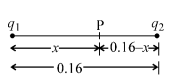
Two charges of$5 \times 10^{-8} C$ and $-3 \times 10^{-8}$ are located at a distance of 16 cm apart. At what point on the line joining the two charges is the electric potential zero? Take the potential at infinity to be zero.
Image
The $\text{K}_\alpha$ X-rays of aluminium (Z = 13) and zinc (Z = 30) have wavelengths 887pm and 146pm respectively. Use Moseley's law $\sqrt{\text{v}}=\text{a}(\text{z-b})$ to find the wavelengths of the $\text{K}_\alpha$ X-ray of iron (Z = 26).
i. There are two sets of apparatus of Young's double-slit experiment. Inset A, the phase difference between the two waves emanating from the slits does not change with time, whereas in set B, the phase difference between the two waves from the slits changes rapidly with time. What difference will be observed in the pattern obtained on the screen in the two setups?
ii. Deduce the expression for the resultant intensity in both the above-mentioned setups ( A and B ), assuming that the waves emanating from the two slits have the same amplitude a and same wavelength $\lambda$.
A parallel-plate capacitor of plate area A and plate separation d is charged to a potential difference V and then the battery is disconnected. A slab of dielectric constant K is then inserted between the plates of the capacitor so as to fill the space between the plates. Find the work done on the system in the process of inserting the slab.
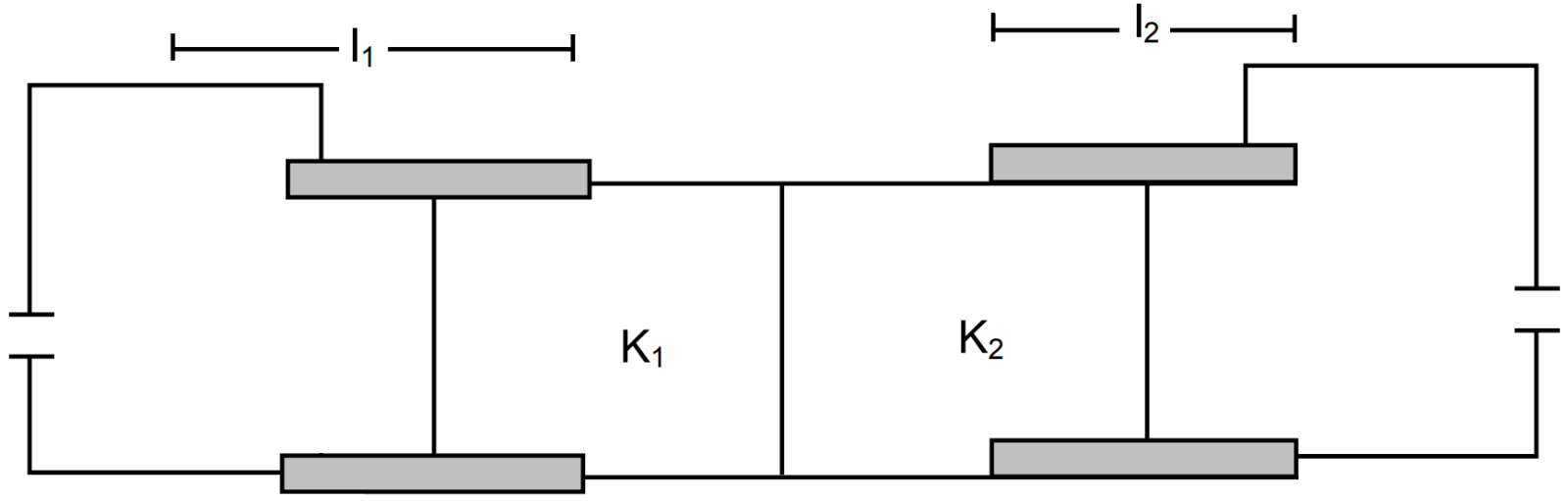
Figure shows two parallel plate capacitors with fixed plates and connected to two batteries. The separation between the plates is the same for the two capacitors. The plates are rectangular in shape with width b and lengths l1 and l2 The left half of the dielectric slab has a dielectric constant K1 and the right half K2. Neglecting any friction, find the ratio of the emf of the left. battery to that of the right battery for which the dielectric slab may remain in equilibrium.

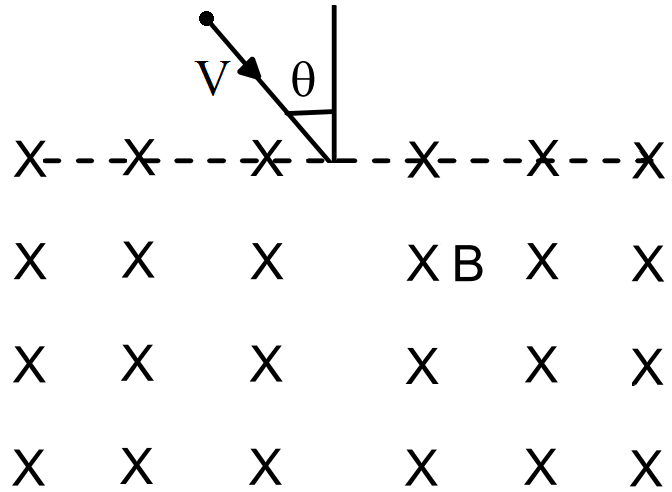
A particle of mass m and positive charge q, moving with a uniform velocity v, enters a magnetic field B, as shown,
  1. Find the radius of the circular arc it describes in the magnetic field.
  2. Find the angle subtended by the arc at the centre.
  3. How long does the particle stay inside the magnetic field?
  4. Solve the three parts of the above problem if the charge q on the particle is negative.

A container of volume 50cc contains air (mean molecular weight = 28.8g) and is open to atmosphere where the pressure is 100kPa. The container is kept in a bath containing melting ice (0°C).
  1. Find the mass of the air in the container when thermal equilibrium is reached.
  2. The container is now placed in another bath containing boiling water (100°C). Find the mass of air in the container.
  3. The container is now closed and placed in the melting-ice bath. Find the pressure of the air when thermal equilibrium is reached.
A radioactive isotope has a half-life of T years. How long will it take the activity to reduce to
  1. 3.125%,
  2. 1% of its original value?
  1. Draw a labelled ray diagram to obtain the real image formed by an astronomical telescope in normal adjustment position. Define its magnifying power.
  2. You are given three lenses of power 0.5 D, 4 D and 10 D to design a telescope:
  1. Which lenses should he used as objective and eyepiece? Justify your answer.
  2. Why is the aperture of the objective preferred to be large?
Find the minimum colatitude which can directly receive a signal from a geostationary satellite.