Question
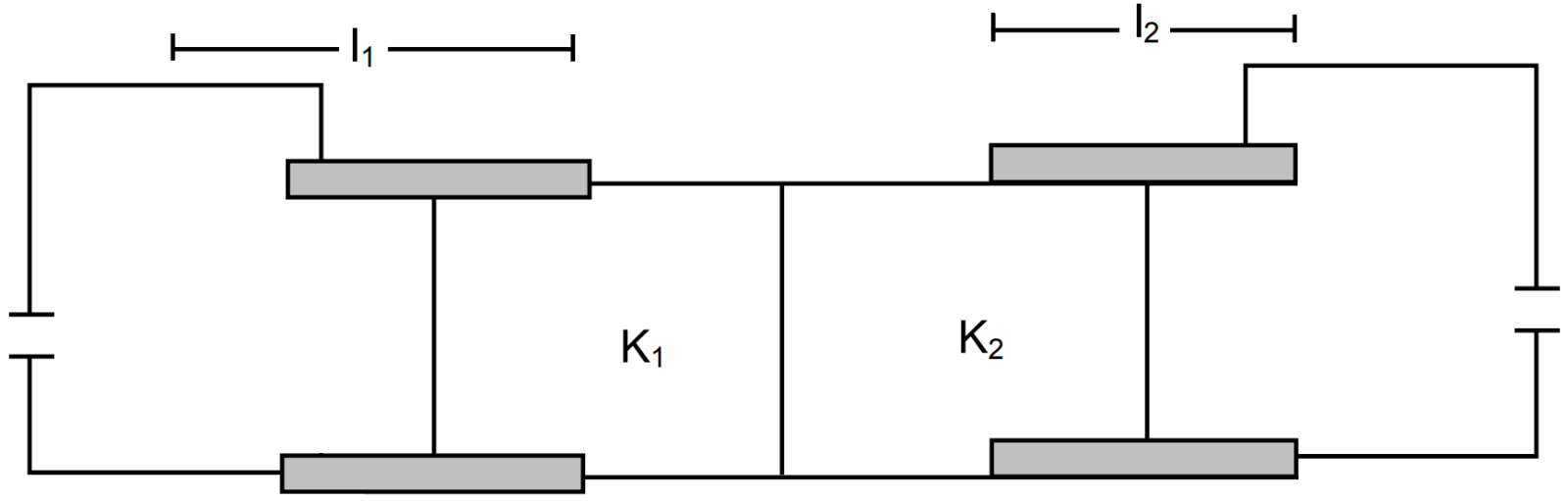
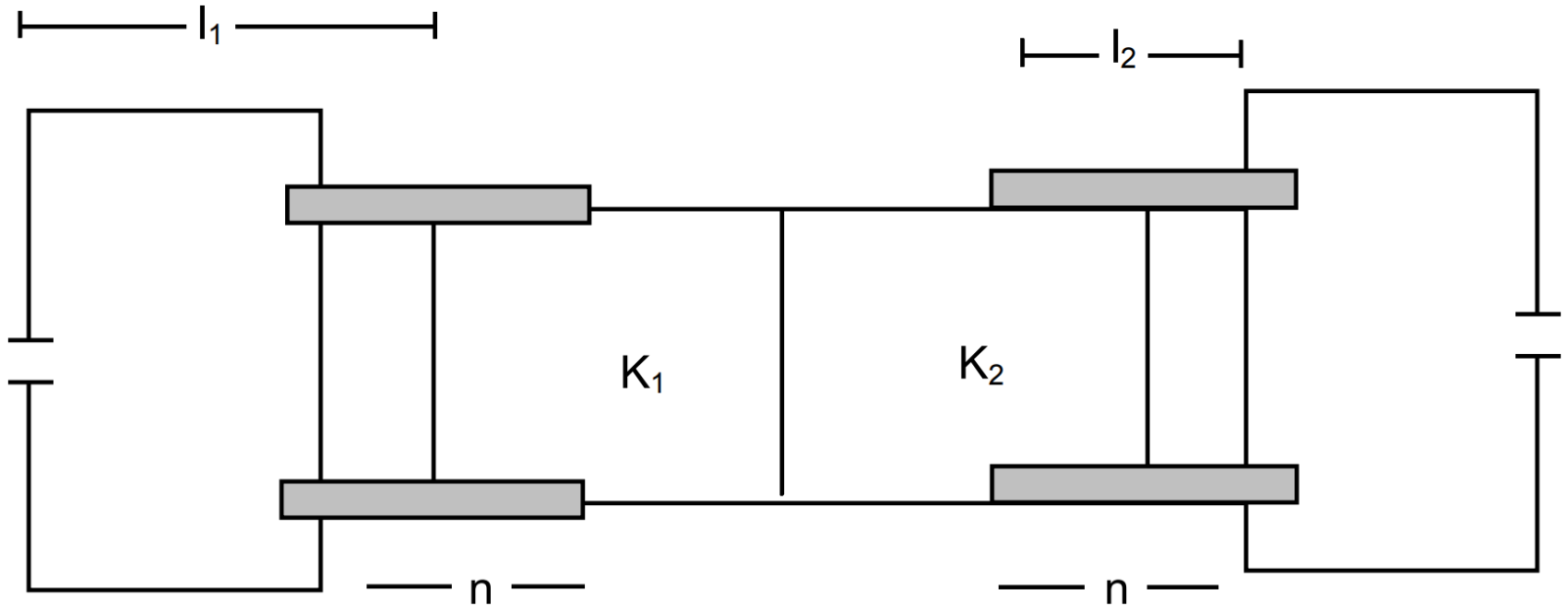
Figure shows two parallel plate capacitors with fixed plates and connected to two batteries. The separation between the plates is the same for the two capacitors. The plates are rectangular in shape with width b and lengths l1 and l2 The left half of the dielectric slab has a dielectric constant K1 and the right half K2. Neglecting any friction, find the ratio of the emf of the left. battery to that of the right battery for which the dielectric slab may remain in equilibrium.
Answer


Consider the left side
The plate area of the part with the dielectric is by its capacitance $\text{C}_1=\frac{\text{K}_1\in_0\text{bx}}{\text{d}}$ and with out dielectric $\text{C}_2=\frac{\in_0\text{b}(\text{L}_1-\text{x})}{\text{d}}$
These are connected in parallel
$\text{C}=\text{C}_1+\text{C}_2$
$=\frac{\in_0\text{b}}{\text{d}}[\text{L}_1+\text{x}(\text{k}_1-1)]$
Let the potential V1
$\text{U}=\Big(\frac{1}{2}\Big)\text{CV}_1^2=\frac{\in_0\text{bv}_1^2}{2\text{d}}[\text{L}_1+\text{x}(\text{k}-1)]\ \dots(1)$
Suppose dielectric slab is attracted by electric field and an external force F consider the part dx which makes inside further, As the potential difference remains constant at V.
The charge supply, dq = (dc)v to the capacitor.
The work done by the battery is dwb = v.dq = (dc)v2
The external force F does a work dwe = (–f.dx) during a small displacement.
The total work done in the capacitor is dwb + dwe = (dc)v2 - fdx
This should be equal to the increase dv in the stored energy.
Thus $\Big(\frac{1}{2}\Big)(\text{dk})\text{v}^2=(\text{dc})\text{v}^2-\text{fdx}$
$\text{f}=\frac{1}{2}\text{v}^2\frac{\text{dc}}{\text{dx}}$
from equation (1)
$\text{F}=\frac{\in_0\text{bv}^2}{2\text{d}}(\text{k}_1-1)$
$\Rightarrow\text{V}_1^2=\frac{\text{F}\times2\text{d}}{\in_0\text{b}(\text{k}_1-1)}$
$\Rightarrow\text{V}_1=\sqrt{\frac{\text{F}\times2\text{d}}{\in_0\text{b}(\text{k}_1-1)}}$
For the right side, $\text{V}_2=\sqrt{\frac{\text{F}\times2\text{d}}{\in_0\text{b}(\text{k}_2-1)}}$
$\frac{\text{V}_1}{\text{V}_2}=\frac{\sqrt{\frac{\text{F}\times2\text{d}}{\in_0\text{b}(\text{k}_1-1)}}}{\sqrt{\frac{\text{F}\times2\text{d}}{\in_0\text{b}(\text{k}_2-1)}}}$
$\frac{\text{V}_1}{\text{V}_2}=\frac{\sqrt{\text{k}_2-1}}{\sqrt{\text{k}_1-1}}$
$\therefore$ The ratio of the emf of the left battery to the right battery $=\frac{\sqrt{\text{k}_2-1}}{\sqrt{\text{k}_1-1}}$

Need a full question paper?

Generate a complete, print-ready paper with questions like this in minutes — across 16+ boards, with answer keys.

Start Generating Free

Similar questions

A 100kg block is started with a speed of 2.0ms-1 on a long, rough belt kept fixed in a horizontal position. The coefficient of kinetic friction between the block and the belt is 0.20.
  1. Calculate the change in the internal energy of the block-belt system as the block comes to a stop on the belt.
  2. Consider the situation from a frame of reference moving at 2.0ms-1 along the initial velocity of the block. As seen from this frame, the block is gently put on a moving belt and in due time the block starts moving with the belt at 2.0ms-1 Calculate the increase in the kinetic energy of the block as it stops slipping past the belt.
  3. Find the work done in this frame by the external force holding the belt.
The magnetic field B and the magnetic intensity H in material are found to be 1.6T and 1000A/m reepectively. Calculate the relative permeability $\mu_\text{r}$ and the susceptibility x of the material.
  1. Derive an expression for drift velocity of electrons in a conductor. Hence, deduce Ohm's law.
  2. A wire whose cross-sectional area is increasing linearly from its one end to the other, is connected across a battery of V volts.

Which of the following quantities remain constant in the wire?

  1. Drift speed.
  2. Current density.
  3. Electric current.
  4. Electric field.
A point object is placed at a distance of 15cm from a convex lens. The image is formed on the other side at a distance of 30cm from the lens. When a concave lens is placed in contact with the convex lens, the image shifts away further by 30cm. Calculate the focal lengths of the two lenses.
a. Derive an expression for the impedance of a series L-C-R circuit connected to an AC supply of variable frequency.
b. Explain briefly how the phenomenon of resonance in the circuit can be used in the tuning mechanism of a radio or a TV set?
The conductivity of an intrinsic samiconductor depends on temperature as $\sigma=\sigma_0\text{ e}^{\frac{-\Delta\text{E}}{2\text{kT}}}$ where $\sigma_0$ is a constant. Find the temperature at which the conductivity pf an intrinsic germanium semiconductor will be double of its value at T = 300K. Assume that the gap for germanium is 0.650eV and remains constant as the temperature is increased.
Derive the lens formula $\frac{1}{\text{f}}=\frac{1}{\text{v}}-\frac{1}{\text{u}}$ for a thin concave lens, using the necessary ray diagram.
i. An alternating voltage $V = V _{ m } \sin \omega t$ applied to a series $L - C - R$ circuit derives a current given by $I = I _{ m } \sin (\omega t+\phi)$. Deduce an expression for the average power dissipated over a cycle.
ii. For circuit used for transporting electric power, a low power factor implies large power loss in transmission. Explain.
An unsymmetrical double convex thin lens forms the image of a point object on its axis. Will the position of the image change if the lens is reversed?
A $5.0\mu\text{F}$ capacitor is charged to 12V. The positive plate of this capacitor is now connected to the negative terminal of a 12V battery and vice versa. Calculate the heat developed in the connecting wires.