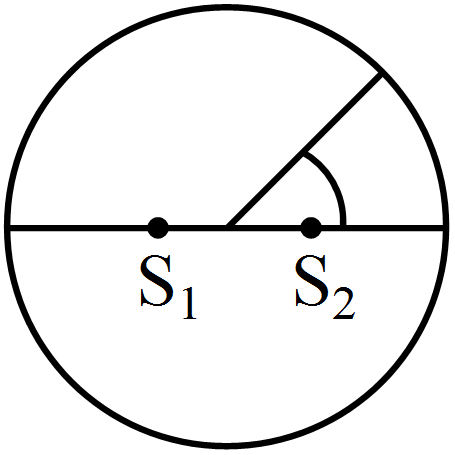
Let the sound waves from the two coherent sources S1 and S2 reach the point P. $\text{OQ}=\text{R}\cos\theta$
$\text{OP}=\text{R}\cos\theta$
$\text{OS}_2=\text{OS}_1=1.5\lambda$
From the figure, we find that: $\text{PS}_1^2=\text{PQ}^2+\text{QS}62=(\text{R}\sin\theta)^2+(\text{R}\cos\theta-1.5\lambda)^2$
$\text{PS}_1^2=\text{PQ}^2+\text{QS}^2_1=(\text{R}\sin\theta)^2+(\text{R}\cos\theta+1.5\lambda)^2$
Path difference between the sound waves reaching point P is given by: $(\text{S}_1\text{P})^2-(\text{S}_2\text{P})^2=\Big[(\text{R}\sin\theta)^2+(\text{R}\cos\theta+1.5)^2\Big]\\-\Big[(\text{R}\sin\theta)^2+(\text{R}\cos\theta-1.5\lambda)^2\Big]$
$=(1.5\lambda+\text{R}\cos\theta)^2-(\text{R}\cos\theta-1.5\lambda)^2$
$=6\lambda\text{R}\cos\theta$
$(\text{S}_1\text{P}-\text{S}_2\text{P})=\frac{6\lambda\text{R}\cos\theta}{2\text{R}}$
Suppose, for construction interference, the path difference be made equal to the integral multiple of $\lambda.$ Hence, $(\text{S}_1\text{P}-\text{S}_2\text{P})=3\lambda\cos\theta=\text{n}\lambda$
$\Rightarrow\cos\theta=\frac{\text{n}}{3}$
$\Rightarrow\theta=\cos^{-1}\Big(\frac{\text{n}}{3}\Big)$
Where, n = 0, 1, 2, ... $\Rightarrow\theta=0^\circ,48.2^\circ,70.5^\circ$ and $90^\circ$ are similar point in other quadrants.