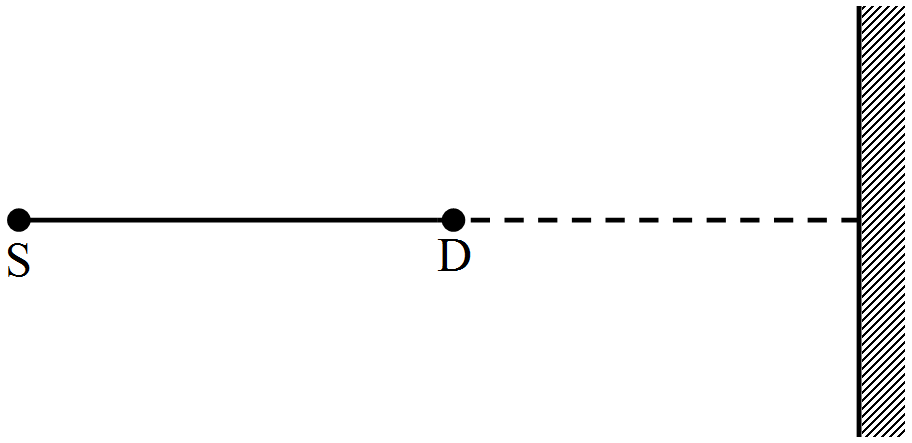
Here $\text{S}=7\text{m}$
So,
$\text{t}=\text{t}_1-\text{t}_2=\Big(\frac{1}{330}-\frac{1}{5200}\Big)$
$=2.75\times10^{-3}\text{sec}=2.75\text{ms}.$
47 questions · timed · auto-graded
Here $\text{S}=7\text{m}$
So,
$\text{t}=\text{t}_1-\text{t}_2=\Big(\frac{1}{330}-\frac{1}{5200}\Big)$
$=2.75\times10^{-3}\text{sec}=2.75\text{ms}.$
$\Rightarrow\text{v}=\text{n}\lambda$
$\Rightarrow\lambda=\Big(\frac{1450}{20\times10^3}\Big)=7.25\text{cm}.$
For maximum wavelength n should be minium$\Rightarrow\text{v}=\text{n}\lambda$
$\Rightarrow \lambda =\frac{\text{v}}{\text{n}}$
$\Rightarrow\frac{1450}{20}=72.5\text{m}.$
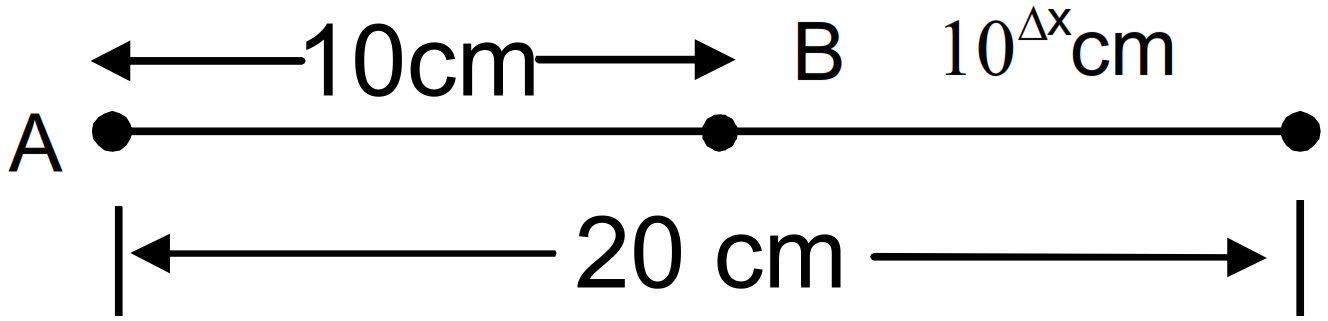
$\Rightarrow\phi=\frac{2\pi}{\lambda}\times\triangle\eta=\frac{2\pi}{5}\times10=4\pi.$
So phase difference is zero.

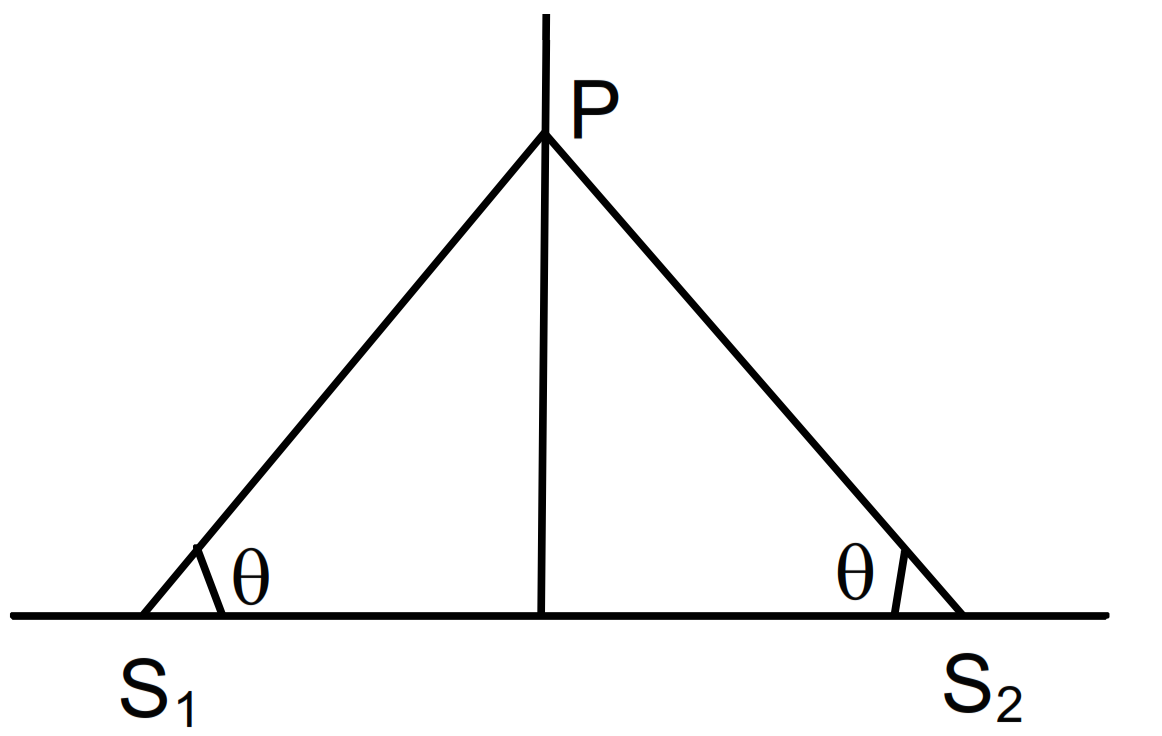
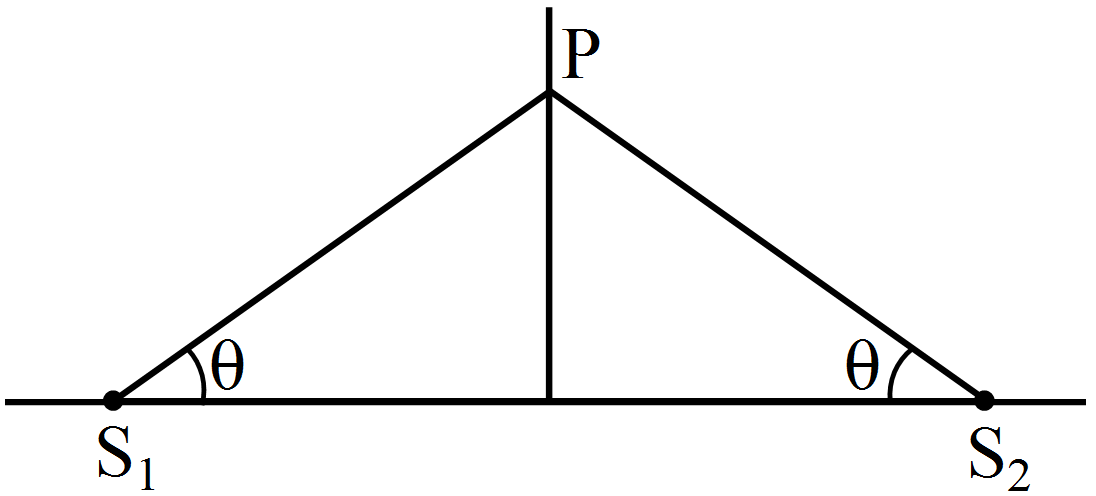
The two sources of sound S1 and S2 vibrate at same phase and frequency. Resultant intensity at P = I0
When $\theta=45^\circ,$ path difference = S1P - S2P = 0 (because S1P = S2P)
So, when source is switched off, intensity of sound at P is $\frac{\text{I}_0}{4}.$
Similarly it can be proved that, the intensity at P is $\frac{\text{I}_0}{4}$ when one is switched off.
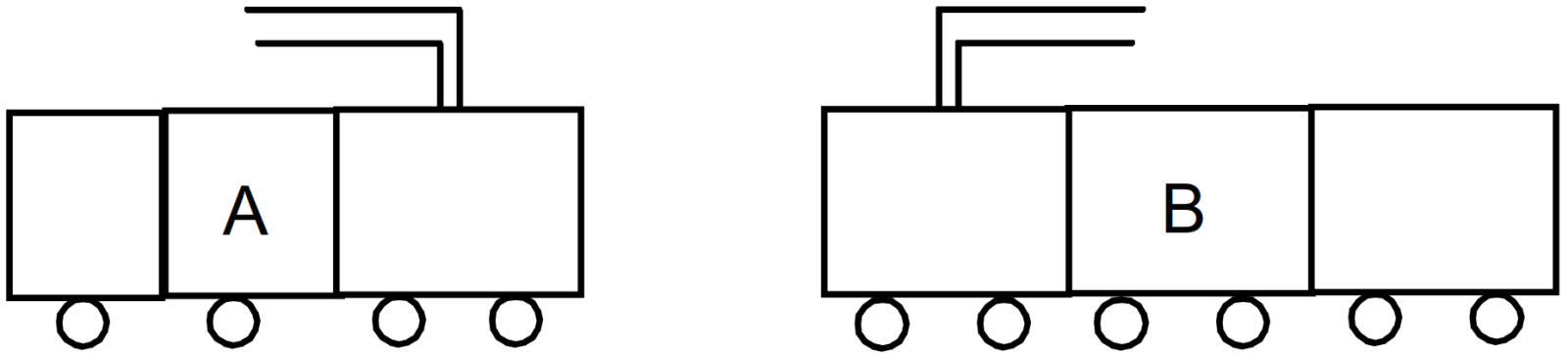
According to the given data Vs = 90km/hour = 25m/sec. v0 = 25 m/sec
So, apparent frequency heard by the observer in train B or
Observer in $=\Big(\frac{350+25}{350-25}\Big)\times500=577\text{Hz}.$
$\Rightarrow\text{n}=\frac{\text{V}}{2\text{l}}=\frac{340}{2\times5\times10^{-2}}=3.4\text{Khz}$
⇒ Then the highest harmonic in the audible range (20Hz - 20KHz)
$=\frac{20000}{3400}=5.8=5$ (integral multiple of 3.4KHz).
According to the given data
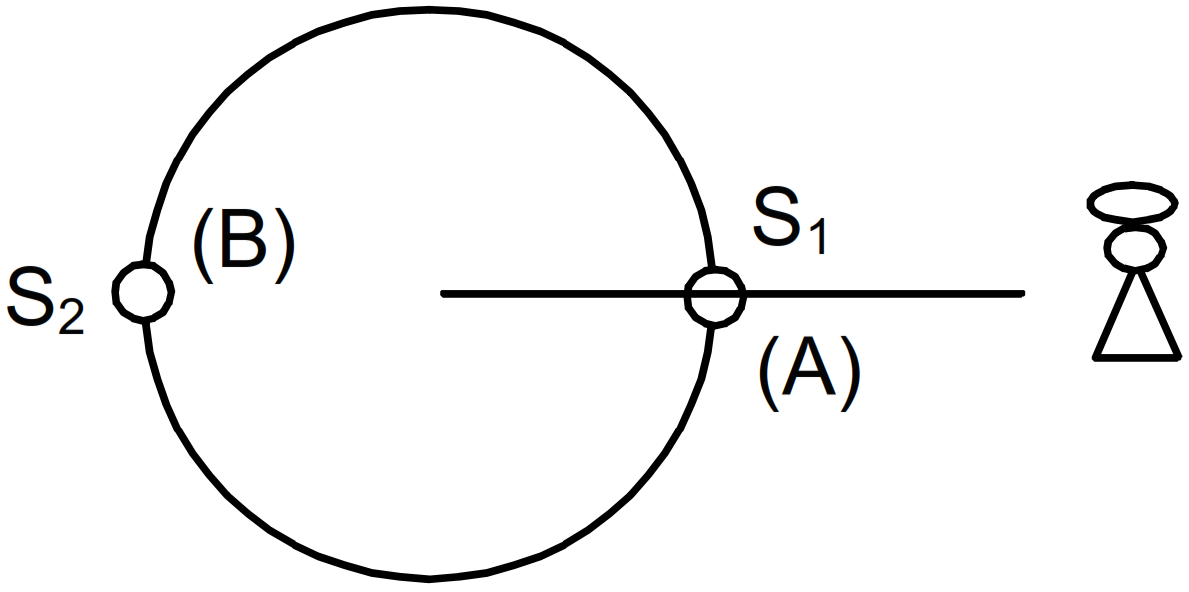
Radius of the circle $\frac{100}{\pi}\times10^{-2}\text{m}=\Big(\frac{1}{\pi}\Big)\ \text{meteres};\ \omega=5\text{rev/sec}.$
So the linear speed $\text{v}=\omega\text{r}=\frac{5}{\pi}=1.59$
So, velocity of the source $\text{V}_\text{s}=1.59\text{m/s}$
As shown in the figure at the position A the observer will listen maximum and at the position B it will listen minimum frequency.
So, apparent frequency at $\text{A}=\frac{332}{332-1.59}\times500=515\text{Hz}$
Apparent frequency at $\text{B}=\frac{332}{332+1.59}\times500=485\text{Hz}.$

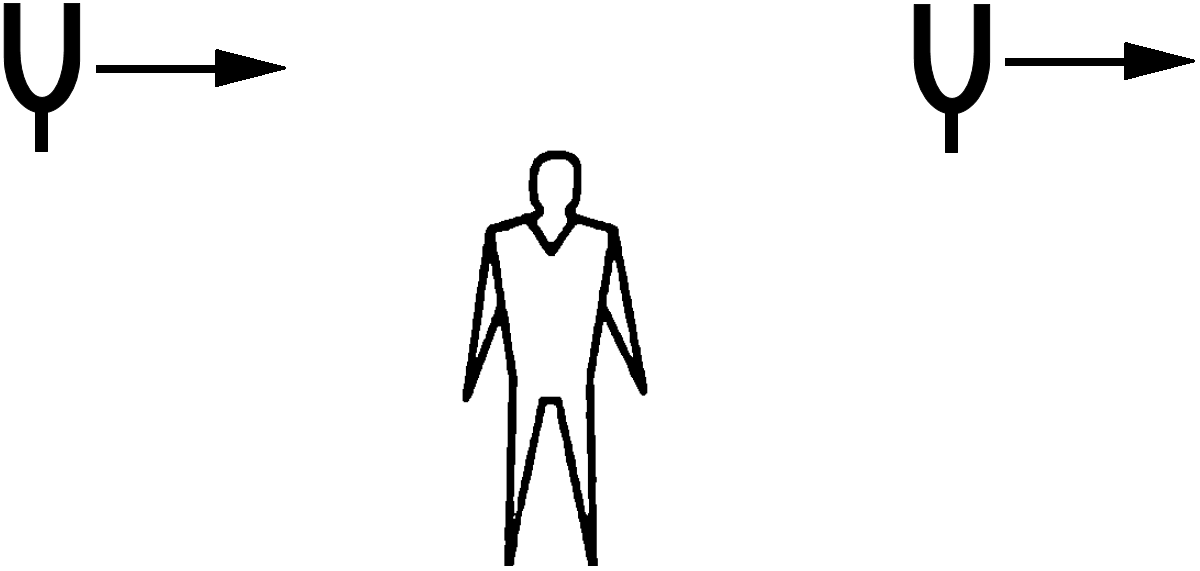
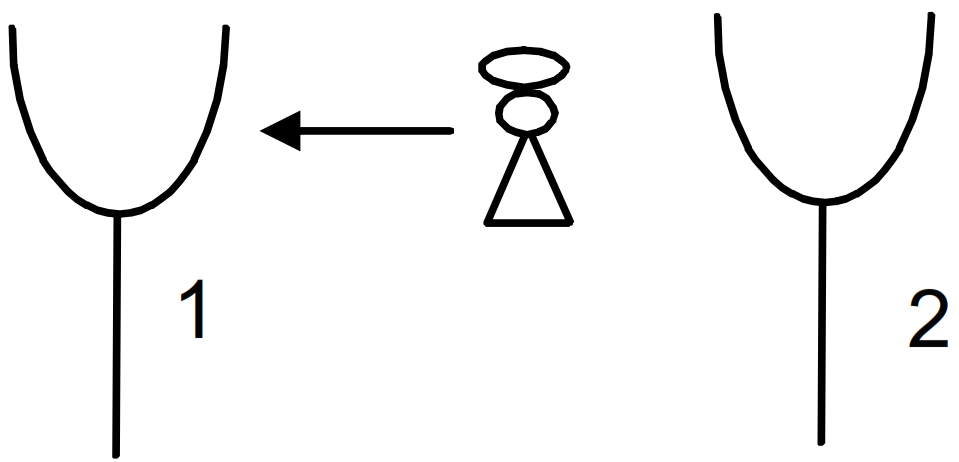
According to the data, Vs = 5.5m/s for each turning fork.
So, the apparent frequency heard from the tuning fork on the left,
$\text{f}'=\Big(\frac{330}{330-5.5}\Big)\times512=527.36\text{Hz}=527.5\text{Hz}$
Similarly, apparent frequency from the tunning fork on the right,
$\text{f}'=\Big(\frac{330}{330-5.5}\Big)\times512=510\text{Hz}$
So, beats produced $527.5-510=17.5\text{Hz}.$

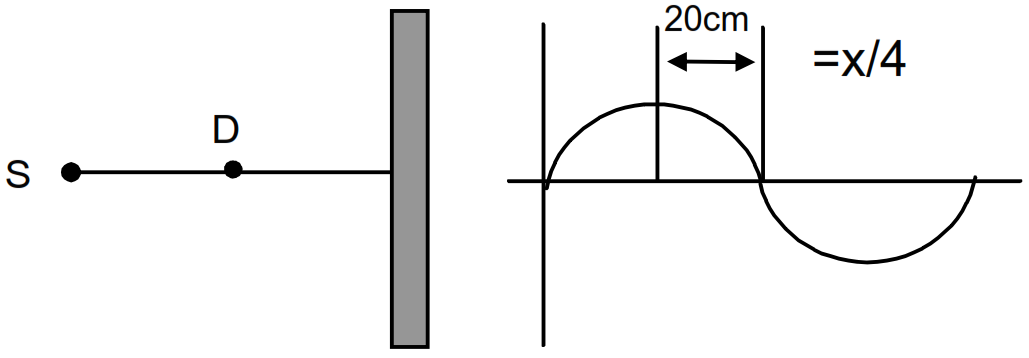
According to the given data
$\text{V}=336\text{m/s},$
$\frac{\lambda}{4}$ distance between maximum and minimum intensity
$=(20\text{cm})\Rightarrow\lambda=80\text{cm}$
⇒ n = frequency = $\frac{\text{V}}{\lambda}=\frac{336}{80\times10^{-2}}$
$=420\text{Hz}.$
$\text{V}_1=\text{v},\ \text{T}_2=?$
We know that $\text{V}\propto\sqrt{\text{T}}$
$\Rightarrow\frac{\text{T}_2}{\text{T}_1}=\frac{\text{V}^2_2}{\text{V}^2_1}$
$\Rightarrow\text{T}_2=273\times2^2=4\times273\text{K}$
So temperature will be $(4\times273)-273=819^\circ\text{c}.$
Distances between two nodes or antinodes
$\Rightarrow\frac{\lambda}{4}=25\text{cm}$
$\Rightarrow\lambda=100\text{cm}=1\text{m}$
$\Rightarrow\text{n}=\frac{\text{v}}{\lambda}=340\text{Hz}.$

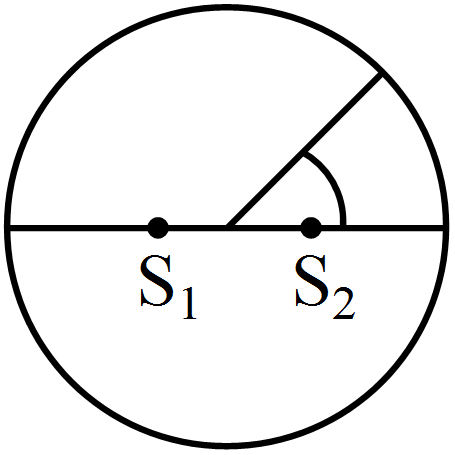
$\text{OQ}=\text{R}\cos\theta$
$\text{OP}=\text{R}\cos\theta$
$\text{OS}_2=\text{OS}_1=1.5\lambda$
From the figure, we find that:$\text{PS}_1^2=\text{PQ}^2+\text{QS}62=(\text{R}\sin\theta)^2+(\text{R}\cos\theta-1.5\lambda)^2$
$\text{PS}_1^2=\text{PQ}^2+\text{QS}^2_1=(\text{R}\sin\theta)^2+(\text{R}\cos\theta+1.5\lambda)^2$
Path difference between the sound waves reaching point P is given by:$(\text{S}_1\text{P})^2-(\text{S}_2\text{P})^2=\Big[(\text{R}\sin\theta)^2+(\text{R}\cos\theta+1.5)^2\Big]\\-\Big[(\text{R}\sin\theta)^2+(\text{R}\cos\theta-1.5\lambda)^2\Big]$
$=(1.5\lambda+\text{R}\cos\theta)^2-(\text{R}\cos\theta-1.5\lambda)^2$
$=6\lambda\text{R}\cos\theta$
$(\text{S}_1\text{P}-\text{S}_2\text{P})=\frac{6\lambda\text{R}\cos\theta}{2\text{R}}$
Suppose, for construction interference, the path difference be made equal to the integral multiple of $\lambda.$ Hence,$(\text{S}_1\text{P}-\text{S}_2\text{P})=3\lambda\cos\theta=\text{n}\lambda$
$\Rightarrow\cos\theta=\frac{\text{n}}{3}$
$\Rightarrow\theta=\cos^{-1}\Big(\frac{\text{n}}{3}\Big)$
Where, n = 0, 1, 2, ...$\Rightarrow\theta=0^\circ,48.2^\circ,70.5^\circ$ and $90^\circ$ are similar point in other quadrants.
$\frac{\triangle\text{v}}{\text{v}}=\frac{1}{2}\frac{\triangle\text{T}}{\text{T}}.$
$\Rightarrow\frac{\text{f}+\triangle\text{f}}{\text{f}}=\sqrt{\frac{\triangle\text{t}+\text{T}}{\text{T}}}$
$\Rightarrow1+\frac{\triangle\text{f}}{\text{f}}=\Big(1+\frac{\triangle\text{T}}{\text{T}}\Big)^{\frac{1}{2}}=1+\frac{1}{2}\frac{\triangle\text{T}}{\text{T}}+\ \dots$ (neglecting other terms)
$\Rightarrow\frac{\triangle\text{f}}{\text{f}}=\Big(\frac{1}{2}\Big)\frac{\triangle\text{T}}{\text{T}}$
$\text{f}\propto\sqrt{\text{T}}$
So, $\frac{\text{f}_1}{\text{f}_2}=\frac{\sqrt{\text{T}_1}}{\sqrt{\text{T}}}$$\Rightarrow\frac{293}{\text{f}_2}=\frac{\sqrt{293}}{\sqrt{295}}$
$\Rightarrow\text{f}_2=\frac{293\times\sqrt{295}}{\sqrt{293}}=294$


$\text{T}_1=273+17=290\text{K},\ \text{T}_2=272+32=305\text{K}$
We know $\text{v}\propto\sqrt{\text{T}}$
$\frac{\sqrt{\text{V}_1}}{\sqrt{\text{V}_2}}=\frac{\sqrt{\text{T}_1}}{\sqrt{\text{T}}_2}$
$\Rightarrow\text{v}_2=\frac{\text{V}_1\times\sqrt{\text{T}_2}}{\sqrt{\text{T}_1}}$
$=340\times\sqrt{\frac{305}{290}}=349\text{m/s}$
$\Rightarrow\text{x}^2=\Big(\frac{2}{2\pi}\Big)$
$\Rightarrow\text{x}=0.4\text{m}$
$=40\text{cm}.$
$\Rightarrow\lambda=10\text{cm}=10^{-1}\text{m}$
We know, V = nx$\Rightarrow\text{n}=\frac{\text{V}}{\lambda}=\frac{340}{10^{-1}}$
$=3400\text{Hz}$
$=3.4\text{KHz}$
$\text{n}_2=\text{n}_1\pm\text{m}$
$\Rightarrow\text{n}_2=256\pm4$
$\Rightarrow\text{n}_2=260\text{Hz or 252 Hz}$
Now, as it is loaded with wax, its frequency will decrease. As it produced 6 beats per second, the original frequency, the beats second should decreas, wich is not possible.$\text{f}_1=\Big(\frac{\text{v}}{2\text{L}}\Big)$
$=\frac{340}{2\times 50\times 10^{-2}}=340\text{Hertz}$
So, the required hamonics will be in the range of 1000Hz to 2000Hz.$\text{f}_2=2\times340=380\text{Hz}$
$\text{f}_3=3\times340=1020\text{Hz}$
$\text{f}_4=4\times 340=1360\text{Hz}$
$\text{f}_5=5\times 340=1700\text{Hz}$
$\text{f}_6=6\times 340=2040\text{Hz}$
f2, f3, f4... are the second, third , fourth overtone, and so on. The possible frequecies between 1000Hz and 2000Hz are 1020Hz and 1700Hz.$\Rightarrow\lambda=2\times4.0=8\text{cm}$
We know that $\text{V}=\text{n}\lambda$$\therefore \text{f}=\frac{\text{v}}{\lambda}=\frac{328}{8\times 10^{-2}}=4.1\text{KHz}$
$\eta=\frac{328}{8\times10^{-2}}=4.1\text{Hz}.$
$\text{v}=340\text{m/s}$
So, $\text{n}=\frac{\text{v}}{\lambda}=\frac{340}{2}=170\text{Hz}.$
$=17\text{KH}_2$ $\big($because $\lambda=2\text{cm}=2\times10^{-2}\text{m}\big)$
$=72\times \frac{5}{18}=20\text{m}/\text{s}$
The person will receive the sound in a direction that makes an angle θ with the track. The angle θ is given by,$\theta =\tan^{-1}\bigg(\frac{0.5}{\frac{2.4}{2}}\bigg)=22.62^\circ$
The velocity of the source will be $'\text{v}\cos \theta'$ when heard by the observer.$\text{f}_1=\Big(\frac{\text{v}}{\text{v}-\text{v}_\text{s}\cos\theta}\Big)\times \text{f}_0$
$\Rightarrow \text{f}_1=\Big(\frac{340}{340-\text{v}_\text{s}\cos22.62^\circ}\Big)\times500$
$\Rightarrow \text{f}_1=\Big(\frac={340}{340-20\times \cos 22.62^\circ}\Big)\times 500$
$\Rightarrow \text{f}_1=528.70\text{Hz}\approx529\text{Hz}$
The apparent frequency heard by the man from train B is:$\text{f}_2=\Big(\frac{\text{v}}{\text{v}+\text{v}\cos\theta}\Big)\times \text{f}_0$
$\Rightarrow \text{f}_2=\Big(\frac{340}{340+20\times \cos22.62^\circ}\Big)\times 500$
$\Rightarrow \text{f}_2=474.24\text{Hz}\approx 474\text{hz}$
$\text{L}_\text{r}=\frac{1.0}{2}=0.5\text{m},\ \text{d}_\text{a}=6.5\text{cm}\times10^{-2}\text{m}$
As Kundt’s tube apparatus is a closed organ pipe, its fundamental frequency$\text{n}=\frac{\text{V}_\text{r}}{4\text{L}_\text{r}}$
$\Rightarrow\text{V}_\text{r}=2600\times4\times0.5=5200\text{m/s}$
$\frac{\text{V}_\text{r}}{\text{V}_\text{a}}=\frac{2\text{L}_\text{r}}{\text{d}_\text{a}}$
$\Rightarrow\text{V}_\text{a}=\frac{5200\times6.5\times10^{-2}}{2\times0.5}=338\text{m/s}$
$\text{f}=\frac{(\text{f}_1+\text{f}_2)}{2}$
$\text{f}=\frac{(476+480)}{2}=478\text{Hz}$
$\therefore\ $length of the pipe P2 will be 20cm.
$\Rightarrow\lambda_\text{air}=\Big(\frac{340}{4.5}\Big)\times10^{-6}=7.36\times10^{-5}\text{m}$
$\text{V}_\text{tissue}=1500\text{m/s}$
$\Rightarrow\lambda_\text{t}=\Big(\frac{1500}{4.5}\Big)\times10^{-6}$
$=3.3\times10^{-4}\text{m}.$
$\mu=\frac{\text{Mass}}{\text{Unit length}}=33\times10^{-3}\text{kg}$
The fundamental frequency $\Rightarrow\text{n}_0=\frac{1}{2\text{l}}\sqrt{\frac{\text{T}}{\mu}}\ \dots(1)$ The fundamental frequency of closed pipe$\Rightarrow\text{n}_0=\Big(\frac{\text{v}}{4\text{l}}\Big)=\frac{340}{4\times50\times10^{-2}}=170\text{Hz}\ \dots(2)$
According equations (1) × (2) we get$170=\frac{1}{2\times30\times10^{-2}}\times\sqrt{\frac{\text{T}}{33\times10^{-3}}}$
$\Rightarrow\text{T}=347\ \text{Newton}$
Hence, then tansion in the wire is 347 N.$\Rightarrow\lambda=2(62-20)=84\text{cm}=0.84\text{m}$
So, $\text{v}=\text{n}\lambda=0.84\times400=336\text{m/s}$
$\Rightarrow\text{d}=\frac{\lambda}{4}-\text{I}_1=21-20=1\text{cm}.$
$\Rightarrow \text{B}=\frac{\text{P}_0\lambda}{2\pi\text{S}_0}=\frac{\triangle \text{p}}{\frac{\triangle\text{V}}{\text{V}}}$
$\Rightarrow\text{B}=\frac{14\times35\times10^2\text{m}}{2\pi(5.5)\times10^{-6}\text{m}}$
$=1.4\times10^5\text{N/m}^2.$
$=\frac{3}{20}\text{second}$
$=333\text{m/s}$
$\Rightarrow\text{n}_0=\frac{\text{v}}{4\text{l}}=\frac{320}{4\times50\times10^{-2}}=100\text{Hz}$
So the frequency of the other harmonics are odd multiple of n0 = (2n + 1)100Hz. According to the question, the harmonic should be between 20Hz and 2KHz.$\text{f}=\frac{\text{v}}{4\text{L}}$
$\therefore \text{L}=\frac{\text{v}}{4\text{f}}$
$\therefore \text{L}=\frac{340}{4\times 500}=0.17\text{m}$
$=17\text{cm}$
$\Rightarrow256=\frac{1}{2\times\text{l}_1}\sqrt{\frac{\text{T}}{\text{M}}}\ \dots(2)$
Dividing (1) by (2) we get$\frac{252}{256}=\frac{\text{l}_1}{25\times10^{-2}}$
$\Rightarrow\frac{252\times25\times10^{-2}}{256}$
$\Rightarrow 0.24609\text{m}$
So, it should be shorten by (25 - 24.61) = 0.39cm.$\therefore\lambda=\frac{360}{(20\times10^3)}=18\times10^{-3}\text{m}=18\text{mm}$
$\Rightarrow\text{x}=\Big(\frac{\text{v}}{\text{n}}\Big)=\frac{360}{20}=18\text{m}.$
$\Rightarrow\frac{(\text{n}+2)\text{v}}{4\text{l}}-\frac{\text{nv}}{4\text{I}}=2592-1944=648$
$\Rightarrow\frac{2\text{v}}{\text{I}}=648$
$\Rightarrow\text{l}=\frac{2\times324\times100}{4\times648}\text{cm}=25\text{cm}$
Hence, the length of the tube is 25cm.$\therefore\text{I}_1=10^{-7}\text{W/m},\ \text{I}_2=10^{-6}\text{W/m}^2$
$\Big($because $\beta=10\log_{10}\big(\frac{\text{I}}{\text{I}_0}\big),$ where $\text{I}_0=10^{-12}\text{W/m}^2\Big)$
Again, $\frac{\text{I}_2}{\text{l}_1}=\Big(\frac{\text{P}_2}{\text{P}_1}\Big)^2$
$=\Big(\frac{10^{-6}}{10^{-7}}\Big)$
$=10$ (where p = pressure amplitude)
$\therefore\Big(\frac{\text{P}_2}{\text{P}_1}\Big)=\sqrt{10}.$