Question
When an electron in hydrogen atom jumps from the third excited state to the ground state, how would the de Broglie wavelength associated with the electron change? Justify your answer.

Answer

$\lambda = \frac{\text{h}}{\text{P}} = \frac{\text{h}}{\sqrt{2\text{mK}}}$
$\frac{\lambda_{1}}{\lambda_{4}} = \sqrt{\frac{\text{K}_{4}}{\text{K}_{1}}}$
But $\text{K}_{n}( = - \text{E}_{n})\propto\frac{1}{\text{n}^{2}}$
Hence , $\frac{\lambda_{1}}{\lambda_{4}} = \sqrt{\frac{1}{16}}$
$\therefore \frac{\lambda_{1}}{\lambda_{4}} = \frac{1}{4}$
$\lambda_{4} = 4 \lambda_{1}$
i.e. $\lambda_{4} > \lambda_{1}$
Alternate Answer
$\lambda_{n} = \frac{\text{h}}{\text{P}_{n}} = \frac{\lambda}{\text{mv}_{n}}$
Velocity of electron in $n^{th}$ state $\upsilon_{n}\propto\frac{1}{n}$
$\lambda_{n}\propto\frac{1}{\upsilon_{n}}\therefore\lambda\propto\text{n}$
$\therefore \frac{\lambda_{4}}{\lambda_{1}} = \frac{\text{n}_{4}}{\text{n}_{1}} = \frac{4}{1}$

Need a full question paper?

Generate a complete, print-ready paper with questions like this in minutes — across 16+ boards, with answer keys.
Start Generating Free

Similar questions

How much positive and negative charge is there in a cup of water?
The coil of a moving-coil galvanometer keeps on oscillating for a long time if it is deflected and released. If the ends of the coil are connected together, the oscillation stops at once. Explain
A circular coil of N turns and radius R carries a current I. It is unwound and rewound to make another coil of radius R/2, current I remaining the same. Calculate the ratio of the magnetic moments of the new coil and the original coil.
From the formula of potential energy of a system of two charges, obtain the equation of $P.E$. of electric dipole in external electric field.
According to the classical electromagnetic theory, calculate the initial frequency of the light emitted by the electron revolving around a proton in hydrogen atom.
Explain the structure of Polaroid.
If we cover the lower half of the reflecting surface of a concave mirror with some opaque (nonreflective) material, then what effect will this have on the image formed by the mirror of an object situated in front of the mirror?
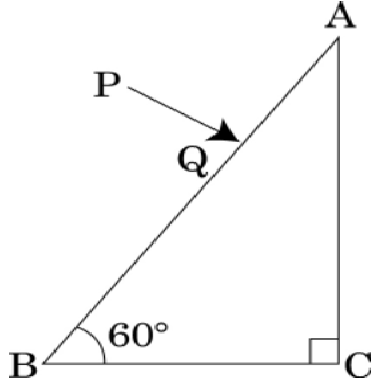
A ray PQ incident normally on the refracting face BA is refracting in the prism BAC made of material of refractive index 1.5. Complete the path of ray through the prism. From which face will the ray emerge? Justify your answer.
Mention important results regarding electrostatics of conductors.
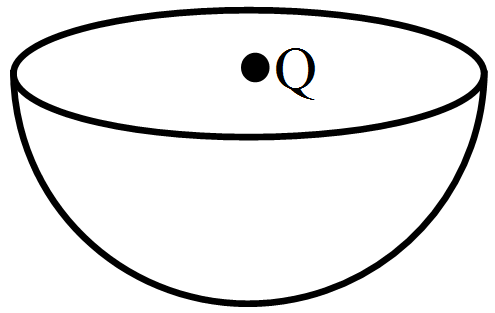
A charge Q is placed at the centre of an imaginary hemispherical surface. Using symmetry arguments and the Gauss's law, find the flux of the electric field due to this charge through the surface of the hemisphere (figure).