Question
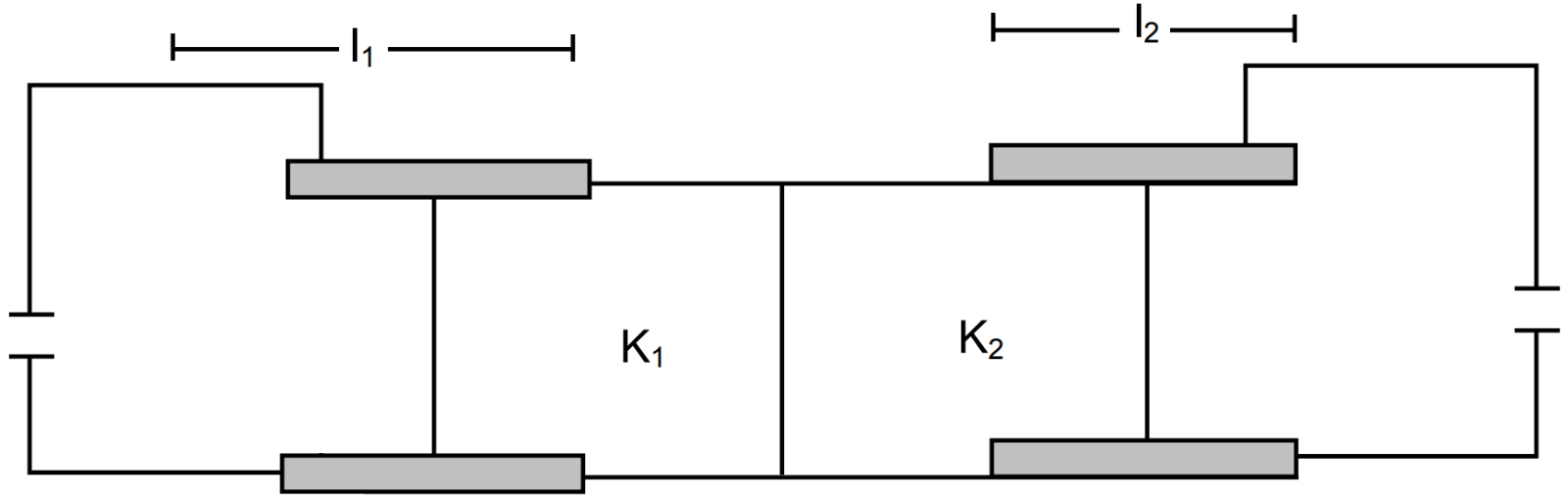
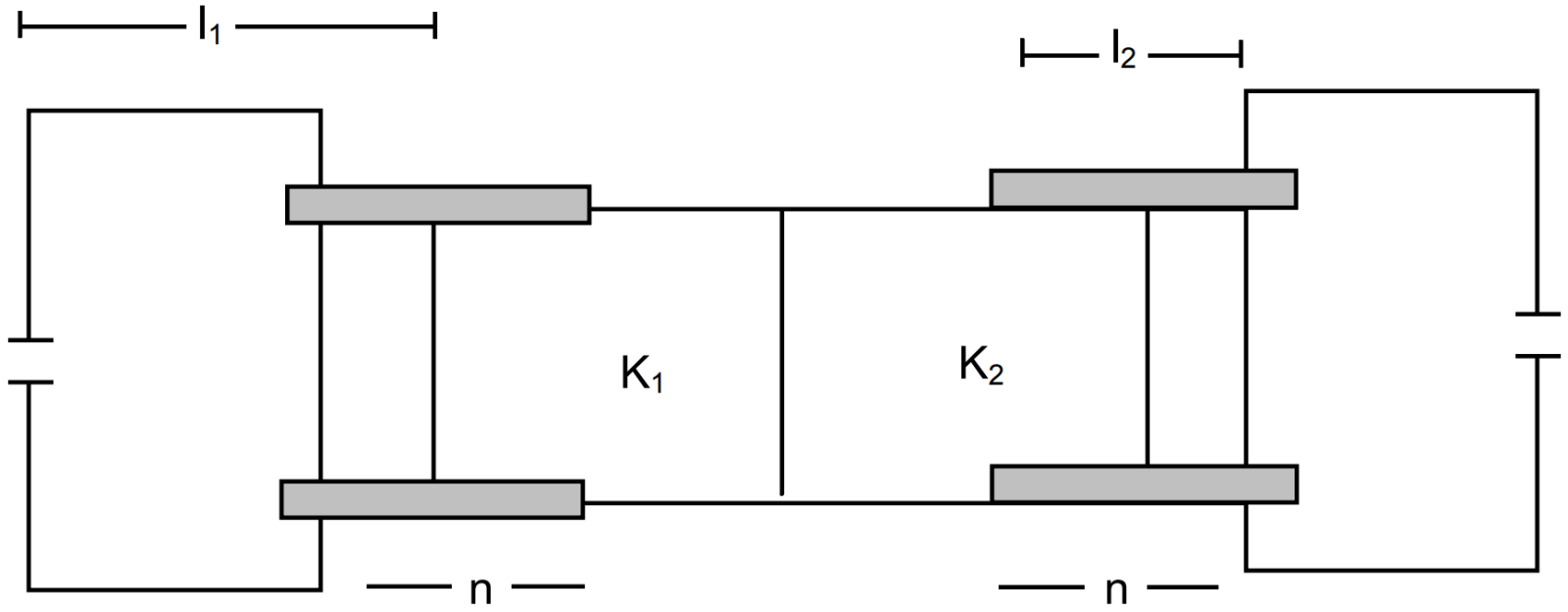
Figure shows two parallel plate capacitors with fixed plates and connected to two batteries. The separation between the plates is the same for the two capacitors. The plates are rectangular in shape with width b and lengths $l_1$ and $l_2$ The left half of the dielectric slab has a dielectric constant $K_1$ and the right half $K_2$. Neglecting any friction, find the ratio of the emf of the left. battery to that of the right battery for which the dielectric slab may remain in equilibrium.
Answer


Consider the left side
The plate area of the part with the dielectric is by its capacitance $\text{C}_1=\frac{\text{K}_1\epsilon_0\text{bx}}{\text{d}}$ and with out dielectric $\text{C}_2=\frac{\epsilon_0\text{b}(\text{L}_1-\text{x})}{\text{d}}$
These are connected in parallel
$\text{C}=\text{C}_1+\text{C}_2$
$=\frac{\epsilon_0\text{b}}{\text{d}}[\text{L}_1+\text{x}(\text{k}_1-1)]$
Let the potential $V_1$
$\text{U}=\Big(\frac{1}{2}\Big)\text{CV}_1^2=\frac{\epsilon_0\text{bv}_1^2}{2\text{d}}[\text{L}_1+\text{x}(\text{k}-1)]\ \dots(1)$
Suppose dielectric slab is attracted by electric field and an external force $F$ consider the part $dx$ which makes inside further, As the potential difference remains constant at $V$.
The charge supply $, dq = (dc)v$ to the capacitor.
The work done by the battery is $dw_b = v.dq = (dc)v^2$
The external force $F$ does a work $\text{dwe} = (–f.dx)$ during a small displacement.
The total work done in the capacitor is $dw_b + dw_e = (dc)v^2 - fdx$
This should be equal to the increase $dv$ in the stored energy.
Thus $\Big(\frac{1}{2}\Big)(\text{dk})\text{v}^2=(\text{dc})\text{v}^2-\text{fdx}$
$\text{f}=\frac{1}{2}\text{v}^2\frac{\text{dc}}{\text{dx}}$
from equation $(1)$
$\text{F}=\frac{\epsilon_0\text{bv}^2}{2\text{d}}(\text{k}_1-1)$
$\Rightarrow\text{V}_1^2=\frac{\text{F}\times2\text{d}}{\epsilon_0\text{b}(\text{k}_1-1)}$
$\Rightarrow\text{V}_1=\sqrt{\frac{\text{F}\times2\text{d}}{\epsilon_0\text{b}(\text{k}_1-1)}}$
For the right side, $\text{V}_2=\sqrt{\frac{\text{F}\times2\text{d}}{\epsilon_0\text{b}(\text{k}_2-1)}}$
$\frac{\text{V}_1}{\text{V}_2}=\frac{\sqrt{\frac{\text{F}\times2\text{d}}{\epsilon_0\text{b}(\text{k}_1-1)}}}{\sqrt{\frac{\text{F}\times2\text{d}}{\epsilon_0\text{b}(\text{k}_2-1)}}}$
$\frac{\text{V}_1}{\text{V}_2}=\frac{\sqrt{\text{k}_2-1}}{\sqrt{\text{k}_1-1}}$
$\therefore$ The ratio of the emf of the left battery to the right battery $=\frac{\sqrt{\text{k}_2-1}}{\sqrt{\text{k}_1-1}}$

Need a full question paper?

Generate a complete, print-ready paper with questions like this in minutes — across 16+ boards, with answer keys.

Start Generating Free

Similar questions

The monkey $B$ shown in figure is holding on to the tail of the monkey A which is climbing up a rope. The masses of the monkeys $A$ and $B$ are $5\ kg$ and $2\ kg$ respectively. If $A$ can tolerate a tension of $30N$ in its tail, what force should it apply on the rope in order to carry the monkey $B$ with it? Take $ g = 10m/s^2$​​​​​​​
Explain graphically the flow of current in semiconductors in the presence of an external electric field.
A mercury lamp is a convenient source for studying frequency dependence of photoelectric emission,
Since it gives a number of spectral lines ranging from the $UV$ to the red end of the visible spectrum. In our experiment with rubidium photo $-$ cell, the following lines from a mercury source were used:
$\lambda_1=3650\ \mathring{\text{A}},\ \lambda_2=4047\ \mathring{\text{A}},\ \lambda_3=4358\ \mathring{\text{A}},\ \lambda_4=5461\ \mathring{\text{A}},\ \lambda_5=6907\ \mathring{\text{A}},$
The stopping voltages, respectively, were measured to be:
$V_{01} = 1.28 V, V_{02} = 0.95 V, V_{03} = 0.74 V, V_{04} = 0.16 V, V_{05} = 0 V$
Determine the value of Planck’s constant h, the threshold frequency and work function for the material.
[Note: You will notice that to get h from the data, you will need to know $e \ ($which you can take to be $1.6 \times 10^{–19} C)$. Experiments of this kind on $\text{Na, Li, K,}$ etc. were performed by Millikan, who, using his own value of e $($from the oil $-$ drop experiment) confirmed Einstein’s photoelectric equation and at the same time gave an independent estimate of the value of $h.]$
The equation of motion of a particle started at t = 0 is given by $\text{x}=5\sin\big(20\text{t}+\frac{\pi}{3}\big)$ where x is in centimetre and t in second. When does the particle.
  1. First come to rest.
  2. First have zero acceleration.
  3. First have maximum speed?
The property of diamagnetism is said to be present in all materials. Then, why are some materials paramagnetic or ferromagnetic?
A spherical capacitor has an inner sphere of radius $12\ cm$ and an outer sphere of radius $13\ cm$. The outer sphere is earthed and the inner sphere is given a charge of $2.5 \mu C$. The space between the concentric spheres is filled with a liquid of dielectric constant $32$.
  1. Determine the capacitance of the capacitor.
  2. What is the potential of the inner sphere?
  3. Compare the capacitance of this capacitor with that of an isolated sphere of radius $12\ cm$. Explain why the latter is much smaller.
Define capacitor. Obtain the relation of equivalence in series combination of capacitors by making a circuit diagram. Write the value of voltage $V_1$ in the given circuit.
Image
Establish the formula for the capacitance of a parallel plate capacitor in the presence of dielectric material completely and partially.
A thin prism of angle $6.0^\circ,\omega=0.07$ and $\mu_\text{y}=1.50$ is combined with another thin prism having $\omega=0.08$ and $\mu_\text{y}=1.60.$ The combination produces no deviation in the mean ray.
  1. Find the angle of the second prism.
  2. Find the net angular dispersion produced by the combination when a beam of white light passes through it.
  3. If the prisms are similarly directed, what will be the deviation in the mean ray
  4. Find the angular dispersion in the situation described in (c).
In en experiment on photoelectric effect, light of wavelength $400$ run is incident on a cesium plate at the rate of $5.0W.$ The potential of the collector plate is made sufficiently positive with respect to the emitter so that the current reaches its saturation value. Assuming that on the average one out of every $10^\circ$ photons is able to eject a photoelectron, find the photocurrent in the circuit.