Question
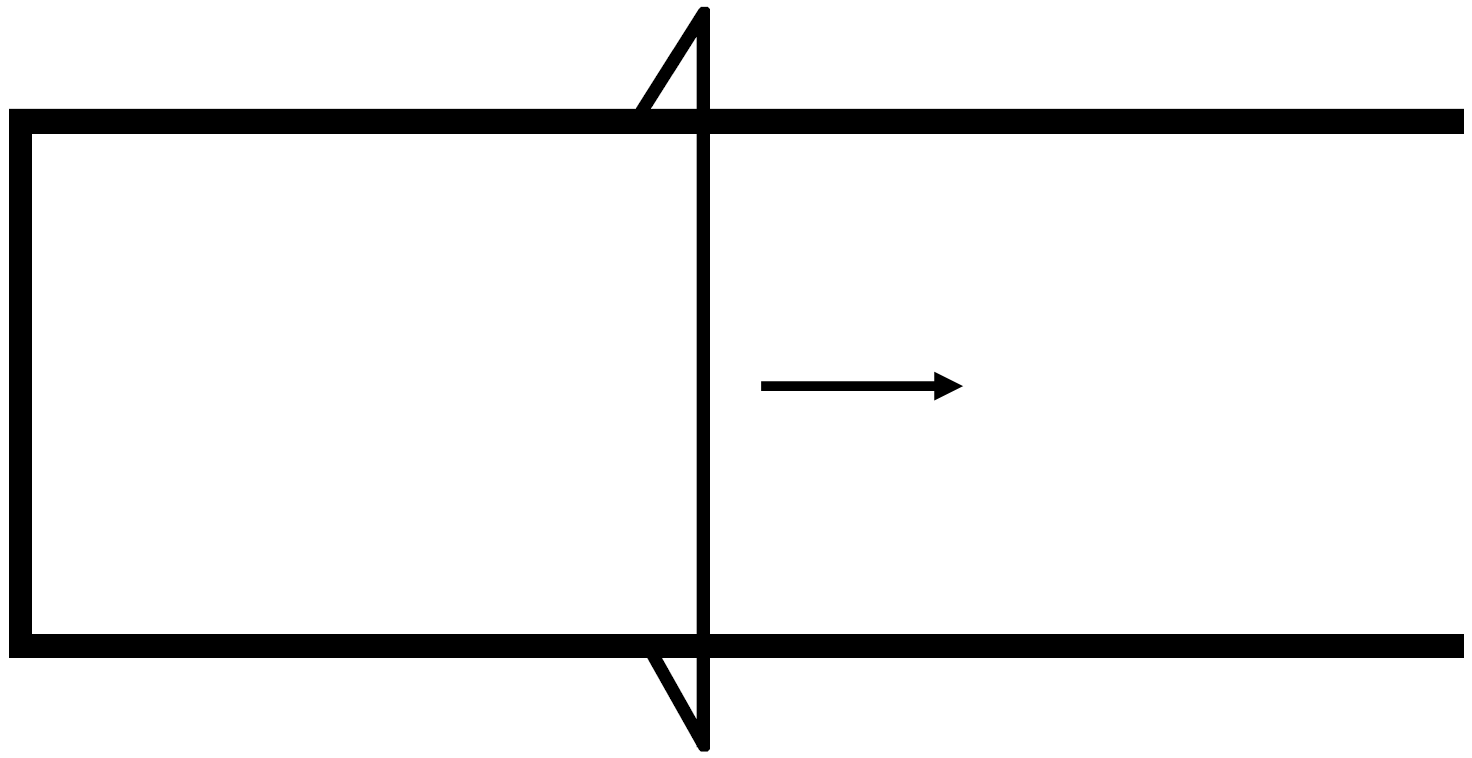
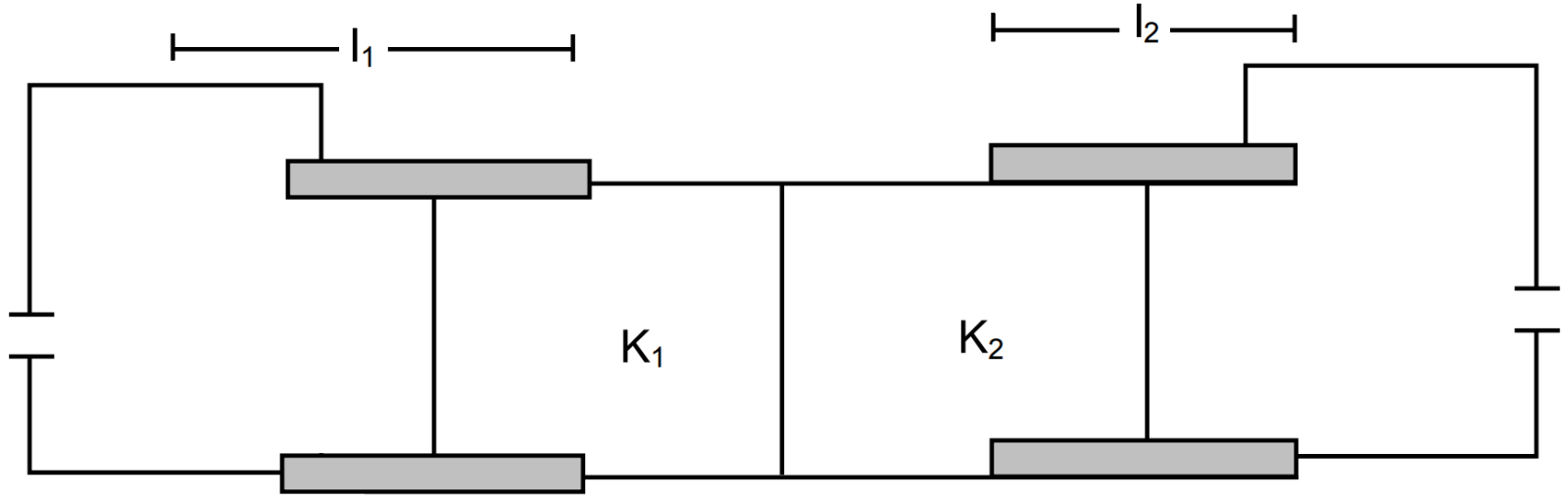
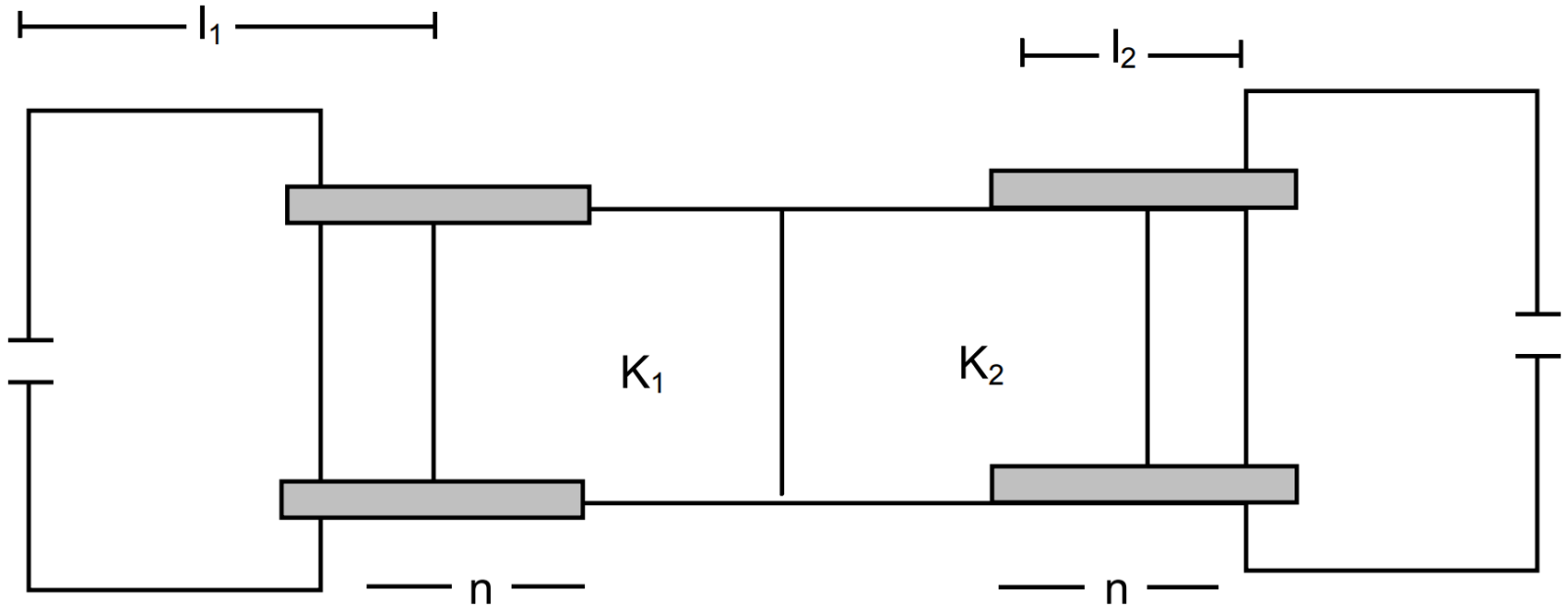
Figure shows two parallel plate capacitors with fixed plates and connected to two batteries. The separation between the plates is the same for the two capacitors. The plates are rectangular in shape with width b and lengths l1 and l2 The left half of the dielectric slab has a dielectric constant K1 and the right half K2. Neglecting any friction, find the ratio of the emf of the left. battery to that of the right battery for which the dielectric slab may remain in equilibrium.
Answer


Consider the left side
The plate area of the part with the dielectric is by its capacitance $\text{C}_1=\frac{\text{K}_1\in_0\text{bx}}{\text{d}}$ and with out dielectric $\text{C}_2=\frac{\in_0\text{b}(\text{L}_1-\text{x})}{\text{d}}$
These are connected in parallel
$\text{C}=\text{C}_1+\text{C}_2$
$=\frac{\in_0\text{b}}{\text{d}}[\text{L}_1+\text{x}(\text{k}_1-1)]$
Let the potential V1
$\text{U}=\Big(\frac{1}{2}\Big)\text{CV}_1^2=\frac{\in_0\text{bv}_1^2}{2\text{d}}[\text{L}_1+\text{x}(\text{k}-1)]\ \dots(1)$
Suppose dielectric slab is attracted by electric field and an external force F consider the part dx which makes inside further, As the potential difference remains constant at V.
The charge supply, dq = (dc)v to the capacitor.
The work done by the battery is dwb = v.dq = (dc)v2
The external force F does a work dwe = (–f.dx) during a small displacement.
The total work done in the capacitor is dwb + dwe = (dc)v2 - fdx
This should be equal to the increase dv in the stored energy.
Thus $\Big(\frac{1}{2}\Big)(\text{dk})\text{v}^2=(\text{dc})\text{v}^2-\text{fdx}$
$\text{f}=\frac{1}{2}\text{v}^2\frac{\text{dc}}{\text{dx}}$
from equation (1)
$\text{F}=\frac{\in_0\text{bv}^2}{2\text{d}}(\text{k}_1-1)$
$\Rightarrow\text{V}_1^2=\frac{\text{F}\times2\text{d}}{\in_0\text{b}(\text{k}_1-1)}$
$\Rightarrow\text{V}_1=\sqrt{\frac{\text{F}\times2\text{d}}{\in_0\text{b}(\text{k}_1-1)}}$
For the right side, $\text{V}_2=\sqrt{\frac{\text{F}\times2\text{d}}{\in_0\text{b}(\text{k}_2-1)}}$
$\frac{\text{V}_1}{\text{V}_2}=\frac{\sqrt{\frac{\text{F}\times2\text{d}}{\in_0\text{b}(\text{k}_1-1)}}}{\sqrt{\frac{\text{F}\times2\text{d}}{\in_0\text{b}(\text{k}_2-1)}}}$
$\frac{\text{V}_1}{\text{V}_2}=\frac{\sqrt{\text{k}_2-1}}{\sqrt{\text{k}_1-1}}$
$\therefore$ The ratio of the emf of the left battery to the right battery $=\frac{\sqrt{\text{k}_2-1}}{\sqrt{\text{k}_1-1}}$

Need a full question paper?

Generate a complete, print-ready paper with questions like this in minutes — across 16+ boards, with answer keys.

Start Generating Free

Similar questions

Describe Davisson and Germer’s experiment to demonstrate the wave nature of electrons. Draw a labelled diagram of apparatus used.
In a certain region of space, electric field is along the z-direction throughout. The magnitude of electric field is, however, not constant but increases uniformly along the positive z-direction, at the rate of 105 NC-1 per metre. What are the force and torque experienced by a system having a total dipole moment equal to 10-7 Cm in the negative z-direction?
We have stimulated emission and spontaneous emission. Do we also have stimulated absorption and spontaneous absorption?
Two parallel wires seprated by a distance of 10cm carry currents of 10A and 40A along-the same direction. Where should a third current be placed so that it experiences no magnetic force?
The two square faces of a rectangular dielectric slab (dielectric constant 4.0) of dimensions 20cm × 20cm × 1.0mm are metal-coated. Find the capacitance between the coated surfaces.
Figure shows a metallic wire of resistance $0.20\Omega$ sliding on a horizontal, U-shaped metallic rail. The separation between the parallel arms is 20cm. An electric current of $2.0\mu\text{A}$ passes through the wire when it is slid at a rate of 20cms-1. If the horizontal component of the earth's magnetic field is 3.0 × 10⁻⁵ T, calculate the dip at the place.

A pin of length 2.0cm lies along the principal axis of a converging lens, the centre being at a distance of 11cm from the lens. The focal length of the lens is 6cm. Find the size of the image.
Consider the situation shown in the figure of the previous problem. Suppose the wire connecting O and C has zero resistance but the circular loop has a resistance R uniformly distributed along its length. The rod OA is made to rotate with a uniform angular speed $\omega$ shown in the figure. Find the current in the rod when $\angle\text{AOC}=90^{\circ}$
A plane electromagnetic wave is passing through a region. Consider (a) electric field (b) magnetic field (c) electrical energy in a small volume and (d) magnetic energy in a small volume. Construct the pairs of the quantities that oscillate with equal frequencies.
Each of the capacitors shown in figure has a capacitance of $2\mu\text{F}.$ Find the equivalent capacitance of the assembly between the points A and B. Suppose, a battery of emf 60 volts is connected between A and B. Find the potential difference appearing on the individual capacitors.