A uniform wheel of radius R is set into rotation about its axis at an angular speed $\omega.$ This rotating wheel is now placed on a rough horizontal surface with its axis horizontal. Because of friction at the contact, the wheel accelerates forward and its rotation decelerates till the wheel starts pure rolling on the surface. Find the linear speed of the wheel after it starts pure rolling.
Download our app for free and get started
A uniform wheel of radius R is set into rotation about its axis (case-I) at an angular speed $\omega.$ 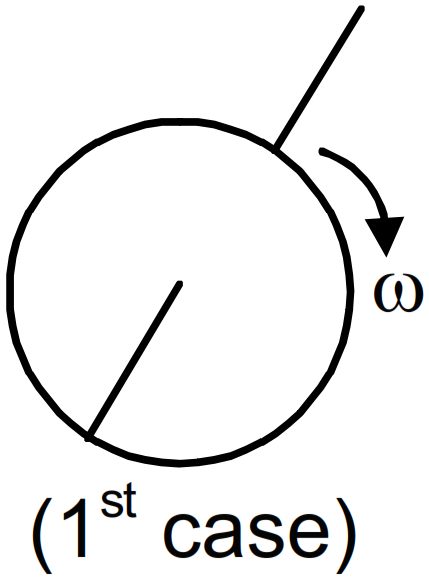 This rotating wheel is now placed on a rough horizontal. Because of its friction at contact, the wheel accelerates forward and its rotation decelerates. As the rotation decelerates the frictional force will act backward.
 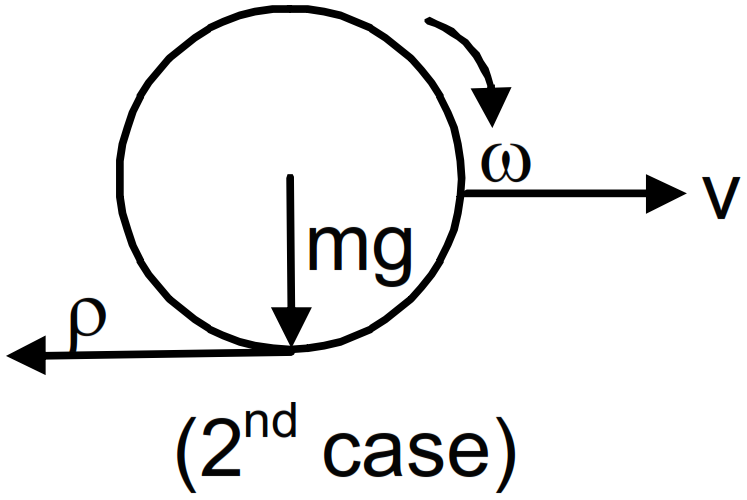 If we consider the net moment at A then it is zero. Therefore the net angular momentum before pure rolling & after pure rolling remains constant Before rolling the wheel was only rotating around its axis. Therefore Angular momentum $=\ell\omega=\Big(\frac{1}{2}\Big)\text{MR}^2\omega\ \dots(1)$ After pure rolling the velocity of the wheel let v Therefore angular momentum $=\ell_{\text{cm}}\omega+\text{m}(\text{v}\times\text{R})$ $=\Big(\frac{1}{2}\Big)\text{m}\text{R}^2\Big(\frac{\text{v}}{\text{R}}\Big)+\text{mvR}=\frac{3}{2}\text{mvR}\ \dots(2)$ Because, Eq. (1) and (2) are equal Therefore, $\frac{3}{2}\text{mvR}=\frac{1}{2}\text{mR}^2\omega$ $\Rightarrow\text{V}=\omega\frac{\text{R}}{3}$
This rotating wheel is now placed on a rough horizontal. Because of its friction at contact, the wheel accelerates forward and its rotation decelerates. As the rotation decelerates the frictional force will act backward. If we consider the net moment at A then it is zero. Therefore the net angular momentum before pure rolling & after pure rolling remains constant Before rolling the wheel was only rotating around its axis. Therefore Angular momentum $=\ell\omega=\Big(\frac{1}{2}\Big)\text{MR}^2\omega\ \dots(1)$ After pure rolling the velocity of the wheel let v Therefore angular momentum $=\ell_{\text{cm}}\omega+\text{m}(\text{v}\times\text{R})$ $=\Big(\frac{1}{2}\Big)\text{m}\text{R}^2\Big(\frac{\text{v}}{\text{R}}\Big)+\text{mvR}=\frac{3}{2}\text{mvR}\ \dots(2)$ Because, Eq. (1) and (2) are equal Therefore, $\frac{3}{2}\text{mvR}=\frac{1}{2}\text{mR}^2\omega$ $\Rightarrow\text{V}=\omega\frac{\text{R}}{3}$
Download our appand get started for free
Experience the future of education. Simply download our apps or reach out to us for more information. Let's shape the future of learning together!No signup needed.*
Similar Questions
- 1View SolutionObtain an expression for linear acceleration of a cylinder rolling down an inclined plane and hence find the condition for the cylinder to roll down the inclined plane without slipping.
- 2Two discs of moments of inertia $I_1$ and $I_2$ about their respective axes (normal to the disc and passing through the centre), and rotating with angular speed $\omega_1$ and $\omega_2$ are brought into contact face to face with their axes of rotation coincident.View Solution
- Does the law of conservation of angular momentum apply to the situation? why?
- Find the angular speed of the two-disc system.
- Calculate the loss in kinetic energy of the system in the process.
- Account for this loss.
- 3View SolutionThe pulleys in figure are identical, each having a radius R and moment of inertia I. Find the acceleration of the block M.
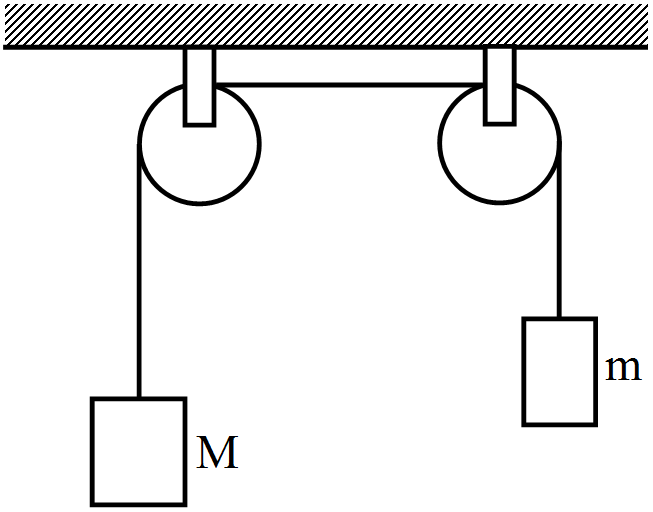
- 4A cord of negligible mass is wound round the rim of a fly wheel of mass $20 \ kg$ and radius $20 \ cm$. A steady pull of $25 N$ is applied on the cord as shown in Fig. $6.31$. The flywheel is mounted on a horizontal axle with frictionless bearings.View Solution
$(a)$ Compute the angular acceleration of the wheel.
$(b)$ Find the work done by the pull, when $2m$ of the cord is unwound.
$(c)$ Find also the kinetic energy of the wheel at this point. Assume that the wheel starts from rest.
$(d)$ Compare answers to parts $(b)$ and $(c).$ - 5Separation of Motion of a system of particles into motion of the centre of mass and motion about the centre of mass: Show $\text{L}=\text{L}'+\text{R}\times\text{MV}$ where $\text{L}'=\sum\text{r}'_\text{i}\times\text{p}'_\text{i}$ is the angular momentum of the system about the centre of mass with velocities taken relative to the centre of mass. Remember $\text{r}'_\text{i}=\text{r}_\text{i}-\text{R},$ rest of the notation is the standard notation used in the chapter.View Solution
Note: $\text{L}'$ and $\text{MR}\times\text{V}$ can be said to be angular momenta, respectively, about and of the centre of mass of the system of particles. - 6View SolutionTwo discs of same mass and thickness are made of materials having different densities. Which one of them will have larger M.I.?
- 7Separation of Motion of a system of particles into motion of the centre of mass and motion about the centre of mass: Show $\text{p}=\text{p}'_\text{i}+\text{m}_\text{i}\text{V}$ where $p_i$ is the momentum of the ith particle (of mass $m_i$ ) and $p′_i = m_iv′_i.$ Note: $v′_i$ is the velocity of the ith particle relative to the centre of mass. Also, prove using the definition of the centre of mass.View Solution
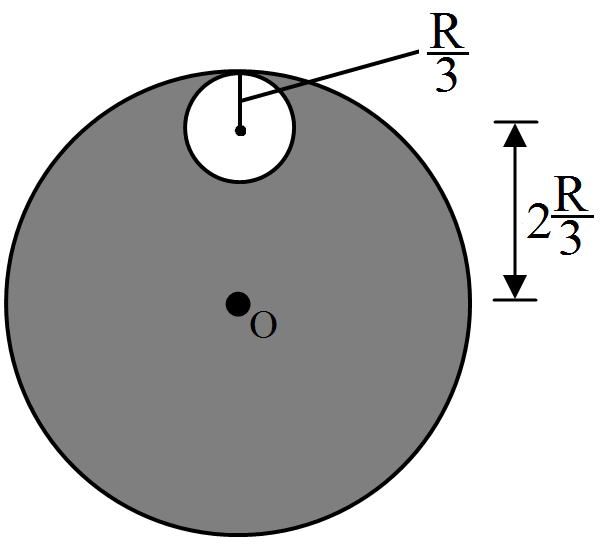
- 8From a circular disc of radius R and mass 9M, a small disc of radius $\frac{\text{R}}{3}$ is removed as shown in Fig. Find the moment of inertia of the remaining disc about an axis perpendicular to the plane of the disc and passing through the point O.View Solution
- 9Find the centre of mass of a uniform $L-$shaped lamina $($a thin flat plate$)$ with dimensions as shown. The mass of the lamina is $3 \ kg.$View Solution
- 10A circular hole of radius $1m$ is cut off from a disc of radius $6m$. The centre of the hole is $3m$ from the centre of the disc. Find the centre of mass of the remaining disc.View Solution