Question
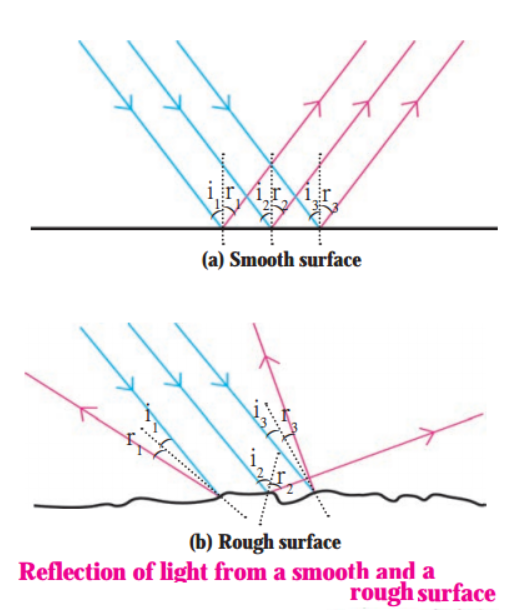
Figures (a) and (b) show three parallel rays, shown in grey, incident on smooth and rough surfaces. The reflected rays drawn using laws of reflection are shown in red.
1. Rays reflected from which surface are parallel to one another?
2. What conclusion can you draw from the figure?
Answer

1. Rays reflected from the smooth surface are parallel to one another
.Image
2.When the reflecting surface is plane and smooth, the angles of incidence (i) as well as of reflection (r) are the same for all parallel rays incident on the surface. If $i_1, i_2$, $i_3, \ldots$ are the angles of incidence for incident parallel rays, and $r_1, r_2, r_3, \ldots$, are the corresponding angles of reflection, then, $i_1=i_2=i_3=\ldots \ldots . . . r_1=r_2=r_3=\ldots .$. This is called regular reflection. Here, the reflected rays are parallel to one another. If the reflecting surface is rough and parallel rays are incident on it, then the angles of incidence are not equal and hence the angles of reflection are also not equal. Here, $i_1 \neq i_2 \neq i_3 \ldots$ and $r_1 \neq r_2 \neq r_3 \ldots$, but $r_1=i_1, r_2=i_2, r_3=i_3 \ldots$ as laws of reflection are obeyed. This is called irregular reflection. [Fig.(b)]. Here, the reflected rays are not parallel to one another and spread over a large surface.

Need a full question paper?

Generate a complete, print-ready paper with questions like this in minutes — across 16+ boards, with answer keys.

Start Generating Free