Question types

Reflection of Light question types

37 questions across 9 question groups — pick any mix to generate a Science paper with step-by-step answer keys.

37
Questions
9
Question groups
5
Question types
Sample Questions

Reflection of Light questions

One sample from each question group in this chapter. Select any group above to see the full set with answer keys.

Q 1MCQ1 Mark
In a periscope, the mirrors are ………….. .
  • parallel to each other
  • B
    at right angles to each other
  • C
    inclined at 45° to each other
  • D
    inclined at 60° to each other

Answer: A.

View full solution
Q 2MCQ1 Mark
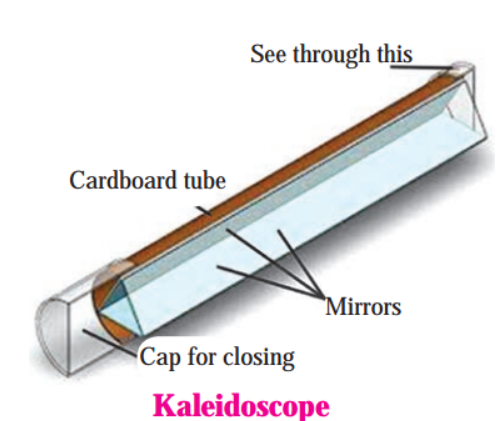
In a kaleidoscope, the mirrors are inclined to each other at ……. .
  • 60°
  • B
    30°
  • C
    45°
  • D
    90°

Answer: A.

View full solution
Q 3MCQ1 Mark
If the angle of incidence is 20°, the angle made by the reflected ray with the normal to the surface must be ……… .
  • 20°
  • B
    70°
  • C
    10°
  • D
    40°

Answer: A.

View full solution
Q 4MCQ1 Mark
If the angle of incidence is 40°, the angle made by the reflected ray with the surface of the plane mirror must be ……. .
  • A
    40°
  • 50°
  • C
    20°
  • D
    80°

Answer: B.

View full solution
Q 5MCQ1 Mark
If the angle made by the incident ray with the surface of a plane mirror is 30°, the angle of reflection must be …….. .
  • A
    30°
  • B
    90°
  • 60°
  • D
    15°

Answer: C.

View full solution
Figures (a) and (b) show three parallel rays, shown in grey, incident on smooth and rough surfaces. The reflected rays drawn using laws of reflection are shown in red.
1. Rays reflected from which surface are parallel to one another?
2. What conclusion can you draw from the figure?
View full solution
Material:
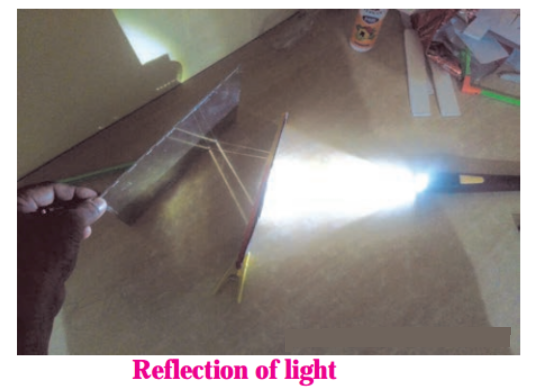
Torch light, mirror, a stand for hanging the mirror, black paper, comb, white paper, drawing board.
Activity :
1. Fit a white paper tightly over a table or drawing board.
2. Leaving out some portion in the middle of the comb, cover the rest with black paper so that light can only pass through the open central portion.
3. Hold the comb perpendicular to the white paper and throw torch light on its central portion.
4. Adjust the comb and torch so as to get light rays on the white paper. Now keep a mirror in the path of this ray of light as shown in the figure.
5. What do you observe?

Image

View full solution
Q 23Draw Diagram.5 Marks
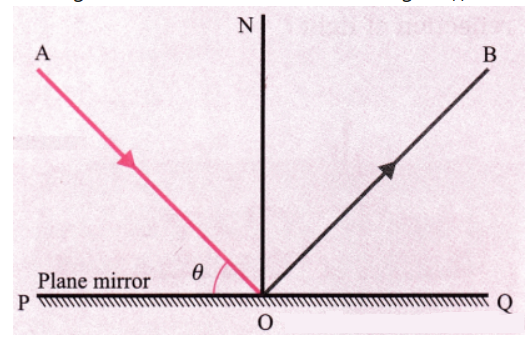
Draw a figure showing the following:
(a) Incident ray
(b) Normal
(c) Angle of incidence
(d) Angle of reflection
(e) Point of incidence
(f) Reflected ray.
View full solution
Q 24Draw Diagram.5 Marks
Draw a figure describing the following: The reflecting surfaces of two mirrors make an angle of 90° with each other. If a ray incident on one mirror has an angle of incidence of 30°, draw the ray reflected from the second mirror. What will be its angle of reflection?
View full solution
Q 25Draw Diagram.5 Marks
Draw a figure describing the following: The reflecting surfaces of two mirrors make an angle of 90° with each other. If a ray incident on one mirror has an angle of incidence of 30°, draw the ray reflected from the second mirror. What will be its angle of reflection?
View full solution
Swara and Yash were looking in a water-filled vessel. They could see their images clearly in the still water. At that instant, Yash threw a stone in the water. Now their images were blurred. Swara could not understand the reason for the blurring of the images.
Explain the reason for blurring of the images to Swara by answering the following
(1)Is there a relation between the reflection of light and the blurring of the images?
(2)Which types of reflection of light can you notice from this?
(3)Are the laws of reflection followed in these types of reflection?
View full solution

Generate a Reflection of Light paper free

Pick question groups from the list above, set marks and difficulty, and export a branded PDF with step-by-step answer keys. First 3 chapters free — no signup.

Download App