Question
Fill in the blanks at (A), (B), (C), (D), (E) and (F) and complete the pathway/ Hatch-Slack pathway:
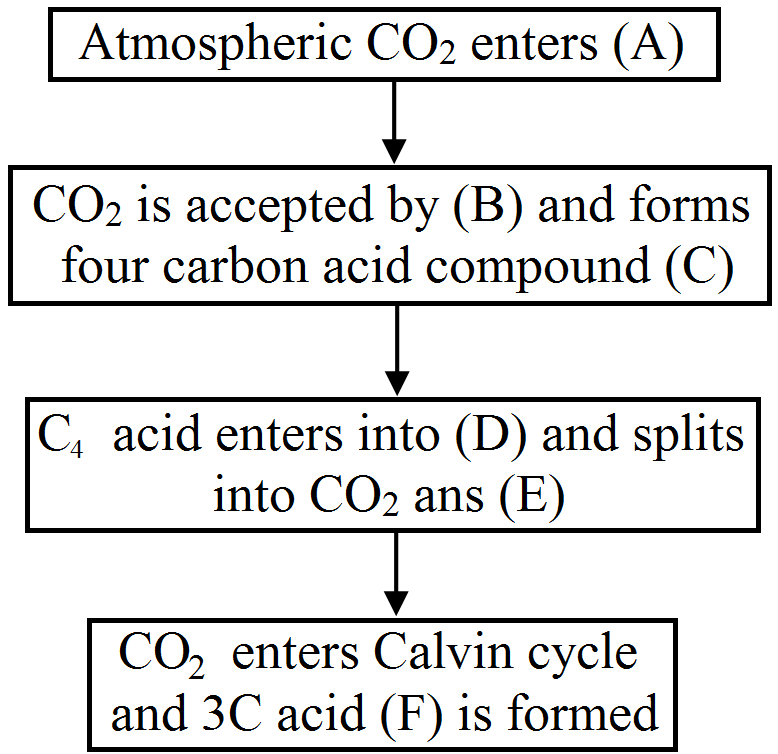
Answer

  1. Mesophyll cell.
  2. Phosphoenol pyruvate.
  3. Oxaloacetic acid.
  4. Bundle sheath cells.
  5. Pyruvate.
  6. Phosphoglyceric acid.

Need a full question paper?

Generate a complete, print-ready paper with questions like this in minutes — across 16+ boards, with answer keys.

Start Generating Free

Similar questions

How is the study of plant anatomy useful to us?
Vidhi attended the guest lecture on photosynthesis with her biology teacher. Guest for the seminar explained the basic functioning of chloroplast in the photosynthetic processes. As students from different schools attended the seminar. The guest for the lecture asked all students to put forward their queries regarding the topic. Vidhi stood up and asked him that, she is unable to understand the division of labour in the chloroplast. He appreciated her doubts and explained her about the same.
  1. What do you understand by the division of labour in chloroplast?
  2. How the different pigments are involved in photosynthesis?
  3. What is the significance of photosynthesis for animals?
  4. Elucide the value shown by Vidhi as a good biology student?
Write differences between ascocarp and basidiocarp.
Write down the common features of the connective tissue. On the basis of structure and function, differentiate between bones and cartilages.
Briefly describe the significance of cell division.
What are factors which affect action of enzyme? What is lock and key model and induced fit model?
Name the product formed by esterification of glycerol with a fatty acid. Also draw its structure.
The mode of arrangements of sepals or petals in a floral bud is known as aestivation. Draw the various types of aestivation possible for a typical pentamerous flower.
Write the role of diaphragm and intercostal muscles in the inspiratory process.
In what kind of plants do you come across ‘kranz’ anatomy? To which conditions are those plants better adapted? How are these plants better adapted than the plants, which lack this anatomy?