Question
Fill in the blanks with correct number

$\left|\begin{array}{ll}
3 & 2 \\
4 & 5
\end{array}\right|=3 \times \square-\square \times 4=\square-8=\square$
Answer


$\left|\begin{array}{ll}3 & 2 \\ 4 & 5\end{array}\right|=3 \times 5-2 \times 4=15-8=7$

Need a full question paper?

Generate a complete, print-ready paper with questions like this in minutes — across 16+ boards, with answer keys.

Start Generating Free

Similar questions

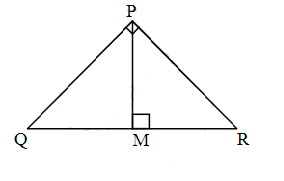
From given figure, in $\triangle P Q R$, if $\angle Q P R=90^{\circ}, P M \perp Q R, P M=10, Q M=8$, then for finding the value of $Q R$, complete the following activity.
Image
Activity: In $\triangle P Q R$, if $\angle Q P R=90^{\circ}, P M \perp Q R$,
[Given]
In $\triangle P M Q^1$ by Pythagoras Theorem,
$\therefore PM ^2+\square= PQ ^2$
$\therefore P Q^2=10^2+8^2$
$\therefore P Q^2=\square+64$
$\therefore P Q^2=\square$
$\therefore P Q=\sqrt{164}$
Here, $\triangle QPR \sim \triangle QMP \sim \triangle PMR$
$\therefore \triangle QMP \sim \triangle PMR$
$\therefore \frac{ PM }{ RM }=\frac{ QM }{ PM }$
$\therefore PM ^2= RM \times QM$
$\therefore 10^2= RM \times 8$
$RM =\frac{100}{8}=\square$
And,
$Q R=Q M+M R$
$QR =\square+\frac{25}{2}=\frac{41}{2}$
Now, let’s find the sum of 75 numbers
$1+3+5+7+\ldots+149$
Here, $a=1, d=2, n=75$
$S _{ n }=\frac{ n }{2}[2 a +( n -1) d ]$
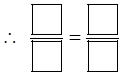
$\therefore \quad S _{75}$ = ⬜
$=\frac{75}{2}(2+74 \times 2)$
$=\frac{75}{2}(2+148)$
$=\frac{75}{2}(150)$
= ⬜$\times$⬜
$\therefore \quad S _{75}$ = ⬜
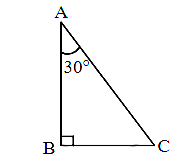
From given figure, In ∆ABC, If ∠ABC = 90° ∠CAB=30°, AC = 14 then for finding value of AB and BC, complete the following activity.

Activity: In $\triangle ABC$, If $\angle ABC =90^{\circ}, \angle CAB =30^{\circ}$
$
\therefore \angle B C A=\square
$
By theorem of $30^{\circ}-60^{\circ}-90^{\circ}$ triangle,
$\therefore \square=\frac{1}{2} AC$ and $\square=\frac{\sqrt{3}}{2} AC$
$\therefore BC =\frac{1}{2} \times \square$ and $AB =\frac{\sqrt{3}}{2} \times 14$
$\therefore BC =7$ and $AB =7 \sqrt{3}$
Write the correct number in the given boxes from the following A. P.
– 3, – 8, – 13, – 18, . . .
$\text { Here } t _3=\square, t _2=\square, t _4=\square, t _1=\square $
$ t _2- t _1=\square, t _3- t _2=\square $
$ \therefore a =\square, d =\square$
prove the theorem Opposite angles of a cyclic quadrilateral are supplementry.
Write the values of the following trigonometric ratios.
$\cos 45^{\circ}=\frac{⬜}{⬜}$
Write the correct number in the given boxes from the following A. P.
1, 8, 15, 22, . . .
Here
a = ⬜, $t _1$ = ⬜, $t _2$ = ⬜, $t _3$ = ⬜
$t _2- t _1$ = ⬜ - ⬜ = ⬜
$t _3- t _2$ = ⬜ - ⬜ = ⬜
∴ d = ⬜
Write the correct number in the given boxes from the following A. P.
1, 8, 15, 22, . . .
$\text { Here } a =\square, t _1=\square, t _2=\square, t _3=\square, $
$ t _2- t _1=\square-\square=\square $
$ t _3- t _2=\square-\square=\square \therefore d =\square$
First term and common difference of an A.P. are 6 and 3 respectively ; find S27.
$a=6, d=3, S_{27}=?$
$S_n=\frac{n}{2}$[⬜ + (n - 1)d]
$\left.\therefore \quad S _{27}=\frac{27}{2}[12+(27-1) ⬜\right]$
$=\frac{27}{2} \times ⬜$
$=27 \times 45$ = ⬜