Question
Write the correct number in the given boxes from the following A. P.
– 3, – 8, – 13, – 18, . . .
$\text { Here } t _3=\square, t _2=\square, t _4=\square, t _1=\square $
$ t _2- t _1=\square, t _3- t _2=\square $
$ \therefore a =\square, d =\square$
Answer

$-3,-8,-13,-18, \ldots$
First term $a =-3$
Second term $t_1=-8$
Third term $t _2=-13$
Fourth term $t_3=-18$
We know that $d=t_{n+1}-t_n$
Thus, $t _2- t _1=-13-(-8)=-13+8=-5$
$t_3-t_2=-18-(-13)=-18+13=-5$
Thus, $d=-5$

Need a full question paper?

Generate a complete, print-ready paper with questions like this in minutes — across 16+ boards, with answer keys.

Start Generating Free

Similar questions

prove the theorem Opposite angles of a cyclic quadrilateral are supplementry.
Fill in the blanks with correct number

$\left|\begin{array}{ll}
3 & 2 \\
4 & 5
\end{array}\right|=3 \times \square-\square \times 4=\square-8=\square$
If ΔABC ~ ΔPQR, A (ΔABC) = 80, A(ΔPQR) = 125, then fill in the blanks.
$\frac{ A (\triangle ABC )}{ A (\Delta \ldots)}=\frac{80}{125}$
$\therefore \frac{ AB }{ PQ }$ = $[-]$
In $\triangle PQR$, seg $RS$ bisects $\angle R$.
If $PR =15, RQ =20 PS =12$
then find $S Q$.
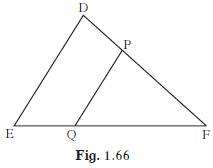
In figure 1.66, seg PQ || seg DE, A(Δ PQF) = 20 units, PF = 2 DP, then find A(DPQE) by completing the following activity.
A(Δ PQF) = 20 units, PF = 2 DP, Let us assume DP = x. ∴ PF = 2x
$DF = DP +\square=\square+\square=3 x$
In Δ FDE and Δ FPQ,
∠FDE ≅ ∠ .......... corresponding angles
∠FED ≅ ∠ ......... corresponding angles
∴ Δ FDE ~ Δ FPQ .......... AA test
$\therefore \frac{ A (\Delta FDE )}{ A (\Delta FPQ )}=\frac{\square}{\square}=\frac{(3 x )^2}{(2 x )^2}=\frac{9}{4}$
$A (\Delta FDE )=\frac{9}{4} A(\Delta FPQ )=\frac{9}{4} \times \square=\square$
$A (\square DPQE )= A (\Delta FDE )- A (\Delta FPQ )$
$\quad=\square-\square$
$\quad=\square$
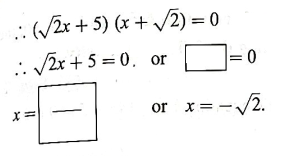
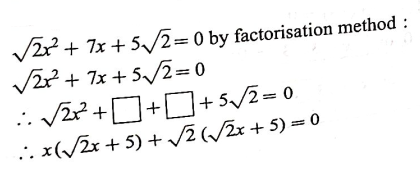
Complete the following activity to solve the quadratic equation

Image
Image
There are 9 tickets in a box, each bearing one of the numbers from 1 to 9 . One ticket is drawn at random from the box.
Event A : Ticket shows an even number.
Complete the following activity :
Image
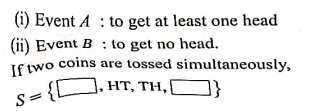
Two coins are tossed simultaneously. Complete the following activity of writing the sample space $(S)$ and expected outcomes of the events :
Image
Image
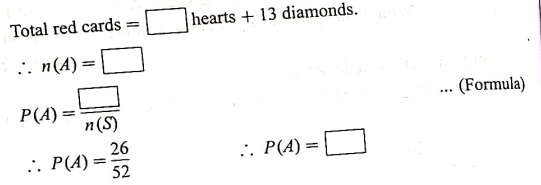
A card is drawn from a well-shuffled pack of 52 playing cards. Complete the following activity to find the probability of the event that the card drawn is a red card:
Suppose S is the sample space. .. n(S) = 52.
Event A Card drawn is a red card.
Image
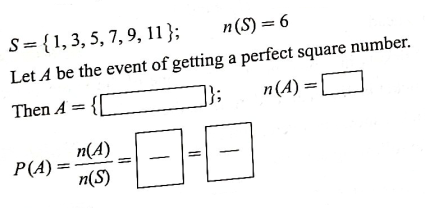
The faces of a die bear the numbers 1, 3, 5, 7, 9, 11. The die is rolled. Find the probability of getting a perfect square number on the upper face of the die.
Image