Question
Fill in the blanks with correct number
$\left|\begin{array}{ll}3 & 2 \\ 4 & 5\end{array}\right|=3 \times \square-\square \times 4=\square-8=\square$

Answer

$\left|\begin{array}{ll}3 & 2 \\ 4 & 5\end{array}\right|=3 \times 5 - 2 \times 4 =15-8=7$

Need a full question paper?

Generate a complete, print-ready paper with questions like this in minutes — across 16+ boards, with answer keys.

Start Generating Free

Similar questions

If $\sec \theta+\tan \theta=\sqrt{3}$, complete the activity to find the value of $\sec \theta-\tan \theta$
Activity:
$ \square=1+\tan ^2 \theta \quad \ldots . . .[\text { Fundamental trigonometric identity] }$
$\square-\tan ^2 \theta=1$
$(\sec \theta+\tan \theta) \cdot(\sec \theta-\tan \theta)=\square$
$\sqrt{3} \cdot(\sec \theta-\tan \theta)=1$
$(\sec \theta-\tan \theta)=\square $
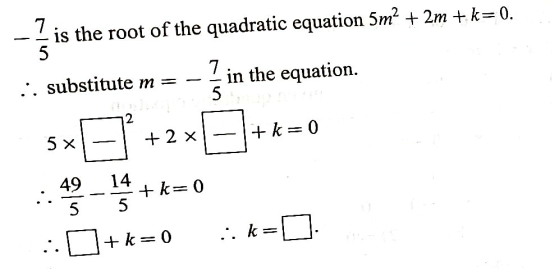
One of the roots of the quadratic equation $5 m^2+2 m+k=1$ is $-\frac{7}{5}$. Complete the following activity to find the value of k :

Image
There are 9 tickets in a box, each bearing one of the numbers from 1 to 9 . One ticket is drawn at random from the box.
Event A : Ticket shows an even number.
Complete the following activity :
Image
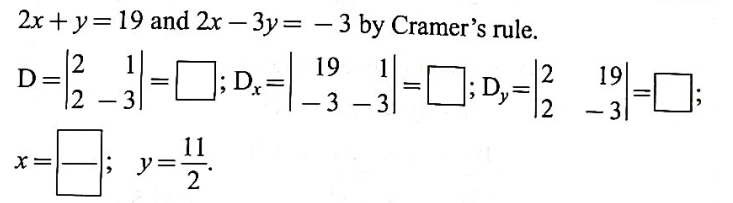
Complete the following activity to solve the simultaneous equations
Image
Find coordinates of the midpoint of a segment joining point $A(-1,1)$ and point $B(5,-7)$
Solution: Suppose $A\left(x_1, y_1\right)$ and $B\left(x_2, y_2\right)$
$x_1=-1, y_1=1 \text { and } x_2=5, y_2=-7$
Using midpoint formula,
$\therefore$ Coordinates of midpoint of segment $A B$
$ =\left(\frac{x_1+x_2}{2}, \frac{y_1+y_2}{2}\right)$
$=\left(\frac{\square}{2}, \frac{\square}{2}\right) $
$\therefore$ Coordinates of the midpoint $=\left(\frac{4}{2}, \frac{\square}{2}\right)$
$\therefore$ Coordinates of the midpoint $=(2, \square)$
Write the values of the following trigonometric ratios.
$\cos 30^{\circ}=\frac{⬜}{⬜}$
Find distance between point $Q(3,-7)$ and point $R(3,3)$
Solution: Suppose $Q\left(x_1, y_1\right)$ and point $R\left(x_2, y_2\right)$
$x_1=3, y_1=-7 \text { and } x_2=3, y_2=3$
Using distance formula,
$ d(Q, R)=\sqrt{\square}$
$\therefore d(Q, R)=\sqrt{\square-100}$
$\therefore d(Q, R)=\sqrt{\square}$
$\therefore d(Q, R)=\square $
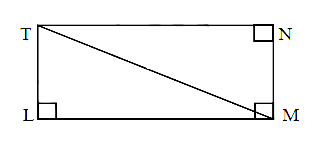
Find the diagonal of a rectangle whose length is 16 cm and area is 192 sq.cm. Complete the following activity.

Activity: As shown in figure GLMNT is a reactangle.
$\therefore$ Area of rectangle $=$ length $\times$ breadth
$\therefore$ Area of rectangle $=\square \times$ breadth
$\therefore 192=\square \times$ breadth
$\therefore$ Breadth $=12 cm$
Also,
$\angle TLM =90^{\circ}$ [Each angle of reactangle is right angle]
In $\triangle T L M$,
By Pythagoras theorem
$\therefore TM ^2= TL ^2+\square$
$\therefore TM ^2=12^2+\square$
$\therefore TM ^2=144+\square$
$\therefore TM ^2=400$
$\therefore TM =20$
 
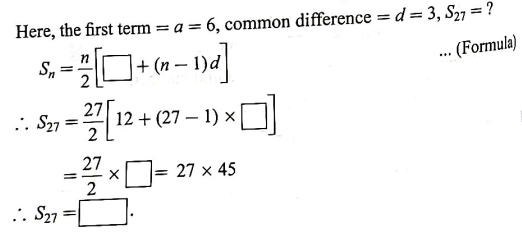
The first term and the common difference of an A.P. are 6 and 3 respectively. Find $S_{27}$.

Image