Question
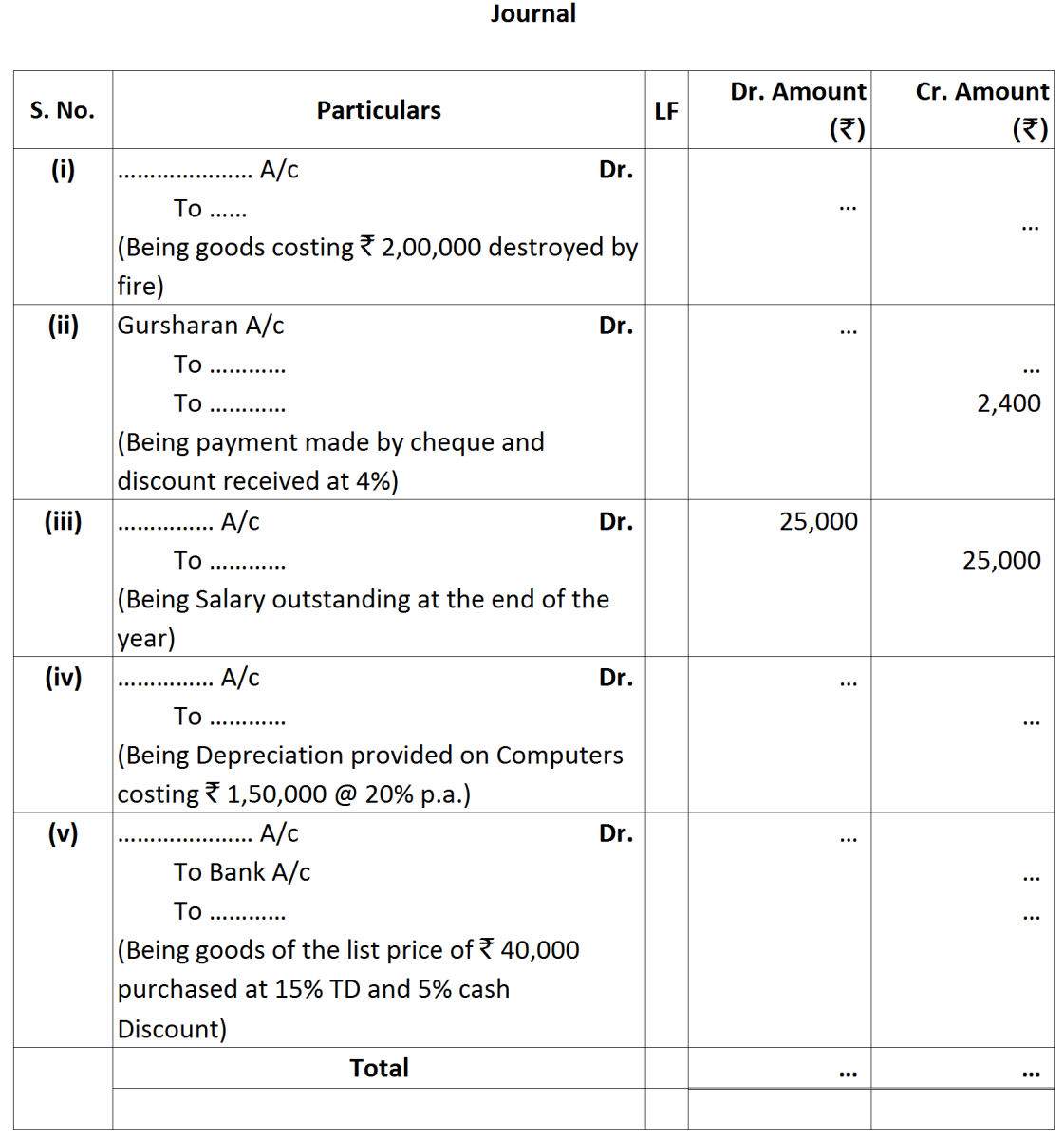
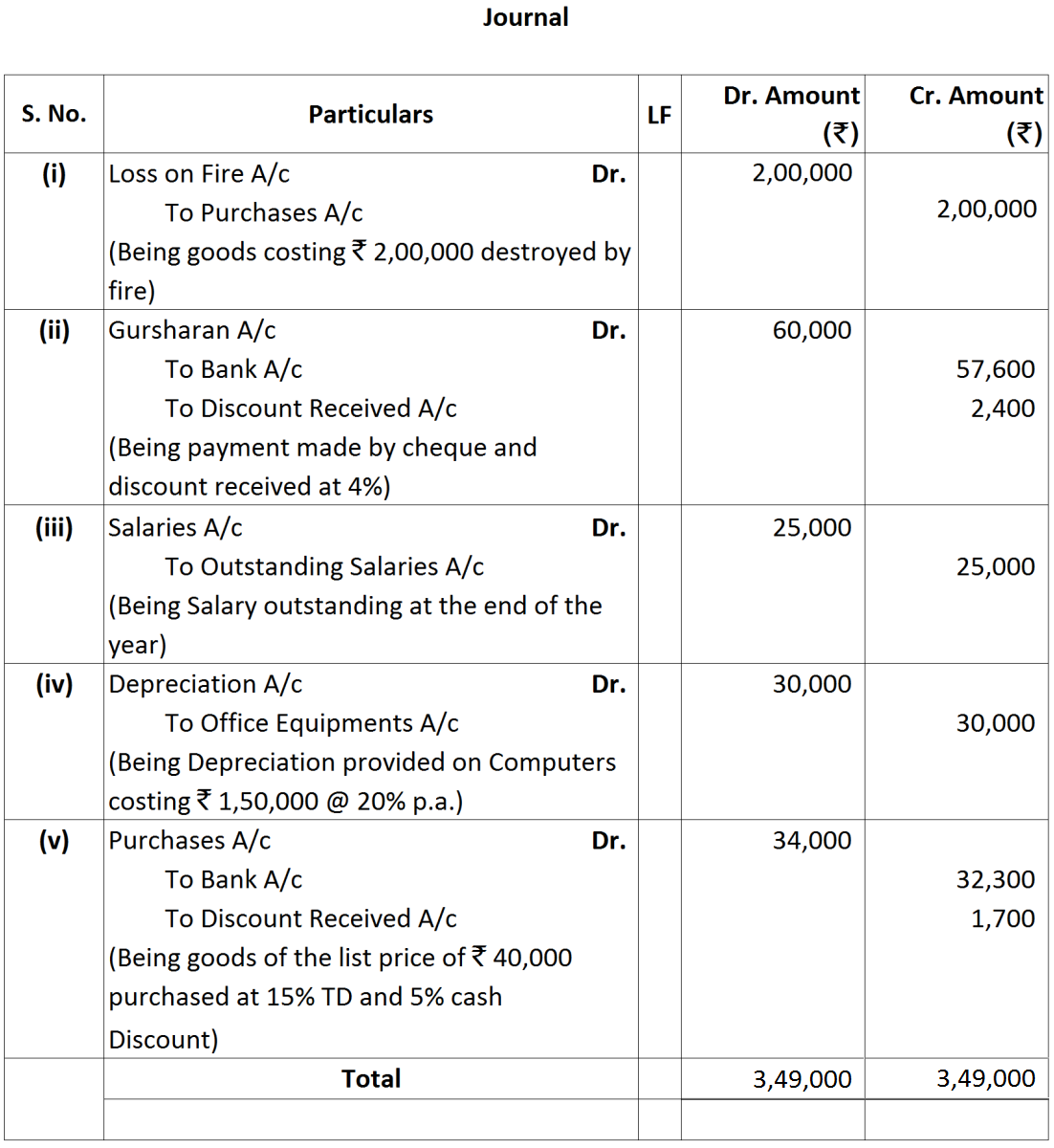
Fill in the missing information in the following journal entries:
Answer


Working Note:
  1. Total Amount $=\frac{2,400}{4}\times100=₹\ 60,000$

Need a full question paper?

Generate a complete, print-ready paper with questions like this in minutes — across 16+ boards, with answer keys.

Start Generating Free

Similar questions

What Journal entry will be passed in the books of drawer (X) and drawee (Y) at the time of dishonour of bill in the following cases:
  1. If bill of ₹ 50,000 was discounted from bank and noting charges paid by the bank was ₹ 600.
  2. If B/R of ₹ 50,000 was endorsed in favour of Z. Noting charges paid by Z ₹ 600.
  3. If B/R is returned with drawer and noting charges were ₹ 600.
On 17th April, 2016, X sold goods to Y for ₹ 80,000 and draws a bill for 2 months upon Y for the amount due. Y accepted the bill and returned it to X. On due date the bill became dishonoured and X paid ₹ 400 as Noting Charges. Fifteen days later Y pays the amount due to X. Pass Journal entries in the books of both the parties.
Prepare Journal from the transactions given below:
 
 
(a)
Cash paid for installation of machine
500
(b)
Goods given as charity
2,000
(c)
Interest charge on capital @ 7% p.a. when total capital were
70,000
(d)
Received ₹ 1,200 of a bad debts written-off last year.
 
(e)
Goods destroyed by fire
2,000
(f)
Rent outstanding
1,000
(g)
Interest on drawings
900
(h)
Sudhir Kumar who owed me ₹ 3,000 has failed to pay the amount. He pays me a compensation of 45 paise in a rupee.
 
(i)
Commission received in advance
7,000
The accountant of a firm finds that the Trial Balance as on 31st March, 2019 is out by an excess debit of ₹ 283. He placed the amount in the Suspense Account. In the first week of April, 2019, he discovered the following errors. Pass the Journal entries necessary to rectify these errors and show the Suspense Account as it would appear at the end of the week. Have you any comment to make?
  1. Cash paid to Amar Nath, ₹ 75, was posted to the credit of Amar Singh's Account as ₹ 57.
  2. Discount allowed by Brijesh of ₹ 5 was not entered in the Cash Book but Brijesh stands debited correctly.
  3. No entry was made for goods worth ₹ 40 taken away by proprietor for personal use.
  4. ₹ 500 received from Jhaveri Bros. for interest on loan advanced to them were recorded in the Cash Book. But the entry was not posted in the Ledger.
  5. The total of Returns Outward Book was short by ₹ 100.
What is meant by maturity of a bill of exchange?
Explain the meaning and significance of “money measurement concept'.
Mehak sold goods for ₹ 24,000 to Shally on July 31, 2017 and drew three bills for ₹ 6,000, ₹ 8,000 and ₹ 10,000 payable after two, three and four months respectively. The first bill was kept by Mehak with her till maturity date. She endorsed the second bill in favour of her creditor Kanak. The third bill was discounted on September 3, 2017 @ 12% p.a. from bank. The first and second bill were duly met on maturity but the third bill was dishonoured and the bank paid ₹ 150 as noting charges. On December 3, 2017 Shally paid ₹ 5,000 and noting charges in cash and accepted a new bill at two months after date for the balance amount plus interest ₹ 200. The new bill was met on maturity by Shally.
You are required to give the Journal Entries in the books of Mehak.
Rectify the following errors assuming that suspense account was opened. Ascertain the difference in trial balance.
  1. Depreciation provided on machinery ₹ 4,000 was not posted to Depreciation account.
  2. Bad debts written-off ₹ 5,000 were not posted to Debtors account.
  3. Discount allowed to a debtor ₹ 100 on receiving cash from him was not posted to discount allowed account.
  4. Goods withdrawn by proprietor for personal use ₹ 800 were not posted to Drawings account.
  5. Bill receivable for ₹ 2,000 received from a debtor was not posted to Bills receivable account.
On 21st Sept. 2017, Radhika sold goods for ₹ 2,00,000 to Parvati and drew upon later a bill for the same amount payable after 3 months. The bill was accepted by Parvati, Radhika discounted the bill from bank at a discount of 15% p.a. on 21st Oct., 2017. On maturity, the bill was dishonoured. Parvati agreed to pay ₹ 1,20,000 in cash including ₹ 3,000 interest and accepted a new bill for 3 months. The new bill was endorsed to Gayatri in full settlement of his account ₹ 85,000. It was duly met on maturity. Pass entries in the books of Radhika.
From the following transactions, state the nature of account and state which account will be debited and which account credited:
S.No
 
i
Manu started business with cash
1,00,000
ii
He purchased furniture for business
20,000
iii
Purchase goods on credit from Anshul
6,000
iv
Paid to his creditor, Anshul
2,000
v
Paid salary to his clerk
1,000
vi
Paid rent
500
vii
Received interest
200