Question
Fill in the missing fraction: $\square+\frac5{27}\;=\;\frac{12}{27}$

Answer

${x + \frac{5}{{27}}\; = \;\frac{{12}}{{27}}}$

${x = \frac{{12}}{{27}} - \;\frac{5}{{27}} = \;\frac{{12 - 5}}{{27}} = \frac{7}{{27}}}$
Thus, $\frac{\displaystyle7}{27}+\frac5{27}\;=\;\frac{12}{27}$

Need a full question paper?

Generate a complete, print-ready paper with questions like this in minutes — across 16+ boards, with answer keys.
Start Generating Free

Similar questions

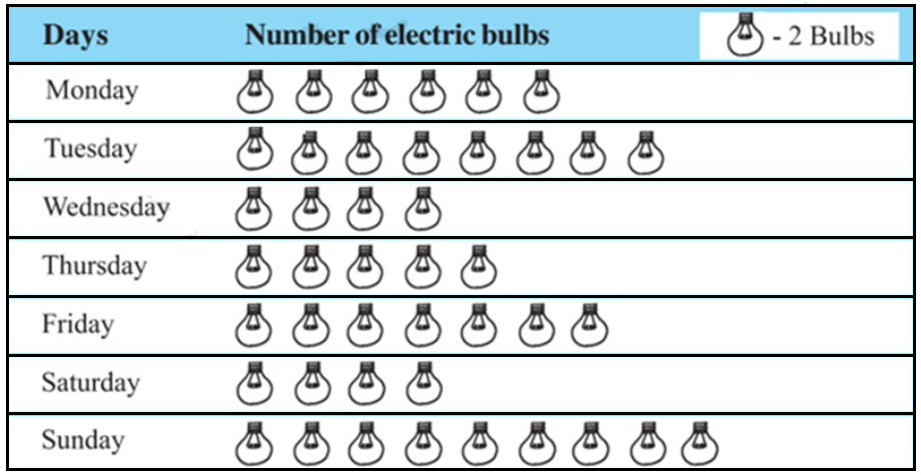
The sale of electric bulbs on different days of a week is shown below:

Observe the pictograph and answer the following questions:
$i.\ $How many bulbs were on Friday?
$ii.\ $On which day maximum number of bulbs were sold?
$iii.\ $If one bulb was sold at the rate of $Rs.\ 10$, what was the total earning on sunday?
$iv.\ $Can you find out the total earning of the week?
$v.\ $If one big carton can hold $9$ bulbs. How many cartons were needed in the given week, more than $7$, more than $8$ or more than $9$?
With $\overline{\text{PQ}}$ of length $6.1\ cm$ as diameter, draw a circle.
On a squared paper, draw (i) a rectangle, (ii) a triangle (iii) any irregular closed figure. Find the approximate area of each by counting the number of squares complete, more than half and exactly half.
The circumferences of four wheels are $50\ cm, 60\ cm, 75\ cm$ and $100\ cm.$ They start moving simultaneously. what least distance should they cover so that each wheel makes a complete number of revolutions?
The circumferences of four wheels are $50\ cm, 60\ cm, 75\ cm$ and $100\ cm$. They start moving simultaneously. what least distance should they cover so that each wheel makes a complete number of revolutions?
In a Mathematics test, the marks were obtained by $40$ students. Arrange these marks in a table using tally marks.
$8$ $1$ $3$ $7$ $6$ $5$ $5$ $4$ $4$ $2$
$4$ $9$ $5$ $3$ $7$ $1$ $6$ $5$ $2$ $7$
$7$ $3$ $8$ $4$ $2$ $8$ $9$ $5$ $8$ $6$
$7$ $4$ $5$ $6$ $9$ $6$ $4$ $4$ $6$ $6$
How many students obtained marks below $4?$
Construct a rectangle whose adjacent sides are $8\ cm$ and $3\ cm.$
Using number line, how do you compare:
$a.\ $Two negative integers?
$b.\ $Two positive integers?
$c.\ $One positive and one negative integer?
Draw a line segment of length $10\ cm$ and bisect it. Further bisect one of the equal parts and measure its length.
Draw an angle of measure $153^\circ $ and divide it into four equal parts.