Question 15 Marks
Jaidev takes $2\frac15$ minutes to walk across the school ground. Rahul takes $\frac74$ minutes to do the same. Who takes less time and by what fraction?
AnswerTime taken by jaidev to walk across the school ground $= 2\frac15$ minutes
= $\frac{(2\times5)+1}5$minutes
= $\frac{10+1}5$minutes $=\frac{11}5$ minutes
Time taken by Rahul to walk across the school ground $ = \frac{7}4$ minutes
$L.C.M. (5, 4) = 20$
Equivalent fractions of $=\frac{11}5$ are $\frac{22}{10}\;,\frac{33}{15},\;\frac{44}{20},\;----$
Equivalent fractions of $\frac74$ are $\frac{14}8\;,\frac{21}{12},\;\frac{28}{16},\;\frac{35}{20},----$
$\because 35 < 44$
$\therefore$ $\frac{35}{20}<\frac{44}{20}$
$\therefore$ Rahul takes less time by$\frac{44}{20}-\;\frac{35}{20}$ minute
i.e., by $\frac{44-35}{20}$ minute i.e., by $=\frac{9}{20}$ minute.
View full question & answer→Question 25 Marks
Asha and Samuel have bookshelves of the same size partly filled with books. Asha's shelf $\frac56$th full and Samuel's shelf is$\frac25$ th full. Whose bookshelf is more full? By what fraction?
AnswerAsha's shelf is $\frac56$ full of book
Samuel's shelf is$\frac25$ full of book.
$L.C.M. (6, 5) = 30$
Equivalent fractions of $\frac56$ are $\frac{10}{12}\;,\frac{15}{18},\;\frac{20}{24},\;\frac{25}{30},---$
Equivalent fractions of $\frac25$ are$\frac4{10}\;,\frac6{15},\;\frac8{20},\;\frac{10}{25},\frac{12}{30},---$
$\because 25 > 12$
$\therefore$ $\frac{25}{30}>\frac{12}{30}$
$\therefore$ Asha's bookshelf is more full fraction$\frac{25}{30}-\frac{12}{30}$
i.e., by fraction $\frac{25-12}{30}$ i.e., by fraction$\frac{13}{30}$.
View full question & answer→Question 35 Marks
Nandini's house is $\frac9{10} \ km$ from her school. She walked some distance and then took a bus for $\frac12 \ km$ to reach the shcool. How far did she walk?
AnswerDistance of Nandini's house from school $=\frac9{10} \ km$
Distance traveled by bus $= \frac12 \ km$
$\therefore$ Distance walked by Nandini $\frac9{10} \ km \frac12 \ km =\frac9{10}\;-\;\frac12 km$
$= \frac9{10}\;-\;\frac{1\times5}{2\times5} \ km . . . . [L.C.M. (10, 2) = 10]$
$= \frac9{10}\;-\;\frac5{10} \ km =\frac{9-5}{10} \ km$
$= \frac4{10} \ km =\frac{4\div2}{10\div2}\;=\;\frac25 \ km ... [H.C.F. (4, 10) = 2]$
View full question & answer→Question 45 Marks
A piece of wire $\frac78$ metre long broke into pieces. One piece was $\frac14$ metre long. How long is the other piece?
AnswerLength of the original piece of wire $=\frac78$ metre
Length of one piece $=\frac14$ metre
$\therefore$ Length of the other piece$=\frac78$ metre $=\frac14$ metre $=\left(\frac78-\;\frac14\right)$ metre
$=\left(\frac78-\;\frac{1\times2}{4\times2}\right)$ metre $... [L.C.M. (8,4) = 8]$
$=\left(\frac78-\;\frac28\right)$ metre
$=\left(\frac{7-2}8\right)$ metre $=\frac58$ metre
View full question & answer→Question 55 Marks
Complete the addition-subtraction box.
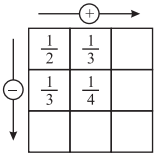
AnswerHere,
$\frac{1}{2}+\frac{1}{3}=\frac{(1 \times 3)+(1 \times 2)}{6}=\frac{3+2}{6}=\frac{5}{6}$
$\frac{1}{3}+\frac{1}{4}=\frac{(1 \times 4)+(1 \times 3)}{12}=\frac{4+3}{12}=\frac{7}{12}$
$\frac{1}{2}-\frac{1}{3}=\frac{(1 \times 3)-(1 \times 2)}{6}=\frac{3-2}{6}=\frac{1}{6}$
$\frac{1}{3}-\frac{1}{4}=\frac{(1 \times 4)-(1 \times 3)}{12}=\frac{4-3}{12}=\frac{1}{12}$
Also,
$\frac{1}{6}+\frac{1}{12}=\frac{(1 \times 2)+1}{12}=\frac{2+1}{12}=\frac{3}{12}=\frac{1}{4}$
Hence, the above-given table can be completed as follows:
| $\frac{1}{2}$ | $\frac{1}{3}$ | $\frac{5}{6}$ |
| $\frac{1}{3}$ | $\frac{1}{4}$ | $\frac{7}{12}$ |
| $\frac{1}{6}$ | $\frac{1}{12}$ | $\frac{1}{4}$ |
View full question & answer→Question 65 Marks
Complete the addition-subtraction box.
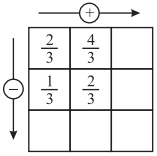
AnswerWe have,
$\frac{2}{3}+\frac{4}{3}=\frac{2+4}{3}=\frac{6}{3}= 2$
$\frac{1}{3}+\frac{2}{3}=\frac{1+2}{3}=\frac{3}{3}= 1$
$\frac{2}{3}-\frac{1}{3}=\frac{2-1}{3}=\frac{1}{3}$
$\frac{4}{3}-\frac{2}{3}=\frac{4-2}{3}=\frac{2}{3}$
and $\frac{1}{3}+\frac{2}{3}=\frac{3}{3} = 1$
Hence, the above-given number box can be completed as:
| $\frac{2}{3}$ |
$\frac{4}{3}$ |
$2$ |
| $\frac{1}{3}$ |
$\frac{2}{3}$ |
$1$ |
| $\frac{1}{3}$ |
$\frac{2}{3}$ |
$1$ |
View full question & answer→Question 75 Marks
Naina was given $1\frac12$ piece of cake Najma was given $1\frac13$ piece of cake. Find the total amount of cake given to both of them.
AnswerCake given to Naina $1\frac12=\;\frac{1\times2+1}2=\;\frac{2+1}2=\;\frac32$ piece
Cake given to Najma $1\frac13=\;\frac{1\times3+1}3=\;\frac{3+1}3=\;\frac43$ piece
∴ Total amount of cake consumed by both of them $\;\frac32$ piece $\;\frac45$ piece $= \frac32+\;\frac43$ piece
$= \frac{3\times3}{2\times3}+\;\frac{4\times2}{3\times2}$ piece $. . . . [L.C.M.(2,3) = 6]$
$\frac96+\;\frac86=\;\frac{9+8}6=\;\frac{17}6\;=\;2\frac56$ piece
View full question & answer→Question 85 Marks
Sarita bought $\frac25$ metre of ribbon and Lalita $\frac34$ metre of ribbon, What was the total length of the ribbon they bought?
AnswerRibbon bought by Sarita $=\frac25 m$
Ribbon bought by Lalita $= \frac34 m$
$∴$ Total length of the ribbon they bought $= \frac25m + \frac34 m =\frac25+\;\frac34 m$
$= \frac{2\times4}{5\times4}+\;\frac{3\times5}{4\times5}m . . . . L.C.M. (5, 4) = 20$
$= \frac8{20}+\;\frac{15}{20}=\;\frac{8+15}{20}=\;\frac{23}{20}\;=\;1\frac3{20} m$
View full question & answer→Question 95 Marks
Fill in the missing fraction: $\square+\frac5{27}\;=\;\frac{12}{27}$
Answer${x + \frac{5}{{27}}\; = \;\frac{{12}}{{27}}}$ ${x = \frac{{12}}{{27}} - \;\frac{5}{{27}} = \;\frac{{12 - 5}}{{27}} = \frac{7}{{27}}}$
Thus, $\frac{\displaystyle7}{27}+\frac5{27}\;=\;\frac{12}{27}$
View full question & answer→Question 105 Marks
Fill in the missing fraction: $\square-\frac{3}{6}=\frac{3}{6}$
AnswerThe difference between $\square$ and $\frac{3}{6}$ is $\frac{3}{6}$
$\therefore$ $\square$ = $\frac{3}{6}+\frac{3}{6}=\frac{3+3}{6}=\frac{6}{6}= 1$
Thus, $\square = 1$
View full question & answer→Question 115 Marks
Fill in the missing fraction: $\square-\frac3{21}\;=\;\frac5{21}$
Answer$x-\frac3{21}\;=\;\frac5{21}$
$x=\frac5{21}+\;\frac3{21}=\;\frac{5+3}{21}=\frac8{21}$
Thus, $\frac8{21}-\frac3{21}\;=\;\frac5{21}$
View full question & answer→Question 125 Marks
Fill in the missing fraction: $\frac7{10}-\square\;=\;\frac3{10}$
Answer${\frac{7}{{10}} - x\; = \;\frac{3}{{10}}}$ ${x = \frac{7}{{10}} - \;\frac{3}{{10}} = \;\frac{{7 - 3}}{{10}} = \frac{4}{{10}} = \frac{{4 \div 2}}{{10\; \div 2}} = \frac{2}{5}}$
Thus, $\frac7{10}-\frac25\;=\;\frac3{10}$
View full question & answer→Question 135 Marks
Ila read $25$ pages of a book containing $100$ pages. Lalita read $\frac{2}{5}$ of the same book. Who read less$?$
AnswerHere, we have,
Number of pages read by Lalita $= \frac{2}{5} \times 100$
$= 2 \times 20 = 40$
Also,
Number of pages read by Ila $= 25$
Hence, Ila has read less number of pages.
View full question & answer→Question 145 Marks
Find. Write and indicate how you solved this. Is $\frac9{16}$ equal to$\frac59$?
AnswerEquivalent fractions of $\frac9{16}$ are $\frac9{16},\frac{18}{32},\frac{27}{48},\;\frac{36}{64},\;\frac{45}{80},\frac{54}{96},\;\frac{63}{112},\frac{72}{128},\frac{\displaystyle81}{\displaystyle144}.................$
Equivalent fractions of $\frac59$ are $\frac{10}{18},\frac{15}{27},\;\frac{20}{36},\;\frac{25}{45},\frac{30}{54},\;\frac{35}{63},\frac{40}{72},\frac{\displaystyle45}{\displaystyle81},\frac{50}{90},\;\frac{55}{99},\frac{60}{108},\;\frac{65}{117},\;\frac{70}{126},\;\frac{75}{135},\;\frac{80}{144}.................$
$\because 81$ is not equal to $80$
$\therefore$ $\frac9{16}$ is not equal to$\frac59$
View full question & answer→Question 155 Marks
Find. Write and indicate how you solved this. Is$\frac59$equal to$\frac45$?
AnswerEquivalent fractions of $\frac59$ are $\frac{10}{18},\frac{15}{27},\frac{20}{36},\;\frac{25}{45},\;.................$
Equivalent fractions of $\frac45$ are$\frac8{10},\frac{12}{15},\frac{16}{20},\;\frac{20}{25},\;\frac{24}{30},\frac{28}{35},\;\frac{32}{40},\frac{36}{45}.................$
$\because 25$ is not equal to $36$
$\therefore$ $\frac59$ is not equal to$\frac45$.
View full question & answer→Question 165 Marks
The following fractions represent just three different numbers. Separate them into three groups of equivalent fractions, by changing each one to its simplest form.
$(a.)\frac{2}{12}$ $(b.)\frac{3}{15}$ $(c.)\frac{8}{50}$ $(d.)\frac{16}{100}$ $(e.)\frac{10}{60}$ $(f.)\frac{15}{75}$ $(g.)\frac{12}{60}$ $(h.)\frac{16}{96}$ $(i.)\frac{12}{75}$ $(j.)\frac{12}{72}$ $(k.)\frac{3}{18}$ $(l.)\frac{4}{25}$
Answer$(a.)$ In this question, we have,
$\frac{2}{12}=\frac{1 \times 2}{6 \times 2}=\frac{1}{6}$
$(b.)$ In this question, we have,
$\frac{3}{15}=\frac{1 \times 3}{5 \times 3}=\frac{1}{5}$
$(c.)$ In this question, we have,
$\frac{8}{50}=\frac{4 \times 2}{25 \times 2}=\frac{4}{25}$
$(d.)$ In this question, we have,
$\frac{16}{100}=\frac{4 \times 4}{25 \times 4}=\frac{4}{25}$
$(e.)$ In this question, we have,
$\frac{10}{60}=\frac{1 \times 10}{6 \times 10}=\frac{1}{6}$
$(f.)$ In this question, we have,
$\frac{15}{75}=\frac{1 \times 15}{5 \times 15}=\frac{1}{5}$
$(g.)$ In this question, we have,
$\frac{12}{60}=\frac{1 \times 12}{5 \times 12}=\frac{1}{5}$
$(h.)$ In this question, we have,
$\frac{16}{96}=\frac{1 \times 16}{6 \times 16}=\frac{1}{6}$
$(i.)$ In this question, we have,
$\frac{12}{75}=\frac{4 \times 3}{25 \times 3}=\frac{4}{25}$
$(j.)$ In this question, we have,
$\frac{12}{72}=\frac{1 \times 12}{6 \times 12}=\frac{1}{6}$
$(k.)$ In this question, we have,
$\frac{3}{18}=\frac{1 \times 3}{6 \times 3}=\frac{1}{6}$
$(l.)$ In this question, we have,
$\frac{4}{25}$
From above, we see that, there are three groups of equivalent fractions:
$\frac{1}{6} = (a), (e), (h), (j)$ and $(k)$
$\frac{1}{5} = (b), (f)$ and $(g)$
$ \frac{4}{25} = (c), (d), (i)$ and $(l)$
View full question & answer→Question 175 Marks
How quickly can you do this? Fill the appropriate sign. $('<', '=', '>')$
$\frac{3}{5} \square \frac{2}{3}$
AnswerHere, first of all, we have to make the same denominator of both the fractions:
$\frac{3 \times 3}{5 \times 3}=\frac{9}{15}$
Also,
$\frac{2 \times 5}{3 \times 5}=\frac{10}{15}$
Now, the denominators of both the fractions are equal
Hence, fraction having greater numerator will be greater
As, $9 < 10$
Therefore,
$\frac{3}{5}<\frac{2}{3}$
View full question & answer→Question 185 Marks
Look at the figures and write $‘<’$ or $'>', ‘=’$ between the given pairs of fractions.
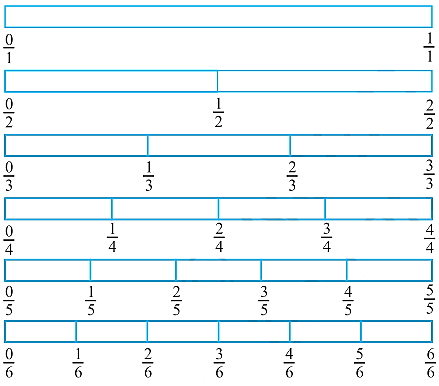
$a.\ \frac{1}{6} \square \frac{1}{3}$
$b.\ \frac{3}{4} \square \frac{2}{6}$
$c.\ \frac{2}{3} \square \frac{2}{4}$
$d.\ \frac{6}{6} \square \frac{3}{3}$
$e.\ \frac{5}{6} \square \frac{5}{5}$
Make five more such problems and solve them with your friends. Answer$a.\ $In this part of the question, we have,
The numerator of both the fractions are equal
Hence, fraction having lesser denominator will be greater
Therefore,
$\frac{1}{6}<\frac{1}{3}$
$b.\ $In this question, first of all, we have to make the same denominator of both the fractions:
$\frac{3 \times 3}{4 \times 3}=\frac{9}{12}$
Also,
$\frac{2 \times 2}{6 \times 2}=\frac{4}{12}$
Now, the denominators of both the fractions are equal
Hence, fraction having greater numerator will be greater
As, $9 > 4$
Therefore,
$\frac{3}{4}>\frac{2}{6}$
$c.\ $In this part of the question, we have,
The numerator of both the fractions are equal
Therefore, fraction having lesser denominator will be greater
Therefore,
$\frac{2}{3}>\frac{2}{4}$
$d.\ $In this part of the question, we have,
$\frac{6}{6}= 1$
Also,
$\frac{3}{3}= 1$
Therefore,
$1 = 1$
Hence,
$\frac{6}{6}=\frac{3}{3}$
$e.\ $In this part of the question, we have,
The numerator of both the fractions are equal
Hence, fraction having lesser denominator will be greater
Therefore,
$\frac{5}{6}<\frac{5}{5}$
View full question & answer→Question 195 Marks
Write the fraction representing the shaded portion

Answer

$\frac56>\frac26,\;\frac36>\frac06,\;\frac16<\frac66,\frac86>\frac56$
View full question & answer→Question 205 Marks
Write shaded portion as fraction. Arrange the following figure in ascending and descending order correct sign $'<', '=', '>'$ between the fractions:
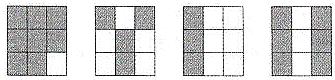
Answer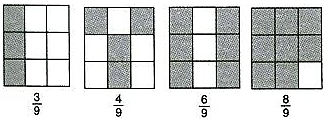
$i.\ $In ascending order, these are $\frac39,\frac49,\frac69,\frac89$
i.e.,$\frac39 < \frac49 < \frac69 < \frac89$
$ii.\ $In descending order, these are$\frac89,\frac69,\frac49,\frac39$
i.e.,$\frac89 > \frac69 > \frac49 > \frac39$ View full question & answer→Question 215 Marks
Write shaded portion as fraction. Arrange them in ascending and descending order correct sign $'<', '=', '>'$ between the fractions.

Answer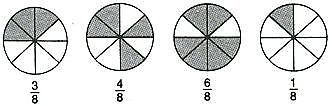
$i.\ $In ascending order, these are $\frac18,\frac38,\frac48,\frac68$
i.e.,$\frac18 < \frac38 < \frac48 < \frac68$
$ii.\ $In descending order, these are $\frac68,\frac48,\frac38,\frac18$
i.e.,$\frac68 > \frac48 > \frac38 > \frac18$ View full question & answer→Question 225 Marks
Match the equivalent fractions:
| $(a) \frac{250}{400}$ |
$i.\frac{2}{3}$ |
| $(b) \frac{180 }{200}$ |
$ii. \frac{2}{5}$ |
| $(c) \frac{660}{990}$ |
$iii.\frac{1}{2}$ |
| $(d) \frac{180}{360}$ |
$iv. \frac{5}{8}$ |
| $(e) \frac{220}{550}$ |
$v. \frac{9}{10}$ |
View full question & answer→Question 235 Marks
Ramesh had $20$ pencils, Sheelu had $50$ pencils and Jammal had $80$ pencils. After $4$ months, Ramesh used up $10$ pencils, sheelu used up $25$ pencils and Jammal used up $40$ pencils. What fraction did each use up$?$
AnswerFor Ramesh
Number of pencils he had $= 20$
Number of pencils used by him $= 10$
$\because H.C.F.$ of $10$ and $20$ is $10$
$\therefore$ Required fraction$=\frac{10}{20}=\frac{10\div10}{20\div10}=\;\frac12$
For Sheelu
Number of pencils she had $= 50$
Number of pencils used by her $= 25$
$\because H.C.F.$ of $25$ and $50$ is $25$
$\therefore$ Required fraction $=\frac{25}{50}=\frac{25\div25}{50\div25}=\;\frac12$
For Jammal
Number of pencils he had $= 80$
Number of pencils used by him $= 40$
$\because H.C.F.$ of $40$ and $80$ is $40$
$\therefore$ Required fraction$= \frac{40}{80}=\frac{40\div40}{80\div40}=\;\frac12$
Yes! each has up an equal fraction of their pencils.
View full question & answer→Question 245 Marks
Reduce the fraction to simplest from: $\frac7{28}$
AnswerFactors of $7$ are $1$ and $7$
Factors of $28$ are $1, 2, 4, 7, 14$ and $28$
$\therefore$ Common factors of $7$ and $28$ are $1$ and $7$
Highest of these common factors is $7$
$\therefore H.C.F.$ of $7$ and $28$ is $7$
Now, $\frac7{28}=\frac{7\div7}{28\div7}=\frac14$
Hence, the simplest form of $\frac7{28}$ is $\frac14$
View full question & answer→Question 255 Marks
Reduce the fraction to simplest from: $\frac{12}{52}$
AnswerFactors of $12$ are $1, 2, 3, 4, 6$ and $12$
Factors of $52$ are $1, 2, 4, 13, 26$ and $52.$
$\therefore$ Common factors of $12$ and $52$ are $1, 2$ and $4.$
Highest of these common factors is $4.$
$\therefore H.C.F.$ of $12$ and $52$ is $4.$
Now,$\frac{12}{52}=\frac{12\div4}{52\div4}=\;\frac3{13}$
Hence, the simplest form of $\frac{12}{52}$ is$\frac3{13}$
View full question & answer→Question 265 Marks
Reduce the fraction to simplest from: $\frac{84}{98}$
AnswerFactors of $84$ are $1, 2, 3, 4, 6, 7, 12, 14, 21, 28, 42$ and $84$
Factors of $98$ are $1, 2, 7, 14, 49$ and $98.$
$\therefore$ Common factors of $84$ and $98$ are $1, 7$ and $14.$
Highest of these common factors is $14.$
$\therefore H.C.F.$ of $84$ and $98$ is $14.$
Now,$\frac{84}{98}=\frac{84\div14}{98\div\;14}=\frac67$
Hence, the simplest form of $\frac{84}{98}$ is$\frac67$
View full question & answer→Question 275 Marks
Reduce the fraction to simplest from: $\frac{150}{60}$
AnswerFactors of $150$ are $1, 2, 3, 5, 6, 10, 15, 25, 30, 50, 75$ and $150$
Factors of $60$ are $1, 2, 3, 4, 5, 6, 10, 12, 15, 20, 30$ and $60$
$\therefore$ Common factors of $150$ and $60$ are $1, 2, 3, 5, 6, 10, 15$ and $30.$
Highest of these common factors is $30.$
$\therefore H.C.F. $ of $150$ and $60$ is $30.$
Now,$\frac{150}{60}=\frac{150\div30}{60\div\;30}=\frac52$
Hence, the simplest form of $\frac{150}{60}$ is$\frac52$
View full question & answer→Question 285 Marks
Write the fraction representing the shaded portion
AnswerFactors of $48$ are $1, 2, 3, 4, ,6, 8, 12, 16, 24$ and $48.$
Factors of $60$ are $1, 2, 3, 4, 5, 6, 10, 12, 15, 20, 30$ and $60.$
$\therefore$ Common factors of $48$ and $60$ are $1, 2, 3, 4, 6$ and $12.$
Highest of these common factors is $12.$
$\therefore H.C.F.$ of $48$ and $60$ is $12$
Now,$\frac{48}{60}=\frac{48\div12}{60\div\;12}=\frac45$
Hence, the simplest form of$\frac{48}{60}$ is $\frac45$
View full question & answer→Question 295 Marks
Write the fractions and pair up the equivalent fractions from each row.
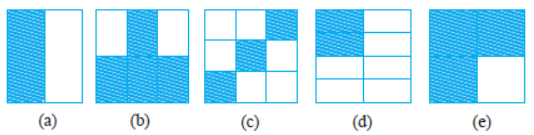
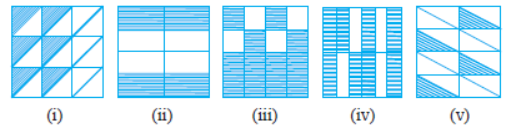
Answer
$a.\ $Here,
The figure is divided into two equal parts
And,
One part is shaded out of these two parts
Hence,
The figure represents a fraction of $\frac{1}{2}$.
$b.\ $Here,
The figure is divided into six equal parts
And,
Four parts are shaded out of these six parts
Hence,
The figure represents a fraction of $\frac{4}{6}$ or $\frac{2}{3}$
$c.\ $Here,
The figure is divided into nine equal parts
And,
Three parts are shaded out of these nine parts
Hence,
The figure represents a fraction of $\frac{3}{9} \text { or } \frac{1}{3}$
$d.\ $Here,
The figure is divided into nine equal parts
And,
Three parts are shaded out of these nine parts
Hence,
The figure represents a fraction of $\frac{2}{8} \text { or } \frac{1}{4}$
$e.\ $Here,
The figure is divided into four equal parts
And,
Three parts are shaded out of these four parts
Hence,
The figure represents a fraction of $\frac{3}{4}$
$i.\ $Here,
The figure is divided into eighteen equal parts
And,
Six parts are shaded out of these eighteen parts
Hence,
The figure represents a fraction of $\frac{6}{18} \text { or } \frac{1}{3}$
$ii.\ $Here,
The figure is divided into eight equal parts
And,
Four parts are shaded out of these eight parts
Hence,
The figure represents a fraction of $\frac{4}{8} \text { or } \frac{1}{2}$
$iii.\ $Here,
The figure is divided into sixteen equal parts
And,
Twelve parts are shaded out of these sixteen parts
Hence,
The figure represents a fraction of $\frac{12}{16} \text { or } \frac{3}{4}$
$iv.\ $Here,
The figure is divided into twelve equal parts
And,
Eight parts are shaded out of these twelve parts
Hence,
The figure represents a fraction of $\frac{8}{12} \text { or } \frac{2}{3}$
$v.\ $Here,
The figure is divided into sixteen equal parts
And,
Four parts are shaded out of these sixteen parts
Hence,
The figure represents a fraction of $\frac{4}{16} \text { or } \frac{1}{4}$
Pair up with the equivalent fractions: $(a) - (ii), (b) - (iv), (c) - (i), (d) - (v), (e) - (iii)$
View full question & answer→Question 305 Marks
Write the fractions. Are all these fraction equivalent ?

Answer
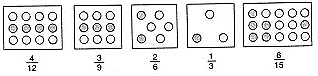
The figure $(i)$ represents $4$ shaded circles out of $12$ circles. So $\frac4{12}=\;\frac{4\div4}{12\div4}=\;\frac13 [\therefore HCF (4, 12) = 4]$
The figure $(ii)$ represents $3$ shaded circles out of $9$ circles. So $\frac3{9}=\;\frac{3\div3}{9\div3}=\;\frac13 [\therefore HCF (3, 9) = 3]$
The figure $(iii)$ represents $2$ shaded circles out of $6$ circles. So $\frac2{6}=\;\frac{2\div2}{6\div2}=\;\frac13 [\therefore HCF (2, 6) = 2]$
The figure $(iv)$ represents $1$ shaded circle out of $3$ circles. So $ \;\frac13$
The figure $(v)$ represents $6$ shaded circles out of $15$ circles. So $\frac6{15}=\;\frac{6\div3}{15\div3}=\;\frac25 [\therefore HCF (6, 15) = 3]$
So, all these fractions are not equivalent. View full question & answer→Question 315 Marks
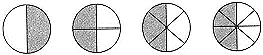
Write the fractions. Are all these fraction equivalent?
Answer
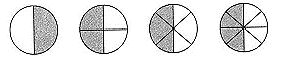
The first figure represents $1$ shaded parts out of $2$ equal parts= $\frac12$
The second figure represents $2$ shaded parts out of $4$ equal parts= $\frac24=\;\frac{2\div2}{4\div2}=\;\frac12$
The third figure represents $3$ shaded parts out of $6$ equal parts. $\frac36=\;\frac{3\div3}{6\div6}=\;\frac12$
The fourth figure represents $4$ shaded parts out of $8$ equal parts. $\frac48=\;\frac{4\div4}{8\div4}=\;\frac12$
So, all these fractions are equivalent. View full question & answer→Question 325 Marks
Draw number line and locate the points on them: $\frac25,\;\frac35,\frac85,\;\frac45$
View full question & answer→Question 335 Marks
Draw number line and locate the points on them: $\frac18,\;\frac28,\frac38,\;\frac78$.
View full question & answer→Question 345 Marks
Draw number line and locate the points on them: $\frac12,\;\frac14,\frac34,\;\frac44$
View full question & answer→Question 355 Marks
Write the natural numbers from $102$ to $113.$ What fraction of them are prime numbers $?$
AnswerThe natural numbers from $102$ to $113 $ are
$102, 103, 104, 105, 106, 107, 108, 109, 110, 111, 112$ and $113$
Total number of natural numbers $= 12$
Out of these, the prime numbers are $103, 107, 111, 113.$
Total number of these prime numbers $= 4$
$\therefore $ Required fraction = $\frac4{12}=\;\frac{4\div4}{12\;\div\;4}=\;\frac13$
View full question & answer→Question 365 Marks
Write the natural numbers from $2$ to $12.$ What fraction of them are prime numbers$ ?$
AnswerThe natural numbers from $2$ to $12$ are $2, 3, 4, 5, 6, 7, 8, 9, 10, 11$ and $12$
Total number of natural numbers from $2$ to $12 = 11$
Out of these, the prime numbers are $2, 3, 5, 7, 11$
Total number of prime numbers from $2$ to $12 = 5$
$\therefore $ Required fraction $ = \frac5{11}$
View full question & answer→Question 375 Marks
Identify the error, if any

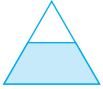
this is $\frac{3}{4}$
AnswerWe know that,
A fraction is a number that represents part of a whole and the parts needs to be equally divided.
Here,
we can see that,
The shape is not divided into equal parts.
Hence,
The given figure does not represent the fraction.
View full question & answer→Question 385 Marks
Identify the error, if any
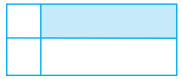
this is $\frac{1}{4}$
AnswerWe know that,
A fraction is a number that represents part of a whole and the parts needs to be equally divided.
Here,
we can see that,
The given figure is not divided into equal parts.
Hence,
The given figure does not represent the given fraction.
View full question & answer→Question 395 Marks
Identify the error, if any
this is $\frac{1}{2}$
AnswerWe know that,
A fraction is a number that represents part of a whole and the parts need to be equally divided.
Here,
The whole may be a single object or a group of objects.
But from the above, figure, we can see that,
It is not divided into equal parts.
Hence,
The given figures do not represent the given fraction.
View full question & answer→Question 405 Marks
Krishna received a $CD$ player for her birthday. She bought $3$ $CDs$ and received $5$ others as gifts. What fraction of her total $CDs$ did she buy and what fraction did she receive as gifts$?$
AnswerNumbers of $CDs$ bought $= 3$
Number of $CDs$ received as gifts $= 5$
$\therefore $ Total number of $CDs = 3 + 5 = 8$
$\therefore $ Fraction of her total $CD$s that she bought $= \frac38$
and, fraction of her total $CDs$ that received as gifts $= \frac58$ .
View full question & answer→Question 415 Marks
Compare $\frac{4}{5}$ and $\frac{5}{6}$.
AnswerThe given fractions are unlike fractions. Their numerators are different too.
Let us write their equivalent fractions.
$\frac{4}{5}=\frac{8}{10}=\frac{12}{15}=\frac{16}{20}=\frac{20}{25}=\frac{24}{30}=\frac{28}{35}=$.........
and $\frac{5}{6}=\frac{10}{12}=\frac{15}{18}=\frac{20}{24}=\frac{25}{30}=\frac{30}{36}=$ ........
The equivalent fractions with the same denominator are :
$\frac{4}{5}=\frac{24}{30}$ and $\frac{5}{6}=\frac{25}{30}$
Since, $25 > 24$
So, $\frac{25}{30}>\frac{24}{30}$
$\Rightarrow$ $\frac{5}{6}>\frac{4}{5}$
View full question & answer→Question 425 Marks
Find the equivalent fraction of $\frac{2}{9}$ with denominator $63.$
AnswerHere,
We have, $\frac{2}{9}=\frac{\square}{63}$
Thus, we should have, $9 \times \square = 2 \times 63.$
But, $63 = 7 \times 9,$ so $9 \times \square = 2 \times 7 \times 9 = 14 \times 9 = 9 \times 14$
or $9 \times \square = 9 \times 14$
By comparison, $\square = 14.$
Therefore, $\frac{2}{9}=\frac{14}{63}.$
View full question & answer→Question 435 Marks
Add $2 \frac{4}{5}$ and $3 \frac{5}{6}$
AnswerHere, we have,
$2 \frac{4}{5}+3 \frac{5}{6}=2+\frac{4}{5}+3+\frac{5}{6}=5+\frac{4}{5}+\frac{5}{6}$
Now $\frac{4}{5}+\frac{5}{6}=\frac{4 \times 6}{5 \times 6}+\frac{5 \times 5}{6 \times 5} ($Since $LCM$ of $5$ and $6 = 30)$
$= \frac{24}{30}+\frac{25}{30}=\frac{49}{30}=\frac{30+19}{30}=1+\frac{19}{30}$
Thus, $5+\frac{4}{5}+\frac{5}{6}=5+1+\frac{19}{30}=6+\frac{19}{30}=6 \frac{19}{30}$
Therefore, $2 \frac{4}{5}+3 \frac{5}{6}=6 \frac{19}{30}$
View full question & answer→