Question
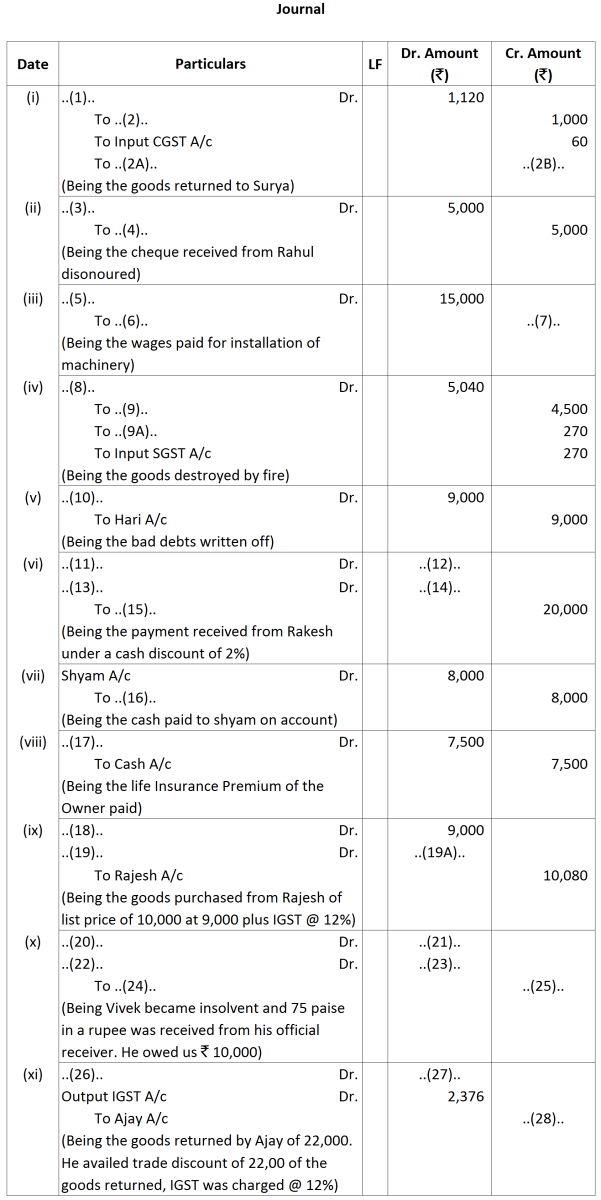
Fill in the missing values on the basis of narration:
Answer

Get the step-by-step solution for this question inside the Vidyadip app.

Get the answer in the app

Need a full question paper?

Generate a complete, print-ready paper with questions like this in minutes — across 16+ boards, with answer keys.

Start Generating Free

Similar questions

Vimal purchased goods ₹ 25,000 from Kamal on Jan. 15, 2017 and accepted a bill of exchange drawn upon him by Kamal payable after two months. On the date of the maturity the bill was duly presented for payment. Vimal dishonoured the bill.
Record the necessary journal entries in the books of Kamal and Vimal when:
  1. The bill was retained by Kamal till the date of its maturity.
  2. The bill was immediately discounted by Kamal with is bank @ 6% p.a.
  3. The bill was endorsed by Kamal in favour of his creditor Sharad.
  4. Five days before its maturity the bill was sent by Kamal to his bank for collection.
Enter the following transactions in the petty cash book with appropriate analysis columns:
2017
 
(₹)
Feb. 1
Received from cashier ₹ 9,250, the amount required to make up the amount of the 'imprest' viz.
10,000
Feb. 3
Chowkidar's Wages
500
Pencils, Pens etc.
250
Feb. 5
Bus fare to workmen sent to customer's premises
600
Feb. 7
Paid for wages
200
Feb. 10
Postage
800
Feb. 12
Three Wheeler's charges for manager's trip to the city
100
Feb. 12
Wages to casual labourer
850
Feb. 14
Repair of furniture
300
Feb. 14
Repair of scooter
400
Feb. 18
Taxi fare to assistant manager
750
Feb. 20
Refreshment to Customers
450
Feb. 22
Paid for cartage
1,500
Feb. 25
Locks purchased
1,200
Feb. 25
Conveyance
250
Feb. 26
Paid for writing pads and registers
900
Feb. 28
Courier Charges
550
Write the following transactions in the Cash Book of Premium Stores, Kolkata (Proprietor Amrit Kumar):
2019
 
Jan. 1
Commenced business with cash
50,000
Jan. 2
Opened Bank Account and deposited cash in bank
20,000
 
Purchased goods in cash of ₹ 5,000 plus CGST and SGST @ 6% each
5,000
Jan. 4
Paid wages
500
Jan. 6
Cash sales of ₹ 2,000 plus CGST and SGST @ 6% each
2,000
 
Purchased goods for ₹ 10,000 plus CGST and SGST @ 6% each for cash
 
Jan. 10
Sold goods of ₹ 4,000 plus CGST and SGST @ 6% each and payment received by cheque which is deposited in Bank, allowed cash discount of ₹ 400
 
 
Received from Amit
5,900
 
Allowed him discount
100
Jan. 15
Paid to Bhaskar
2,800
 
Received discount
200
Jan. 18
Purchased goods from Kanchan, Delhi of ₹ 10,000 plus IGST @ 12%
 
Jan. 20
Goods were destroyed during transportation, Transport Company settled the claim for ₹ 10,000 in full
 
Jan. 27
Received cheque from the transport company
10,000
Jan. 28
Withdrew for office use
5,000
On 1st April, 2015, a Company bought Plant and Machinery costing ₹ 68,000. It is estimated that its working life is 10 years, at the end of which it will fetch ₹ 8,000. Additions are made on 1st April, 2016 to the value of ₹ 40,000 (Residual value ₹ 4,000). More additions are made on Oct. 1, 2017 to the value of ₹ 9,800 (Break up value ₹ 800). The working life of both the additional Plant and machinery is 20 years.
Show the Plant and Machinery account for the first four years, if depreciation is written off according to Straight Line Method. The accounts are closed on 31st March every year.
Rectify the following errors:
i. Sold old furniture of A for $₹ 11,500$ was passed through the Sales Book.
ii. Credit purchases of $₹ 12,000$ from Ashely omitted to be recorded in the books.
iii. Repair made were debited to Building Account ₹ 7,000 .
iv. Credit Sale of ₹ 1,800 to Anshika was recorded as ₹ 8,100 .
v. ₹ 6,000 paid for office furniture was debited to the office expense account.
vi. A credit sale of goods $₹ 15,000$ to Rajesh has been wrongly passed through the Purchases Book.
Journalise the following trasactions:
 
 
1.
Charge depreciation on Machinery
20,000
2.
Salary due to Office Clerks
1,00,000
3.
Received cash for Bad-Debts written off last year
5,000
4.
Purchased goods from Ashok & Co. for 50,000 at 20% Trade Discount. Half the payment was made in cash.
 
5.
Issued cheque to Ashok & Co. in full settlement
19,500
6.
Paid Life Insurance Premium by cheque
6,000
7.
Proprietor used goods for household purposes
20,000
8.
Goods given free to a hospital out of business
10,000
Rectify the following errors:
  1. Credit sales to Mohan ₹ 7,000 were posted to Karan.
  2. Credit purchases from Rohan ₹ 9,000 were posted to Gobind.
  3. Goods returned to Rakesh ₹ 4,000 were posted to Naresh.
  4. Goods returned from Mahesh ₹ 1,000 were posted to Manish.
  5. Cash sales ₹ 2,000 were posted to commission account.
Rectify the following errors assuming that a suspense account was opened. Ascertain the difference in trial balance.
  1. Credit sales to Mohan ₹ 7,000 were posted to the credit of his account.
  2. Credit purchases from Rohan ₹ 9,000 were posted to the debit of his account as ₹ 6,000.
  3. Goods returned to Rakesh ₹ 4,000 were posted to the credit of his account.
  4. Goods returned from Mahesh ₹ 1,000 were posted to the debit of his account as ₹ 2,000.
  5. Cash sales ₹ 2,000 were posted to the debit of sales account as ₹ 5,000.
On Checking Ram's Cash Book with the bank statement of his overdraft current account for the month of November 2014, you find the following:
  1. Cash Book showed an overdraft of ₹ 16,200.
  2. The payment side of the Cash Book had been undercast by ₹ 500.
  3. A cheque for ₹ 13,600 drawn on his saving deposit account has been wrongly recorded as drawn on current account in the Cash Book.
  4. Cheques amounting to ₹ 18,800 drawn and entered in the Cash Book had not been presented.
  5. Cheques amounting to ₹ 7,500 sent to the bank for collection though entered in the Cash Book, had not been credited by the bank.
  6. Bank charge of ₹ 150 as per bank statement of account had not been taken in the Cash Book.
  7. Dividend of the amount of ₹ 420 had been paid direct to the bank and not entered in the Cash Book.
You are requested to arrive at the balance as it would appear in the bank statement as on 30th November 2014.
A Trial Balance showed excess credit of ₹ 2,728, which were placed in a suspense account. Later on the following errors were located. Pass rectifying entries and prepare Suspense A/c.
  1. ₹ 825, the total of purchase return book has been posted to the debit of sales return account.
  2. Goods purchased from Suresh ₹ 1,800 recorded in Sales Book as ₹ 180.
  3. An item of ₹ 328 written off as a bad debt from Ajay Sharma has not been debited to Bad Debts Account.
  4. Goods purchased from X ₹ 3,500 and from Y ₹ 4,000, but were recorded in the purchase book as X ₹ 4,000 and Y ₹ 3,500.
  5. Goods returned to Ramesh for ₹ 2,600 was correctly recorded in the return outward book but was wrongly posted to his account as ₹ 260.
  6. A sum of ₹ 2,210 stolen by an ex-employee stand debited to Suspense A/c.
  7. A sum of ₹ 500 written off as depreciation on Machinery, were not posted to Machinery account.