Question
Find a cubic polynomial whose zeroes are $\frac{1}{2},$ $1$ and $−3$.

Answer

If the zeroes of the cubic polynomial are a, b and c then the cubic polynomial can be found as:
$x^3- (a + b + c)x^2 + (ab + bc + ca)x - abc ...(1)$
Let $\text{a}=\frac{1}{2},$ $b = 1$ and $c = -3$
Substituting the values in (1), we get
$\text{x}^3-\Big(\frac{1}{2}+1-3\Big)\text{x}^2+\Big(\frac{1}{2}-3-\frac{3}{2}\Big)\text{x}-\Big(\frac{-3}{2}\Big)$
$\Rightarrow\text{x}^3-\Big(\frac{-3}{2}\Big)\text{x}^2-\text{4x}+\frac{3}{2}$
$\Rightarrow\text{2x}^3+\text{3x}^2-\text{8x}+3$

Need a full question paper?

Generate a complete, print-ready paper with questions like this in minutes — across 16+ boards, with answer keys.
Start Generating Free

Similar questions

Solve for x and y:
$\frac{5}{\text{x}}-\frac{3}{\text{y}}=1,$
$\frac{3}{\text{2x}}+\frac{2}{\text{3y}}=\text{5}$ $(\text{x}\neq0,\ \text{y}\neq0).$
Solve for x and y:
$\frac{2}{(3\text{x}+\text{2y)}}+\frac{3}{(3\text{x}-\text{2y)}}=\frac{17}{5},$
$\frac{5}{(3\text{x}+\text{2y)}}+\frac{1}{(3\text{x}-\text{2y)}}=2$
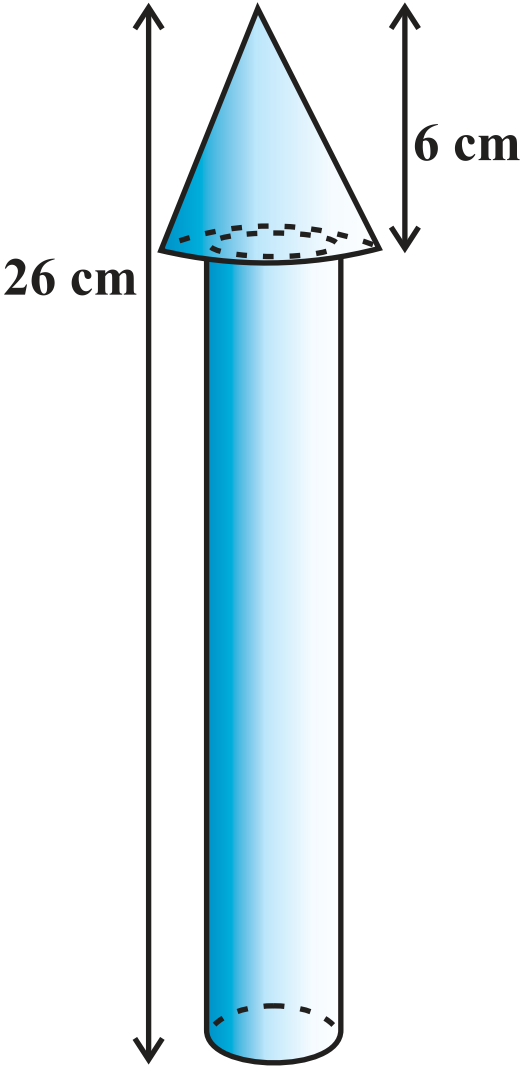
A wooden toy is in the shape of a cone mounted on a cylinder, as shown in the figure. The total height of the toy is 26cm, while the height of the conical part is 6cm. The diameter of the base of the conical part is 5cm and that of the cyliridrical part is 4cm. The conical part and the cylindrical part are respectively painted red and white. Find the area to be painted by each of these colours. $\big[$Take $\pi=\frac{22}{7}\big]$
Prove that $\frac{1}{(sec\theta-\tan\theta)}-\frac{1}{\cos\theta}=\frac{1}{\cos\theta}-\frac{1}{(\sec\theta+\tan\theta)}.$
To construct a triangle similar to $\triangle\text{ABC}$ in which BC = 4.5cm, $\angle\text{B}=45^\circ$ and $\angle\text{C}=60^\circ,$ using a scale factor of $\frac35$ BC will be divided in the ratio.
  1. 3 : 4
  2. 4 : 7
  3. 3 : 10
  4. 3 : 7
Show that $\big(4+3\sqrt2\big)$ is irrational.
Find the sum of n terms of the following series:
$\Big(4-\frac{1}{\text{n}}\Big)+\Big(4-\frac{2}{\text{n}}\Big)+\Big(4-\frac{3}{\text{n}}\Big)+\ ...$
A man invested an amount at 10% per annum and another amount at 8% per annum simple interest. Thus, he received ₹ 1350 as annual interest. Had he interchanged the amounts invested, he would have received ₹ 45 less as interest. What amounts did he invest at different rates?
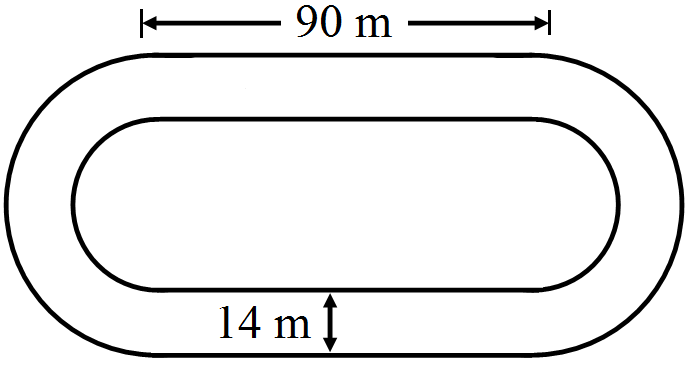
The inside perimeter of a running track shown in the shown in the figure is 400m. the length of the straigth portions is 90m, and the ends are semicicles. if the track. Also find the length of the outer boundary of the track. $\Big[\text{Use }\pi=\frac{22}{7}\Big]$
Draw a circle of radius 3.5cm. Draw a pair of tangent to this circle which are inclined to each other at an angle of 60°. Write the steps of construction.