Question 15 Marks
Short-Answer Question:
If $\alpha$ and $\beta$ are the zeroes of a polynomial $f(x) = 5x^2 - 7x + 1$, find the value of $\Big(\frac{1}{\alpha}+\frac{1}{\beta}\Big).$
AnswerSince $\alpha$ and $\beta$ are the zeros of $5x^2 - 7x + 1,$ we have
$\alpha+\beta=-\frac{(-7)}{5}=\frac{7}{5}$
$\alpha\beta=\frac{1}{5}$
$\therefore\frac{1}{\alpha}+\frac{1}{\beta}=\frac{\beta+\alpha}{\alpha\beta}$
$=\frac{\frac{7}{5}}{\frac{1}{5}}$
$=\frac{7}{5}\times\frac{5}{1}$
$=7$
View full question & answer→Question 25 Marks
Short-Answer Question:
If $\alpha$ and $\beta$ are the zeroes of a polynomial $f(x) = x^2 + x - 2$, find the value of $\Big(\frac{1}{\alpha}-\frac{1}{\beta}\Big).$
AnswerSince $\alpha$ and $\beta$ are the zeros of $x^2 + x - 2$, we have
$\alpha+\beta=-\frac{1}{1}=-1$
$\alpha\beta=\frac{-2}{1}=-2$
$\therefore\frac{1}{\alpha}-\frac{1}{\beta}=\frac{\beta-\alpha}{\alpha\beta}$
$=\frac{\sqrt{(\beta+\alpha)^2-4\alpha\beta}}{\alpha\beta}$ $\dots[(\text{a}-\text{b})^2=(\text{a}+\text{b})^2-\text{4ab}]$
$=\frac{\sqrt{(-1)^2-4(-2)}}{-2}$
$=-\frac{\sqrt{1+8}}{2}$
$=-\frac{\sqrt9}{2}$
$=-\frac{3}{2}$
View full question & answer→Question 35 Marks
Find the quotient and the remainder when:
$f(x) = x^4 - 3x^2 + 4x + 5$ is divided by $g(x) = x^2 + 1 - x$
Answer
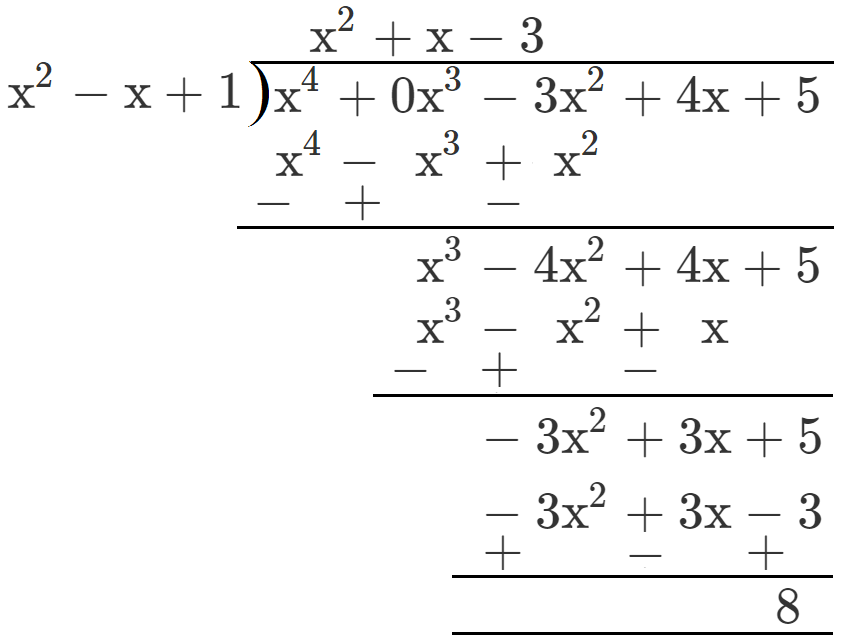
Quotient $q(x) = x^2 + x - 3$
Remainder $r(x) = 8$ View full question & answer→Question 45 Marks
Find the quadratic polynomial whose zeros are $\frac{2}{3}$ and $\frac{-1}{4}.$ Verify the relation between the coefficients and the zeros of the polynomial.
AnswerLet $\alpha$ and $\beta$ are the zeros then
$\alpha +\beta=\frac{2}{3}+\Big(-\frac{1}{4}\Big)$
$=\frac{8-3}{12}=\frac{5}{12}$
$\alpha\beta=\frac{2}{3}\times\Big(-\frac{1}{4}\Big)$
$=-\frac{2}{12}=-\frac{1}{6}$
$\therefore$ quadratic polynomial whose zeros are $\alpha,\beta$ is:
$\text{x}^2-(\alpha+\beta)\text{x}+\alpha\beta$
$=\text{x}^2-\Big(\frac{5}{12}\Big)\text{x}+\Big(-\frac{1}{6}\Big)$
$=\frac{1}{12}(\text{12x}^2-\text{5x}-2)$
Sum of zeros $=-\frac{\text{Coefficient of x}}{\text{Coefficients of }\text{x}^2}$
$=-\frac{-5}{12}=\frac{5}{12}$
Also sum of zeros $=\frac{2}{3}+\Big(-\frac{1}{4}\Big)$
$=\frac{5}{12}$
Product of zeros $=\frac{\text{Constant term}}{\text{Coefficient of }\text{x}^2}$
$=\frac{-2}{12}=\frac{-1}{6}$
Also product of zeros $=\frac{2}{3}\times\Big(-\frac{1}{4}\Big)$
$=\frac{-2}{12}=\frac{-1}{6}$
View full question & answer→Question 55 Marks
If two zeroes of the polynomial $p(x) = 2x^4 - 3x^3 - 3x^2 + 6x - 2 $are $\sqrt2$ and $-\sqrt2,$ find its other two zeroes.
AnswerGiven:$ p(x) = 2x^4 - 3x^3 - 3x^2 + 6x - 2$ and the two zeros $\sqrt2$ and $-\sqrt2$So, the polynomial is $\big(\text{x}+\sqrt2\big)\big(\text{x}-\sqrt2\big)=\text{x}^2-2$
Let us divide p(x) by $(x^2 - 2).$
$$Here,$ 2x^4 - 3x^3 - 3x^2 + 6x - 2$
$= (x^2 - 2)(2x^2 - 3x + 1)$
$ = (x^2 - 2)[2x^2 - (2 + 1)x + 1] $
$= (x^2 - 2)(2x^2- 2x - x + 1) $
$= (x^2 - 2)[(2x(x - 1) - 1(x - 1))] $
$= (x^2 - 2)(2x - 1)(x - 1)$
$\therefore$ The other two zeros are $\frac{1}{2}$ and 1.
View full question & answer→Question 65 Marks
Short-Answer Question:
If the zeroes of a polynomial $f(x) = x^3 - 3x^2+ x + 1$ are $(a - b), a$ and $(a + b),$ find a and $b.$
AnswerGiven Polynomial is $p(x) = x^3 - 3x^2+ x + 1$
Let $\alpha=(\text{a}-\text{b}) ,\ \beta=\text{a}$ and $\gamma=(\text{a}+\text{b})$
Now, $\alpha+\beta+\gamma=-\frac{(-3)}{1}$
$\Rightarrow (a - b) + a + (a + b) = 3$
$\Rightarrow 3a = 3$
$\Rightarrow a = 1$
Also, $\alpha\beta+\beta\gamma+\gamma\alpha=\frac{1}{1}$
$\Rightarrow (a - b)a + a(a + b) + (a + b)(a - b) = 1$
$\Rightarrow a^2 - ab + a^2 + ab + a^2 - b^2 = 1$
$\Rightarrow 3a^2- b^2 = 1$
$\Rightarrow 3(1)^2 - b^2 = 1$
$\Rightarrow b^2 = 2$
$\Rightarrow\text{b}=\pm\sqrt2$
Hence, a = 1 and $\text{b}=\pm\sqrt2$
View full question & answer→Question 75 Marks
On dividing, $3 x^3+x^2+2 x+5$ by a polynomial $g(x)$, the quotient and remainder are $3 x-5$ and $9 x+10$ respectively. Find $g ( x )$
Hint: $g ( x )=\frac{\left(3 x ^3+ x ^2+2 x +5\right)-(9 x +10)}{(3 x -5)}$
AnswerBy using division rule, we have
Divided = Quotient × Divisor + Remainder
$\therefore$ $3x^3 + x^2 + 2x + 5 = (3x - 5)g(x) + 9x + 10$
$\Rightarrow 3x^3+ x^2 + 2x + 5 - 9x - 10 = (3x - 5)g(x)$
$\Rightarrow 3x^3 + x^2 - 7x - 5 = (3x - 5)g(x)$
$\Rightarrow\text{g}(\text{x})=\frac{3\text{x}^3+\text{x}^2-\text{7x}-5}{\text{3x}-5}$
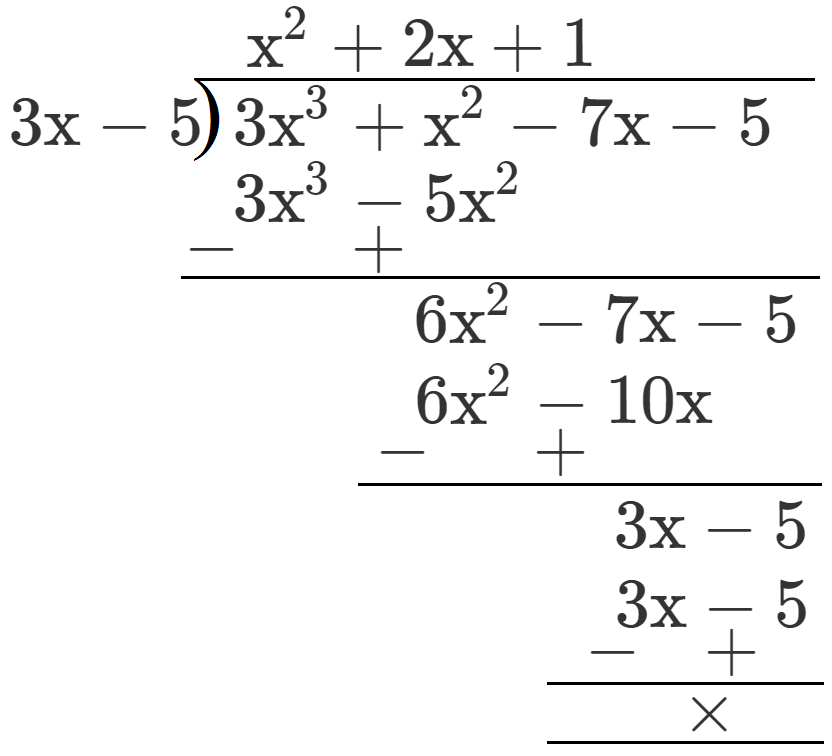
$\therefore g(x) = x^2 + 2x + 1$ View full question & answer→Question 85 Marks
Find a cubic polynomial whose zeros are $3, 5$ and $-2$
AnswerLet $\alpha,\ \beta$ and $\gamma$ be the zeros of the required polynomial.
Then we have:
$\alpha+\beta+\gamma$
$=3+5+(-2)=6$
$\alpha\beta+\beta\gamma+\gamma\alpha$
$=3\times5+5\times(-2)+(-2)\times3=-1$
and $\alpha\beta\gamma=3\times5\times-2=-30$
Now, $\text{p}(\text{x})=\text{x}^3-\text{x}^2(\alpha+\beta+\gamma)+\text{x}(\alpha\beta+\beta\gamma+\gamma\alpha)-\alpha\beta\gamma$
$=\text{x}^3-\text{x}^2\times6+\text{x}\times(-1)-(- 30)$
$=\text{x}^3-\text{6x}^2-\text{x}=30$
So, the required polynomial is $p(x)=x^3-6 x^2-x+30$
View full question & answer→Question 95 Marks
Find the quotient when $p(x) = 3x^4 + 5x^3 - 7x^2 + 2x + 2$ is divided by $(x^2 + 3x + 1).$
AnswerGiven: $p(x) = 3x^4 + 5x^3 - 7x^2 + 2x + 2$
Dividing $p(x) by (x^2 + 3x + 1)$, we have:
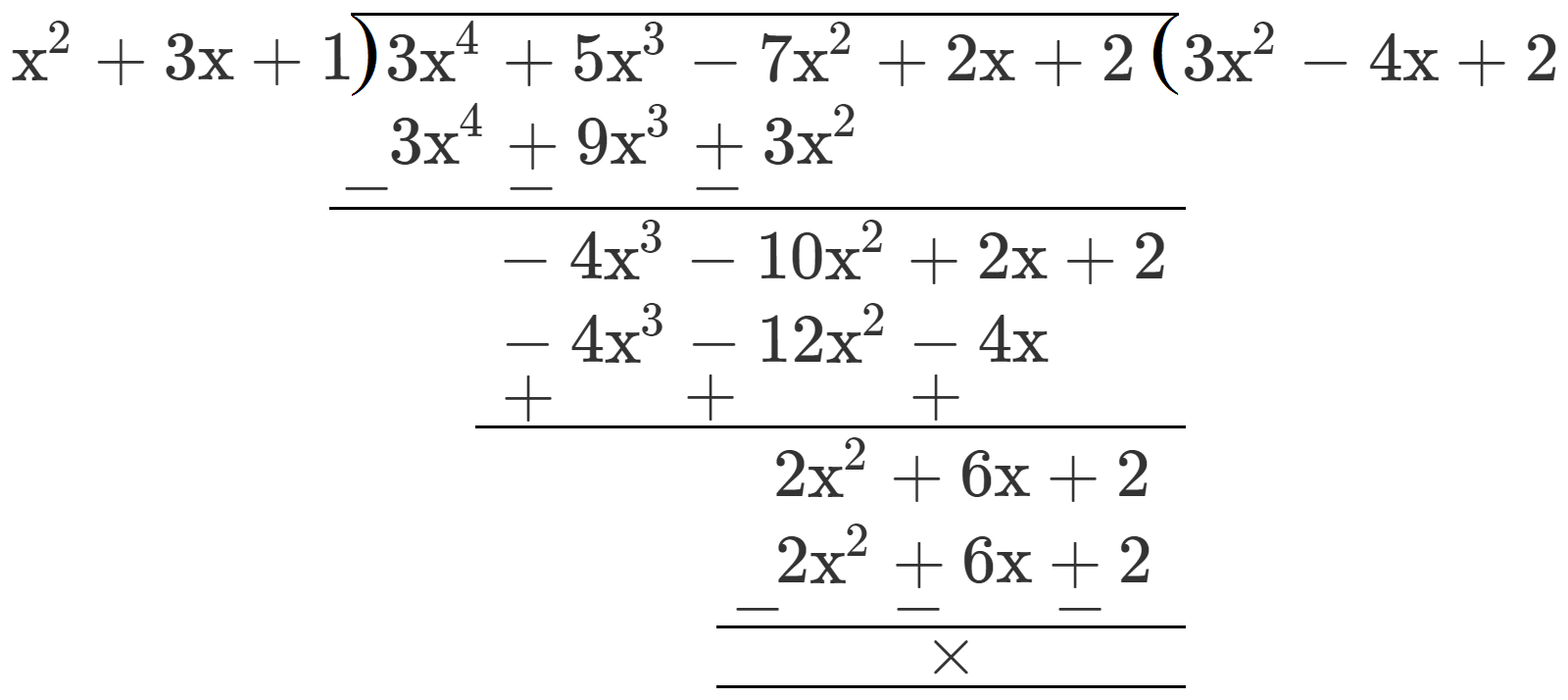
$\therefore$ The quotient is $3x^2 - 4x + 2$ View full question & answer→Question 105 Marks
Short-Answer Question:
Write the zeros of the quadratic polynomial $\text{f}(\text{x})=4\sqrt3\text{x}^2+\text{5x}-2\sqrt3$
AnswerWe have,
$\text{f}(\text{x})=4\sqrt3\text{x}^2+\text{5x}-2\sqrt3$
$=4\sqrt3\text{x}^2+\text{8x}-\text{3x}-2\sqrt3$
$=\text{4x}\big(\sqrt3\text{x}+2\big)-\sqrt3\big(\sqrt3\text{x}+2\big)$
$=\big(\text{4x}-\sqrt3\big)\big(\sqrt3\text{x}+2\big)$
$\therefore\text{f}(\text{x})=0$
$\Rightarrow\big(\text{4x}-\sqrt3\big)\big(\sqrt3\text{x}+2\big)=0$
$\Rightarrow\text{4x}-\sqrt3=0$ or $\sqrt3\text{x}+2$
$\Rightarrow\text{x}=\frac{\sqrt3}{4}$ or $\text{x}=-\frac{2}{\sqrt3}$
So, the zeros of f(x) are $\frac{\sqrt3}{4}$ and $-\frac{2}{\sqrt3}$
View full question & answer→Question 115 Marks
Find all the zeros of the polynomial $(2x^4 - 11x^3 + 7x^2 + 13x)$, it being given that two if its zeros are $3+\sqrt2$ and $3-\sqrt2.$
AnswerLet $f(x) = 2x^4 - 11x^3 + 7x^2 + 13x - 7$
Since $\big(3+\sqrt2\big)$ and $\big(3-\sqrt2\big)$ are the zeros of f(x), it follows that each one of $\big(\text{x}+3+\sqrt2\big)$ and $\big(\text{x}+3-\sqrt2\big)$ is a factor of f(x).
Consequently, $\big[\text{x}-\big(3+\sqrt2\big)\big]\big[\text{x}-\big(3-\sqrt2\big)\big]$
$=\big[(\text{x}-3)-\sqrt2\big]\big[(\text{x}-3)+\sqrt2\big]$
$=\big[(\text{x}-3)^2-2\big]=\text{x}^2-6\text{x}+7,$ which is a factor of f(x).
On dividing f(x) by$ (x^2 - 6x + 7)$, we get:
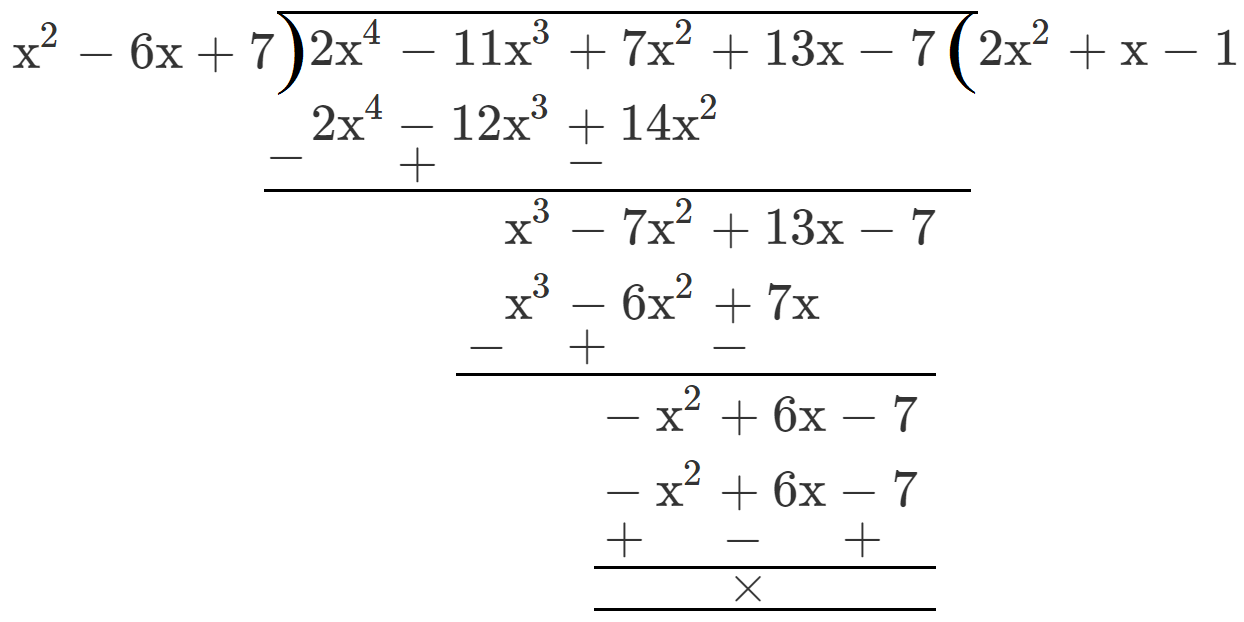
$\therefore$ $f(x) = 0$
$\Rightarrow 2x^4 - 11x^3 + 7x^2 + 13x - 7 = 0$
$\Rightarrow (x^2 - 6x + 7)(2x^2 + x - 1) = 0$
$\Rightarrow\big(\text{x}+3+\sqrt2\big)\big(\text{x}+3-\sqrt2\big)\$\text{2x}-1)(\text{x}+1)=0$
$\Rightarrow\text{x}=-3-\sqrt2$ or $\text{x}=-3+\sqrt2$ or $\text{x}=\frac{1}{2}$ or x = -1
Hence, all the zeros are $\big(-3-\sqrt2\big),\ \big(-3+\sqrt2\big),\ \frac{1}{2}$ and -1 View full question & answer→Question 125 Marks
If $3$ and $-3$ are two zeros of the polynomial $(x^4 + x^3 - 11x^2 - 9x + 18),$ find all the zeros of the given polynomial.
AnswerLet $f(x) = x^4 + x^3 - 11x^2 - 9x + 18$ Since $3$ and $-3$ are the zeros of $f(x),$ it follows that each one of $(x + 3)$ and $(x - 3)$ is a factor of $f(x)$. Consequently, $(x - 3)(x + 3) = (x^2 - 9)$ is a factor of $f(x).$ On dividing f(x) by $(x^2 - 9)$, we get:
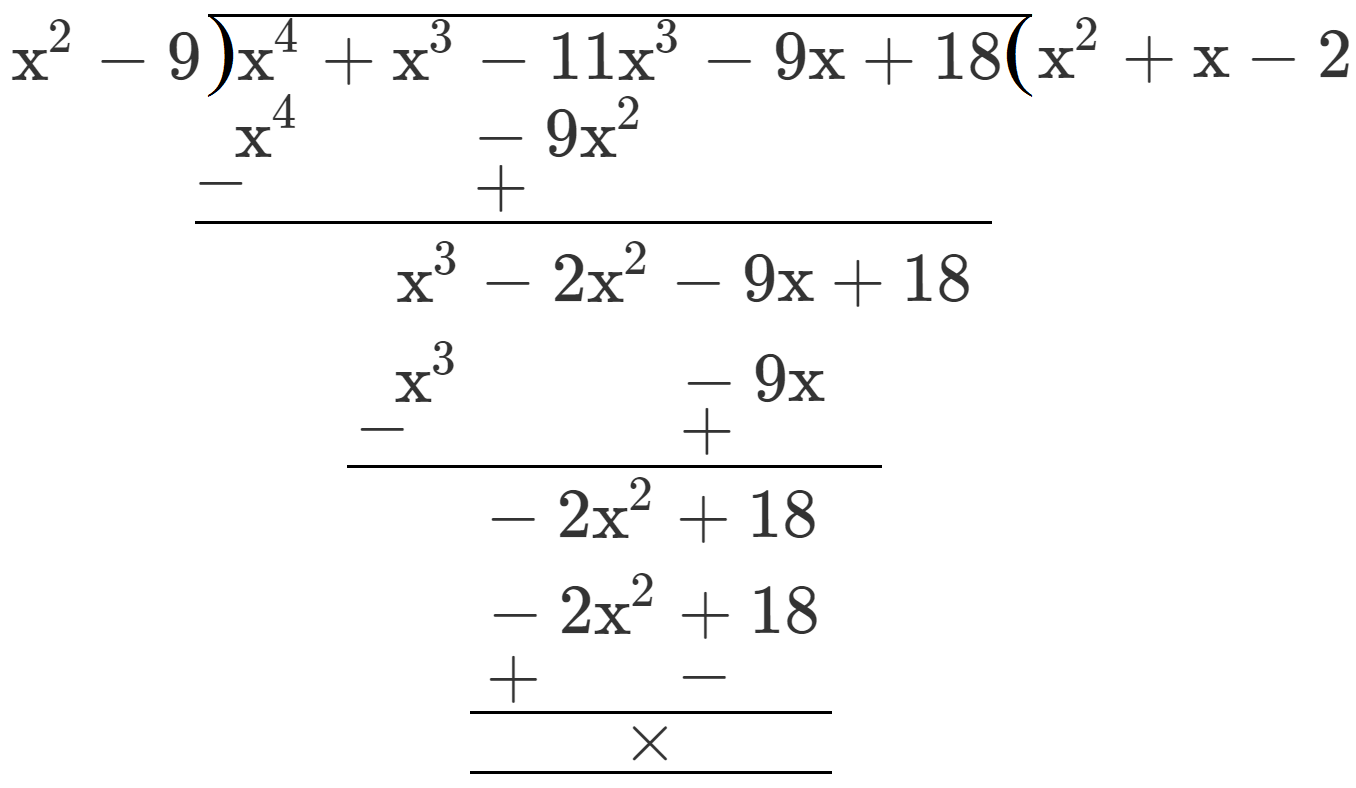
$\therefore$ $f(x) = 0 $
$\Rightarrow (x^2 + x - 2)(x^2 - 9) = 0 $
$\Rightarrow (x^2 + 2x - x - 2)(x - 3)(x + 3) = 0 $
$\Rightarrow (x - 1)(x + 2)(x - 3)(x + 3) = 0$
$\Rightarrow x = 1$ or $x = -2$ or $x = 3$ or $x = -3$ Hence, all the zeros are $1, -2, 3$ and $-3$ View full question & answer→Question 135 Marks
If one zero of the polynomial $p(x) = x^3 - 6x^2 + 11x - 6$ is $3$, find the other two zeroes.
AnswerGiven: $p(x) = x^3 - 6x^2 + 11x - 6$ and its factor, $x + 3$
Let us divided $p(x)$ by $(x - 3).$
Here, $x^3 - 6x^2 + 11x - 6$
$= (x - 3)(x^2 - 3x + 2)$
$= (x - 3)[x^2 - (2 + 1)x + 2]$
$= (x - 3)(x^2 - 2x - x + 2)$
$= (x - 3)[x(x - 2) - 1(x - 2)]$
$= (x - 3)(x - 1)(x - 2)$
$\therefore$ The other two zeros are $1$ and $2.$
View full question & answer→Question 145 Marks
Find a cubic polynomial whose zeroes are $\frac{1}{2},$ $1$ and $−3$.
AnswerIf the zeroes of the cubic polynomial are a, b and c then the cubic polynomial can be found as:
$x^3- (a + b + c)x^2 + (ab + bc + ca)x - abc ...(1)$
Let $\text{a}=\frac{1}{2},$ $b = 1$ and $c = -3$
Substituting the values in (1), we get
$\text{x}^3-\Big(\frac{1}{2}+1-3\Big)\text{x}^2+\Big(\frac{1}{2}-3-\frac{3}{2}\Big)\text{x}-\Big(\frac{-3}{2}\Big)$
$\Rightarrow\text{x}^3-\Big(\frac{-3}{2}\Big)\text{x}^2-\text{4x}+\frac{3}{2}$
$\Rightarrow\text{2x}^3+\text{3x}^2-\text{8x}+3$
View full question & answer→Question 155 Marks
Obtain all other zeros of $(x^4 + 4x^3 - 2x^2 - 20x - 15)$ if two of its zeros are $\sqrt5$ and $-\sqrt5.$
AnswerLet $f(x) = x^4 + 4x^3 - 2x^2 - 20x - 15$
Since $\sqrt5$ and $-\sqrt5$ are the zeros of $f(x)$, it follows that each one of $\big(\text{x}-\sqrt5\big)$ and $(\text{x}+\sqrt5)$ is a factor of f(x).
Consequently, $\big(\text{x}-\sqrt5\big)\big(\text{x}+\sqrt5\big)=(\text{x}^2-5)$ is a factor of $f(x)$.
On dividing $f(x)$ by $(x^2 - 5)$, we get:
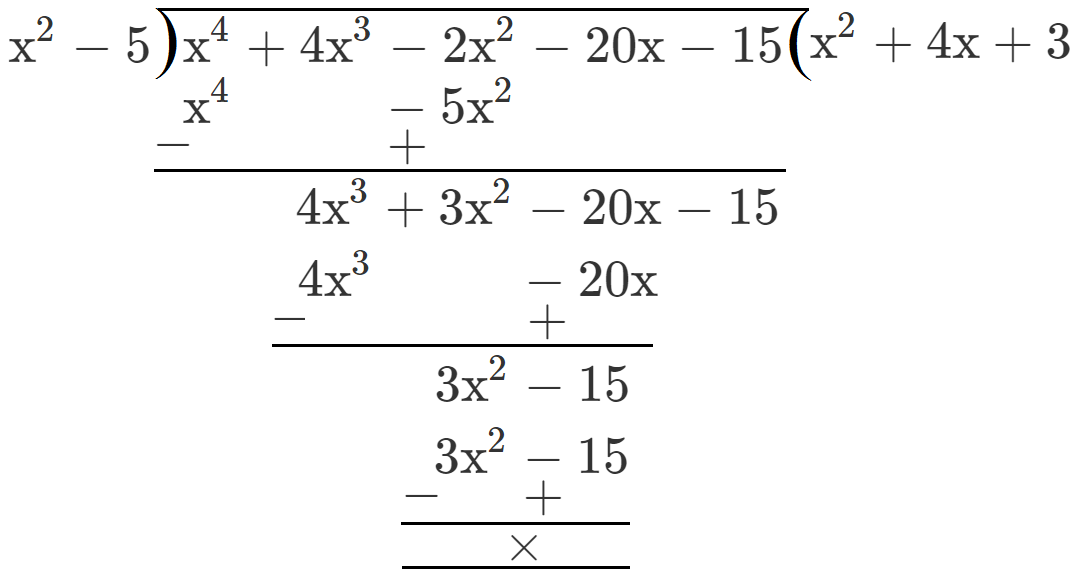
$\therefore$ $f(x) = 0 \Rightarrow x^4 + 4x^3 - 2x^2 - 20x - 15 \Rightarrow (x^2 - 5)(x^2 - 4x + 3)$
$\Rightarrow\big(\text{x}-\sqrt5\big)\big(\text{x}+\sqrt5\big)(\text{x}+1)(\text{x}+3)=0$
$\Rightarrow\text{x}=\sqrt5$ or $\text{x}=-\sqrt5$ or $x = -1$ or $x = -3$
Hence, all the zeros are $\sqrt5,\ -\sqrt5,\ -1$ and $-3$ View full question & answer→Question 165 Marks
Short-Answer Question:
Write the zeros of the quadratic polynomial $f(x) = 6x^2 - 3$
AnswerTo find the zeros of the quadratic polynomial we will equate $f(x)$ to $0 f(x) = 0$
$\Rightarrow 6x^2 - 3 = 0 $
$\Rightarrow 3(2x^2 - 1) = 0$
$ \Rightarrow 2x^2 - 1 = 0 $
$\Rightarrow 2x^2 = 1$
$\Rightarrow\text{x}^2=\frac{1}{2}$ $\Rightarrow\text{x}=\pm\frac{1}{\sqrt2}$
Hence, the zeros of the quadratic polynomial $f(x) = 6x^2 - 3$ are $\frac{1}{\sqrt2},\ -\frac{1}{\sqrt2}.$
View full question & answer→Question 175 Marks
Find all the zeros of $(x^4+x^3-23 x^2-3 x+60)$, if it is given that two of its zeros are $\sqrt3$ and $-\sqrt3.$
AnswerLet $f(x)=x^4+x^3-23 x^2-3 x+60$
Since $\sqrt3$ and $-\sqrt3$ are the zeros of f(x), it follows that each one of $\big(\text{x}-\sqrt3\big)$ and $(\text{x}+\sqrt3)$ is a factor of f(x).
Consequently, $\big(\text{x}-\sqrt3\big)\big(\text{x}+\sqrt3\big)=(\text{x}^2-3)$ is a factor of $f(x)$.
On dividing $f(x)$ by $(x^2 - 3)$, we get:
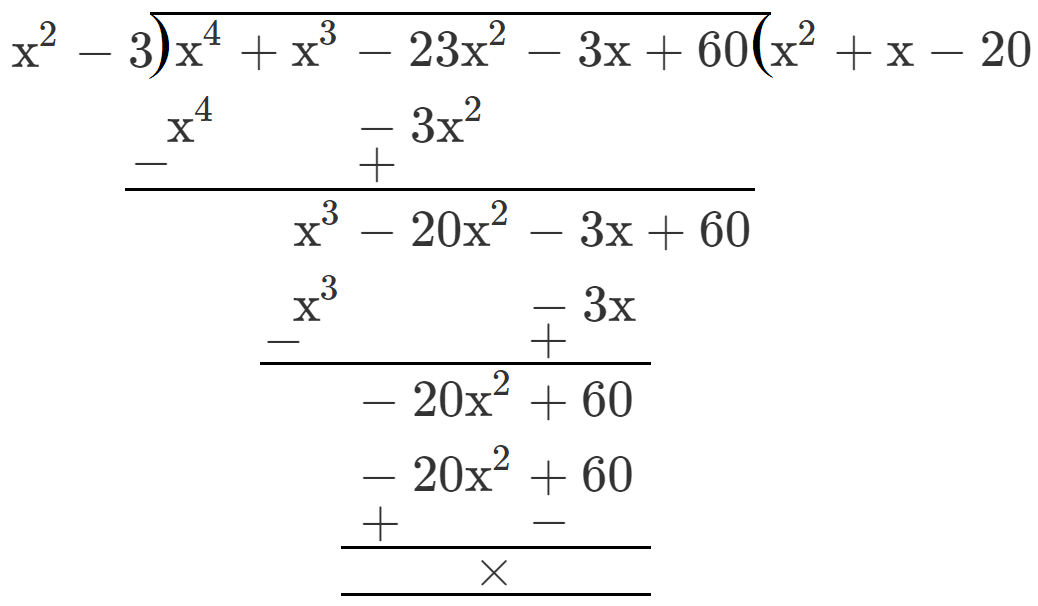
$\therefore$ $f(x) = 0 \Rightarrow (x^2 + x - 20)(x^2 - 3) = 0$
$ \Rightarrow (x^2 + 5x - 4x - 20)(x^2 - 3) = 0 $
$\Rightarrow [x(x + 5) - 4(x + 5)](x^2 - 3) = 0$
$\Rightarrow(\text{x}-4)(\text{x}+5) \big(\text{x}-\sqrt3\big)\big(\text{x}+\sqrt3\big)=0$
$\Rightarrow x = 4$ or $x = -5$ or $\text{x}=\sqrt3$ or $\text{x}=-\sqrt3$
Hence, all the zeros are $\sqrt3,\ -\sqrt3,\ 4$ and -5 View full question & answer→Question 185 Marks
Use remainder theorem to find the value of k, it being given that when $x^3 + 2x^2 + kx + 3$ is divided by $(x - 3)$, then the remainder is $21$.
AnswerLet $p(x) = x^3 + 2x^2 + kx + 3$
Now, $p(3) = (3)^3 + 2(3)^2 + 3k + 3$
$= 27 + 18 + 3k + 3$
$= 48 + 3k$
It is given that the remainder is $21$
$\therefore$ $3k + 48 = 21$
$\Rightarrow 3k = -27$
$\Rightarrow k = -9$
View full question & answer→