Question
Find a rational number between $-\frac{3}{4}$ and $-\frac{2}{5}$

Answer

$-\frac{3}{4}$ and $-\frac{2}{5}$Let:
$\text{x}=-\frac{3}{4}$ and $\text{y}=-\frac{2}{5}$
Rational number lying between x and y.
$\frac{1}{2}(\text{x}+\text{y})=\frac{1}{2}\Big(-\frac{3}{4}-\frac{2}{5}\Big)$
$\frac{1}{2}\Big(\frac{-15-8}{20}\Big)=-\frac{23}{40}$

Need a full question paper?

Generate a complete, print-ready paper with questions like this in minutes — across 16+ boards, with answer keys.
Start Generating Free

Similar questions

If the supplement of an angle is two-third of itself. Determine the angle and its supplement.
Define the following terms:
Half line.
Factorise:
$x^2-32 x-105$
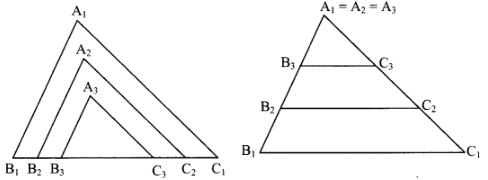
Draw a triangle $\Delta A _1 B_1 C _1$ on a card-sheet and cut it out.
Measure $\angle A _1, \angle B_1, \angle C _1$
Draw two more triangles $AA _2 B_2 C _2$ and $AA _3 B_3 C _3$ such that
$\angle A _1=\angle A _2=\angle A _3, \angle B_1=\angle B _2=\angle B _3, \angle C _1=\angle C _2=\angle C _3$ and $B _1 C _1> B _2 C _2> B _3 C _3$.
Now cut these two triangles also.
Measure the lengths of the three triangles. Arrange the triangles in two ways as shown in the figure.

Image

Check the ratios $\frac{A_1 B_1}{A_2 B_2}, \frac{B_1 C_1}{B_2 C_2}, \frac{A_1 C_1}{A_2 C_2}$.
You will notice that the ratios are equal.
Similarly, see whether the ratios $\frac{A_1 C_1}{A_3 C_3}, \frac{B_1 C_1}{B_3 C_3}, \frac{A_1 B_1}{A_3 B_3}$ are equal.
What do you observe?
The weights of 10 students (in kg) are given below:
40, 35, 42, 43, 37, 35, 37, 37, 42, 37. Find the mode of the data.
Assuming that x, y, z are positive real numbers, simplify the following:$\Big(\text{x}^{-\frac{2}{3}}\text{y}^{-\frac{1}{2}}\Big)^2$
If a = 2, b = 3, find the values of:$\big(\text{a}^{\text{b}}+\text{b}^{\text{a}}\big)^{-1}$
Factorize the following polynomials: $\left(x^2-x\right)^2-8\left(x^2-x\right)+12$
Express the following equation in the form ax + by + c = 0 and indicate the values of a, b, c in case.
x = 6
Write the following in the expanded form:
$(-2 x+3 y+2 z)^2$