Question 12 Marks
Rationalise the denominator of the following:$\frac{1}{\sqrt{5}-2}$
AnswerIf a and b are integers, then$\big(\text{a}+\sqrt{\text{b}}\big)$ and $\big(\text{a}-\sqrt{\text{b}}\big)$ are rationalising factor of each other, as $\big(\text{a}+\sqrt{\text{b}}\big)\big(\text{a}-\sqrt{\text{b}}\big)=\big(\text{a}^2-\text{b}\big),$ which is rational.
Therefore, we have,$=\frac{1}{\big(\sqrt{5}-2\big)}=\frac{1}{\sqrt{5}-2}\times\frac{\sqrt{5}+2}{\sqrt{5}+2}$
$=\frac{\sqrt{5}+2}{\big(\sqrt{5}\big)^2-(2)^2}=\frac{\sqrt{5}+2}{5-4}$
$=\frac{\sqrt{5}+2}{1}=\sqrt{5}+2$
View full question & answer→Question 22 Marks
Examine whether the following number are rational or irrational:$\sqrt{8}+4\sqrt{32}-6\sqrt{2}$
Answer$\sqrt{8}+4\sqrt{32}-6\sqrt{2}$$=\sqrt{4\times2}+4\sqrt{16\times2}-6\sqrt{2}$
$=2\sqrt{2}+16\sqrt{2}-6\sqrt{2}$
$=12\sqrt{2}$
Thus, the given number is irrational.
View full question & answer→Question 32 Marks
Examine whether the following numbers are rational or irrational.$\sqrt{7}\times\sqrt{343}$
AnswerAs, $\sqrt{7}\times\sqrt{343}$$=\sqrt{7\times343}$
$=\sqrt{2401}$
$=49,$ which is an integer
Hence, $\sqrt{7}\times\sqrt{343}$ is rational.
View full question & answer→Question 42 Marks
Multiply:$18\sqrt{21}$ by $6\sqrt{7}$
Answer$18\sqrt{21}$ by $6\sqrt{7}$$18\sqrt{21}\div6\sqrt{7}=\frac{18\sqrt{21}}{6\sqrt{7}}=\frac{3\sqrt{21}}{\sqrt{7}}=\frac{3\sqrt{21}\times\sqrt{7}}{\sqrt{7}\times\sqrt{7}}$
$=\frac{3\sqrt{3\times7\times7}}{7}=\frac{3\times7\sqrt{3}}{7}=3\sqrt{3}$
View full question & answer→Question 52 Marks
Simplify:$(1296)^\frac{1}{4}\times(1296)^\frac{1}{2}$
Answer$(1296)^\frac{1}{4}\times(1296)^\frac{1}{2}$$=(6^4)^\frac{1}{4}\times(6^4)^\frac{1}{2}$
$=6^{4\times\frac{1}{4}}\times6^{4\times\frac{1}{2}}$
$=6\times6^2$
$=6\times36$
$=216$
View full question & answer→Question 62 Marks
Write the following in decimal form and say what kind of decimal expansion has.$\frac{15}{13}$
Answer$\frac{15}{13}=0.\overline{384615}$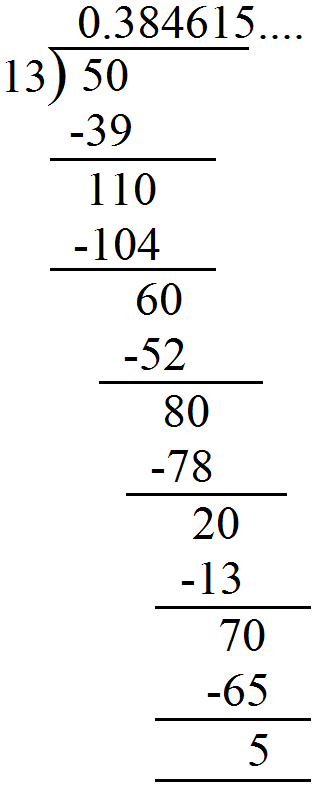
It is a non-terminating recurring decimal. View full question & answer→Question 72 Marks
Multiply:$3\sqrt{5}$ by $2\sqrt{5}$
Answer$3\sqrt{5}$ by $2\sqrt{5}$$3\sqrt{5}\times2\sqrt{5}=3\times2\times\sqrt{5}\times\sqrt{5}$
$=(3\times2\times5)=30$
View full question & answer→Question 82 Marks
Examine whether the following number are rational or irrational:$\frac{2\sqrt{13}}{3\sqrt{52}-4\sqrt{117}}$
Answer$\frac{2\sqrt{13}}{3\sqrt{52}-4\sqrt{117}}$$=\frac{2\sqrt{13}}{3\sqrt{4\times13}-4\sqrt{9\times13}}$
$=\frac{2\sqrt{13}}{3\times2\sqrt{13}-4\times3\sqrt{13}}$
$=\frac{2\sqrt{13}}{6\sqrt{13}-12\sqrt{13}}$
$=\frac{2\sqrt{13}}{-6\sqrt{13}}$
$=-\frac{1}{3}$
Thus, the given number is rational.
View full question & answer→Question 92 Marks
Give an example of a number $x$ such that $x^2$ is an irrational number and $x^3$ is a rational number.
AnswerThe cube roots of natural numbers which are not perfect cubes are all irrational numbers.
Let $\text{x}=\sqrt[3]{2}=2^{\frac{1}{3}}$
Now,$\text{x}^2=\big(2^{\frac{1}{3}}\big)^2=2^{\frac{2}{3}}=\big(2^2\big)^{\frac{1}{3}}=4^\frac{1}{3},$ which is an irrational number
Also,$\text{x}^3=\Big(2^{\frac{1}{3}}\Big)^3=2^{3\times\frac{1}{3}}=2,$ which is a rational number.
View full question & answer→Question 102 Marks
Write the following in decimal form and say what kind of decimal expansion has.$\frac{3}{11}$
Answer$\frac{3}{11}=0.\overline{27}$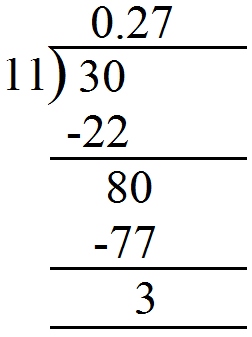
It is a non-terminating recurring decimal. View full question & answer→Question 112 Marks
Simplify the product $\sqrt[3]{2}\times\sqrt[4]{2}\times\sqrt[12]{32}.$
Answer$\sqrt[3]{2}\times\sqrt[4]{2}\times\sqrt[12]{32}$$=2^\frac{1}{3}\times2^\frac{1}{4}\times32^\frac{1}{12}$
$=2^\frac{1}{3}\times2^\frac{1}{4}\times2^{5\times\frac{1}{12}}$
$=2^\frac{1}{3}\times2^\frac{1}{4}\times2^\frac{5}{12}$
$=2^{\frac{1}{3}+\frac{1}{4}+\frac{5}{12}}$
$=2^{\frac{4+3+5}{12}}$
$=2^\frac{12}{12}$
$=2$
View full question & answer→Question 122 Marks
Examine whether the following numbers are rational or irrational.$3+\sqrt{3}$
AnswerLet us assume, to the contrary, that $3+\sqrt{3}$ is rational. Then, $3+\sqrt{3}=\frac{\text{p}}{\text{q}},$ where p and q are coprime and $\text{q}\neq0.$$\Rightarrow\sqrt{3}=\frac{\text{p}}{\text{q}}-3$
$\Rightarrow\sqrt{3}=\frac{\text{p}-3\text{q}}{\text{q}}$
Since, p and q are are integers.$\Rightarrow\frac{\text{p}-3\text{q}}{\text{q}}$ is rational.
So, $\sqrt{3}$ is also rational. But this contradicts the fact that $\sqrt{3}$ is irrational. This contradiction has arisen because of our incorrect assumption that $3+\sqrt{3}$ is rational. Hence, $3+\sqrt{3}$ is irrational.
View full question & answer→Question 132 Marks
Find two rational numbers of the form $\frac{\text{p}}{\text{q}}$ between the numbers 0.2121121112... and 0.2020020002...
AnswerThe rational numbers between the numbers 0.2121121112... and 0.2020020002... are:$0.21=\frac{21}{100}$ and $0.205=\frac{206}{1000}=\frac{41}{200}$
Disclaimer: There are an infinite number of rational numbers between two irrational numbers.
View full question & answer→Question 142 Marks
Simplify:$\Big(\frac{7776}{243}\Big)^{-\frac{3}{5}}$
Answer$\Big(\frac{7776}{243}\Big)^{-\frac{3}{5}}$$=\Big(\frac{243}{7776}\Big)^{\frac{3}{5}}$
$=\Big(\frac{3^5}{6^5}\Big)^{\frac{3}{5}}$
$=\frac{3^{5\times\frac{3}{5}}}{6^{5\times\frac{3}{5}}}$
$=\frac{3^3}{6^3}$
$=\frac{3\times3\times3}{6\times6\times6}$
$=\frac{1}{8}$
View full question & answer→Question 152 Marks
Simplify:$\sqrt{72}+\sqrt{800}-\sqrt{18}$
Answer$\sqrt{72}+\sqrt{800}-\sqrt{18}$$=\sqrt{ 36\times2}+\sqrt{400\times2}-\sqrt{9\times2}$
$=6\sqrt{2}+20\sqrt{2}-3\sqrt{2}$
$=23\sqrt{2}$
View full question & answer→Question 162 Marks
If $10^x=64$, find the value of $10^{\left(\frac{x}{2}+1\right)}$.
AnswerGiven. $10^x=6410\left(\frac{x}{2}+1\right)$
$=10^\frac{\text{x}}{2}\times10^1$
$=(10\text{x})^\frac{1}{2}\times10$
$=(64)^\frac{1}{2}\times10$
$=(8^2)^\frac{1}{2}\times10$
$=8\times10$
$=80$
View full question & answer→Question 172 Marks
Find a rational number between 1.3 and 1.4
Answer1.3 and 1.4 Let x = 1.3 and y = 1.4 Rational number lying between x and y.$\frac{1}{2}(\text{x}+\text{y})=\frac{1}{2}\big(1.3+1.4\big)$
$=\frac{1}{2}(2.7)=1.35$
View full question & answer→Question 182 Marks
Simplify:$\big(3-\sqrt{3}\big)^2$
Answer$\big(3-\sqrt{3}\big)^2$$=(3)^2+\big(\sqrt{3}\big)^2-2.3.\sqrt{3}$
$=9+3-6\sqrt{3}$
$=12-6\sqrt{3}$
View full question & answer→Question 192 Marks
Examine whether the following numbers are rational or irrational.$\sqrt{\frac{13}{117}}$
Answer$\sqrt{\frac{13}{117}}=\sqrt{\frac{1}{9}}=\frac{1}{3},$ which is rationalHence, $\sqrt{\frac{13}{117}}$ is rational.
View full question & answer→Question 202 Marks
Simplify:$\big(\sqrt{5}-\sqrt{3}\big)^2$
Answer$\big(\sqrt{5}-\sqrt{3}\big)^2$$=\big(\sqrt{5}\big)^2+\big(\sqrt{3}\big)^2-2\sqrt{5}.\sqrt{3}$
$=5+3-2\sqrt{15}$
$=8-2\sqrt{15}$
View full question & answer→Question 212 Marks
Find the value of x in the following:$\sqrt[5]{5\text{x}+2}=2$
Answer$\sqrt[5]{5\text{x}+2}=2$$\Rightarrow(5\text{x}+2)^\frac{1}{5}=2$
$\Rightarrow\bigg[(5\text{x}+2)^\frac{1}{5}\bigg]=2^5$
$\Rightarrow5\text{x}+2=32$
$\Rightarrow5\text{x}=30$
$\Rightarrow\text{x}=6$
View full question & answer→Question 222 Marks
Rationalise the denominator of the following:$\frac{1}{\sqrt{7}-\sqrt{6}}$
Answer$\frac{1}{\sqrt{7}-\sqrt{6}}$$=\frac{1}{\sqrt{7}-\sqrt{6}}\times\frac{\sqrt{7}+\sqrt{6}}{\sqrt{7}+\sqrt{6}}$
$=\frac{\sqrt{7}+\sqrt{6}}{\big(\sqrt{7}\big)^2-\big(\sqrt{6}\big)^2}$
$=\frac{\sqrt{7}+\sqrt{6}}{7-6}$
$=\sqrt{7}+\sqrt{6}$
View full question & answer→Question 232 Marks
Write the following in decimal form and say what kind of decimal expansion has.$2\frac{5}{12}$
Answer$2\frac{5}{12}=\frac{29}{12}=2.41\overline{6}$By actual division, we have:
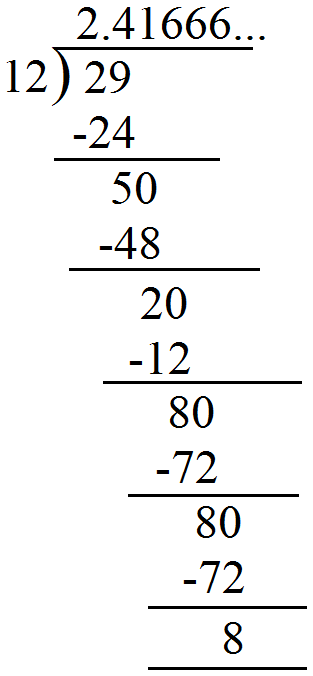
It is a non-terminating decimal expansion. View full question & answer→Question 242 Marks
Prove that:$\frac{\text{x}^{\text{a}(\text{b}-\text{c})}}{\text{x}^{\text{b}(\text{a}-\text{c})}}\div\Big(\frac{\text{x}^\text{b}}{\text{x}^\text{a}}\Big)^\text{c}=1$
Answer$\text{L.H.S}=\frac{\text{x}^{\text{a}(\text{b}-\text{c})}}{\text{x}^{\text{b}(\text{a}-\text{c})}}\div\Big(\frac{\text{x}^\text{b}}{\text{x}^\text{a}}\Big)^\text{c}$$=\frac{\text{X}^{\text{ab}-\text{ac}}}{\text{X}^{\text{ab}-\text{bc}}}\div\frac{\text{X}^\text{bc}}{\text{X}^\text{ac}}$
$=\text{X}^{\text{ab}-\text{ac}-\text{ab}+\text{bc}}\div\text{X}^{\text{bc}-\text{ac}}$
$=\text{X}^{\text{bc}-\text{ac}}\div\text{X}^{\text{bc}-\text{ac}}$
$=1$
$=\text{R.H.S}$
View full question & answer→Question 252 Marks
Simplify:$\Bigg(\frac{12^\frac{1}{5}}{27^\frac{1}{5}}\Bigg)^\frac{5}{2}$
Answer$\Bigg(\frac{12^\frac{1}{5}}{27^\frac{1}{5}}\Bigg)^\frac{5}{2}$$=\frac{12^{\frac{1}{5}\times\frac{5}{2}}}{15^{\frac{1}{5}\times\frac{5}{2}}}$
$=\frac{12^\frac{1}{2}}{27^\frac{1}{2}}$
$=\frac{\sqrt{12}}{\sqrt{27}}$
$=\frac{\sqrt{4\times3}}{\sqrt{9\times3}}$
$=\frac{2\sqrt3}{3\sqrt3}$
$=\frac{2}{3}$
View full question & answer→Question 262 Marks
Write the reciprocal of $\big(2+\sqrt{3}\big).$
AnswerThe reciprocal of $\big(2+\sqrt{3}\big)$$=\frac{1}{2+\sqrt{3}}$
$=\frac{1}{2+\sqrt{3}}\times\frac{2-\sqrt{3}}{2-\sqrt{3}}$
$=\frac{2-\sqrt{3}}{2^2-\big(\sqrt{3}\big)^2}$
$=\frac{2-\sqrt{3}}{4-3}$
$=2-\sqrt{3}$
View full question & answer→Question 272 Marks
Find the value of x in the following:$\frac{3^{3\text{x}}\times3^{2\text{x}}}{3^\text{x}}=\sqrt[4]{3^{20}}$
Answer$\frac{3^{3\text{x}}\times3^{2\text{x}}}{3^\text{x}}=\sqrt[4]{3^{20}}$$\Rightarrow\frac{3^{3\text{x}+2\text{x}}}{3^\text{x}}=3^{20\times\frac{1}{4}}$
$\Rightarrow\frac{3^{5\text{x}}}{3^\text{x}}=3^5$
$\Rightarrow3^{4\text{x}}=3^5$
$\Rightarrow4\text{x}=5$
$\Rightarrow\text{x}=\frac{5}{4}$
View full question & answer→Question 282 Marks
Let a be a rational number and b be an irrational number. Is ab necessarily an irrational number? Justify your answer with an example.
Answera be a rational number and b be an irrational number then ab necessarily will be an irrational number.
Example: 6 is a rational number but $\sqrt{5}$ is irrational. And $6\sqrt{5}$ is also an irrational number.
View full question & answer→Question 292 Marks
Multiply:$\sqrt{10}$ by $\sqrt{40}$
Answer$\sqrt{10}$ by $\sqrt{40}$$\sqrt{10}\times\sqrt{40}=\sqrt{10\times40}$
$=\sqrt{2\times5\times2\times2\times2\times5}$
$=(2\times2\times5)=20$
View full question & answer→Question 302 Marks
It being given that $\sqrt{3}=1.732,\sqrt{5}=2.236,\sqrt{6}=2.449$ and $\sqrt{10}=3.162,$ find to three places of decimal, the value of the following:$\frac{1}{\sqrt{6}+\sqrt{5}}$
Answer$\frac{1}{\sqrt{6}+\sqrt{5}}$$=\frac{1}{\sqrt{6}+\sqrt{5}}\times\frac{\sqrt{6}-\sqrt{5}}{\sqrt{6}-\sqrt{5}}$
$=\frac{\sqrt{6}-\sqrt{5}}{\big(\sqrt{6}\big)^2-\big(\sqrt{5}\big)^2}$
$=\frac{\sqrt{6}-\sqrt{5}}{6-5}$
$=\frac{\sqrt{6}-\sqrt{5}}{1}$
$=\sqrt{6}-\sqrt{5}$
$=2.449-2.236$
$=0.213$
View full question & answer→Question 312 Marks
If a = 2, b = 3, find the values of:$\big(\text{a}^{\text{a}}+\text{b}^{\text{b}}\big)^{-1}$
AnswerGiven, a = 2 and b = 3$\big(\text{a}^{\text{a}}+\text{b}^{\text{b}}\big)^{-1}=(2^2+3^3)^{-1}$
$=(4+27)^{-1}$
$=(31)^{-1}$
$=\frac{1}{31}$
View full question & answer→Question 322 Marks
Simplify:$\Bigg(\frac{15^\frac{1}{3}}{9^\frac{1}{4}}\Bigg)^{-6}$
Answer$\Bigg(\frac{15^\frac{1}{3}}{9^\frac{1}{4}}\Bigg)^{-6}$$=\Bigg(\frac{9^\frac{1}{4}}{15^\frac{1}{3}}\Bigg)^6$
$=\Bigg(\frac{3^{2\times\frac{1}{4}}}{15^\frac{1}{3}}\Bigg)^6$
$=\Bigg(\frac{3^\frac{1}{2}}{15^\frac{1}{3}}\Bigg)^6$
$=\frac{3^{\frac{1}{2}\times6}}{15^{\frac{1}{3}\times6}}$
$=\frac{3^3}{15^2}$
$=\frac{27}{225}$
View full question & answer→Question 332 Marks
Simplify:$\Bigg(\frac{15^\frac{1}{4}}{3^\frac{1}{2}}\Bigg)^{-2}$
Answer$\Bigg(\frac{15^\frac{1}{4}}{3^\frac{1}{2}}\Bigg)^{-2}$$=\Bigg(\frac{3^\frac{1}{2}}{15^\frac{1}{4}}\Bigg)^2$
$=\frac{3^{\frac{1}{2}\times2}}{15^{\frac{1}{4}\times2}}$
$=\frac{3}{15^\frac{1}{2}}$
View full question & answer→Question 342 Marks
Find the value of x in the following:$\Big(\frac{3}{4}\Big)^3\Big(\frac{4}{3}\Big)^{-7}=\Big(\frac{3}{4}\Big)^{2\text{x}}$
Answer$\Big(\frac{3}{4}\Big)^3\Big(\frac{4}{3}\Big)^{-7}=\Big(\frac{3}{4}\Big)^{2\text{x}}$$\Rightarrow\Big(\frac{3}{4}\Big)^3\Big(\frac{3}{4}\Big)^7=\Big(\frac{3}{4}\Big)^{2\text{x}}$
$\Rightarrow\Big(\frac{3}{4}\Big)^{3+7}=\Big(\frac{3}{4}\Big)^{2\text{x}}$
$\Rightarrow\Big(\frac{3}{4}\Big)^{10}=\Big(\frac{3}{4}\Big)^{2\text{x}}$
$\Rightarrow2\text{x}=10$
$\Rightarrow\text{x}=5$
View full question & answer→Question 352 Marks
Find three different irrational numbers between the rational numbers $\frac{5}{7}$ and $\frac{9}{11}.$
AnswerAs, $\frac{5}{7}\approx0.714$ and $\frac{9}{11}\approx0.818$
So, the three different irrational numbers are: 0.72020020002..., 0.7515511555111... and 0.808008000...
Disclaimer: There are an infinite number of irrational numbers between two rational numbers.
View full question & answer→Question 362 Marks
Simplify:$\Big(\frac{32}{243}\Big)^{-\frac{4}{5}}$
Answer$\Big(\frac{32}{243}\Big)^{-\frac{4}{5}}$$=\Big(\frac{243}{32}\Big)^{\frac{4}{5}}$
$=\Big(\frac{3^5}{2^5}\Big)^{\frac{4}{5}}$
$=\frac{3^{5\times\frac{4}{5}}}{2^{5\times\frac{4}{5}}}$
$=\frac{3^4}{2^4}$
$=\frac{81}{16}$
View full question & answer→Question 372 Marks
Multiply:$2\sqrt{6}$ by $3\sqrt{3}$
Answer$2\sqrt{6}$ by $3\sqrt{3}$$2\sqrt{6}\times3\sqrt{3}=2\times3\times\sqrt{6}\times\sqrt{3}$
$=6\times\sqrt{6\times3}$
$=6\times\sqrt{2\times3\times3}$
$=6\times3\sqrt{2}=18\sqrt{2}$
View full question & answer→Question 382 Marks
Write the following in decimal form and say what kind of decimal expansion has.$\frac{231}{625}$
Answer$\frac{231}{625}=0.3696$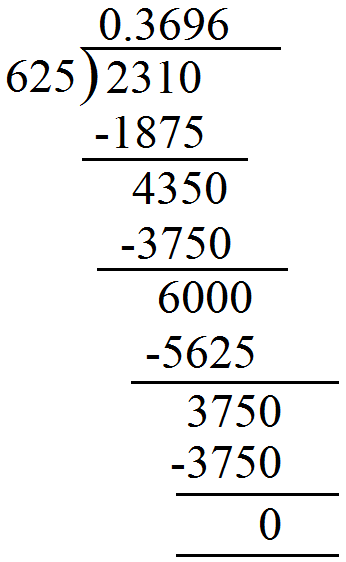
It is a terminating decimal expansion. View full question & answer→Question 392 Marks
Rationalise the denominator of the following:$\frac{4}{\sqrt{11}-\sqrt{7}}$
Answer$\frac{4}{\sqrt{11}-\sqrt{7}}$$=\frac{4}{\sqrt{11}-\sqrt{7}}\times\frac{\sqrt{11}+\sqrt{7}}{\sqrt{11}+\sqrt{7}}$
$=\frac{4\big(\sqrt{11}+\sqrt{7}\big)}{\big(\sqrt{11}\big)^2-\big(\sqrt{7}\big)^2}$
$=\frac{4\big(\sqrt{11}+\sqrt{7}\big)}{11-7}$
$=\frac{4\big(\sqrt{11}+\sqrt{7}\big)}{4}$
$=\sqrt{11}+\sqrt{7}$
View full question & answer→Question 402 Marks
What are irrational numbers? How do they differ from rational numbers? Give examples.
AnswerA number that can neither be expressed as a terminating decimal nor be expressed as a repeating decimal is called an irrational number. A rational number, on the other hand, is always a terminating decimal, and if not, it is a repeating decimal.
Examples of irrational numbers:
0.101001000...
0.232332333...
View full question & answer→Question 412 Marks
On her birthday Reema distributed chocolates in an orphanage. The total number of chocolates she distributed is given by $\big(5+\sqrt{11}\big)\big(5-\sqrt{11}\big).$
- Find the number of chocolates distributed by her.
- Write the moral values depicted here by Reema.
Answer
- Number of chocolates distributed by Reema
$=\big(5+\sqrt{11}\big)\big(5-\sqrt{11}\big)$
$=(5)^2-\big(\sqrt{11}\big)^2$
$=25-11$
$=14$
- Loving, helping and caring attitude towards poor and needy children.
View full question & answer→Question 422 Marks
Find a rational number between -1 and $\frac{1}{2}$
Answer$-1$ and $\frac{1}{2}$Let:
$\text{x}=-1$ and $\text{y}=\frac{1}{2}$
Rational number lying between x and y.
$\frac{1}{2}(\text{x}+\text{y})=\frac{1}{2}\Big(-1+\frac{1}{2}\Big)$
$=-\frac{1}{4}$
View full question & answer→Question 432 Marks
Write the following in decimal form and say what kind of decimal expansion has.$\frac{5}{8}$
Answer$\frac{5}{8}=0.625$By actual division, we have:
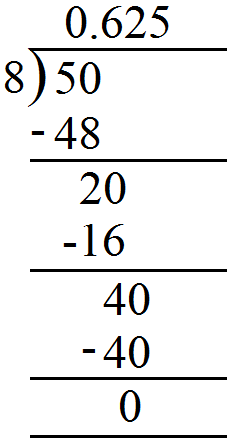
It is a terminating decimal expansion. View full question & answer→Question 442 Marks
Multiply:$3\sqrt{28}$ by $2\sqrt{7}$
Answer$3\sqrt{28}$ by $2\sqrt{7}$$3\sqrt{28}\times2\sqrt{7}=3\times2\times\sqrt{28}\times\sqrt{7}$
$=6\times\sqrt{28\times7}$
$=6\times\sqrt{2\times2\times7\times7}$
$=(6\times2\times4)=84$
View full question & answer→Question 452 Marks
Examine whether the following number are rational or irrational:$\big(\sqrt{3}+2\big)^2$
Answer$\big(\sqrt{3}+2\big)^2$$=\big(\sqrt{3}\big)^2+2\times2\times\sqrt{3}+(2)^2$
$=3+4\sqrt{3}+4$
$=7+4\sqrt{3}$
Clearly, the given number is irrational.
View full question & answer→Question 462 Marks
How many irrational numbers lie between $\sqrt{2}$ and $\sqrt{3}?$ Find any three irrational numbers lying between $\sqrt{2}$ and $\sqrt{3}.$
AnswerThere are infinite number of irrational numbers lying between $\sqrt{2}$ and $\sqrt{3}.$
As, $\sqrt{2}=1.414$ and $\sqrt{3}=1.732$
So, the three irrational numbers lying between $\sqrt{2}$ and $\sqrt{3}$ are:
1.420420042000..., 1.505005000... and 1.616116111...
View full question & answer→Question 472 Marks
Write the following in decimal form and say what kind of decimal expansion has.$\frac{11}{24}$
Answer$\frac{11}{24}=0.458\overline{3}$By actual division, we have:
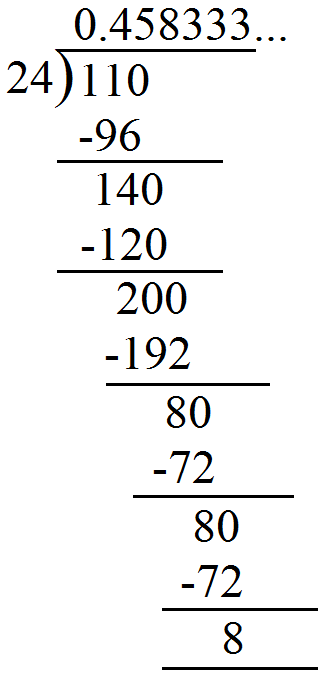
It is a non-terminating recurring decimal expansion. View full question & answer→Question 482 Marks
Is the product of two irrationals always irrational? Justify your answer.
AnswerProduct of two irrational numbers is not always an irrational number.
Example: $\sqrt{5}$ is irrational number. And $\sqrt{5}\times\sqrt{5}=5$ is a rational number. But the product of another two irrational numbers $\sqrt{2}$ and $\sqrt{3}$ is $\sqrt{6}$ which is also an irrational numbers.
View full question & answer→Question 492 Marks
Simplify $\Bigg[\Big\{(256)^{-\frac{1}{2}}\Big\}^{-\frac{1}{4}}\Bigg]^2.$
Answer$\Bigg[\Big\{(256)^{-\frac{1}{2}}\Big\}^{-\frac{1}{4}}\Bigg]^2$$=\Bigg[\Big\{\big(16^2\big)^{-\frac{1}{2}}\Big\}^{-\frac{1}{4}}\Bigg]^2$
$=\Bigg[\Big\{16^{-1}\Big\}^{-\frac{1}{4}}\Bigg]^2$
$=\Bigg[16^{-1\times\big(-\frac{1}{4}\big)}\Bigg]^2$
$=\Bigg[16^{\frac{1}{4}}\Bigg]^2$
$=\Bigg[2^{4\times\frac{1}{4}}\Bigg]^2$
$=2^2$
$=4$
View full question & answer→Question 502 Marks
Simplify:$\big(\sqrt{5}-\sqrt{2}\big)\big(\sqrt{2}-\sqrt{3}\big)$
Answer$\big(\sqrt{5}-\sqrt{2}\big)\big(\sqrt{2}-\sqrt{3}\big)$$=\sqrt{5}\big(\sqrt{2}-\sqrt{3}\big)-\sqrt{2}\big(\sqrt{2}-\sqrt{3}\big)$
$=\Big(\sqrt{10}-\sqrt{15}-2+\sqrt{16}\Big)$
View full question & answer→Question 512 Marks
Find two rational and two irrational number between 0.5 and 0.55.
AnswerThe two rational numbers between 0.5 and 0.55 are: 0.51 and 0.52
The two irrational numbers between 0.5 and 0.55 are: 0.505005000... and 0.5101100111000...
Disclaimer: There are infinite number of rational and irrational numbers between 0.5 and 0.55.
View full question & answer→Question 522 Marks
Multiply:$6\sqrt{15}$ by $4\sqrt{3}$
Answer$6\sqrt{15}$ by $4\sqrt{3}$$6\sqrt{15}\times4\sqrt{3}=6\times4\times\sqrt{15}\times\sqrt{3}$
$=24\times\sqrt{15\times3}$
$=24\times\sqrt{3\times5\times3}$
$=24\times3\sqrt{5}=72\sqrt{5}$
View full question & answer→Question 532 Marks
If a = 2, b = 3, find the values of:$\big(\text{a}^{\text{b}}+\text{b}^{\text{a}}\big)^{-1}$
AnswerGiven, a = 2 and b = 3$\therefore\big(\text{a}^{\text{b}}+\text{b}^{\text{a}}\big)^{-1}=\frac{1}{\text{a}^{\text{b}}+\text{b}^{\text{a}}}$
$=\frac{1}{2^3+3^2}$
$=\frac{1}{8+9}$
$=\frac{1}{17}$
View full question & answer→Question 542 Marks
Add:$\big(2\sqrt{3}-5\sqrt{2}\big)$ and $\big(\sqrt{3}+2\sqrt{2}\big)$
AnswerWe have:$=\big(2\sqrt{3}-5\sqrt{2}\big)+\big(\sqrt{3}+2\sqrt{2}\big)$
$=\big(2\sqrt{3}+\sqrt{3}\big)+\big(-5\sqrt{2}+2\sqrt{2}\big)$
$=(2+1)\sqrt{3}+(-5+2)\sqrt{2}$
$=3\sqrt{3}-3\sqrt{2}$
View full question & answer→Question 552 Marks
Examine whether the following numbers are rational or irrational.$\sqrt{8}\times\sqrt{2}$
AnswerAs $\sqrt{8}\times\sqrt{2}$$=\sqrt{8\times2}$
$=\sqrt{16}$
$=4,$ which is an integer
Hence, $\sqrt{8}\times\sqrt{2}$ is rational.
View full question & answer→Question 562 Marks
Rationalise the denominator of the following:$\frac{1+\sqrt{2}}{2-\sqrt{2}}$
Answer$\frac{1+\sqrt{2}}{2-\sqrt{2}}$$=\frac{1+\sqrt{2}}{2-\sqrt{2}}\times\frac{2+\sqrt{2}}{2+\sqrt{2}}$
$=\frac{\big(1+\sqrt{2}\big)\big(2+\sqrt{2}\big)}{(2)^2-\big(\sqrt{2}\big)^2}$
$=\frac{1\times2+\sqrt{2}+2\sqrt{2}+\big(\sqrt{2}\big)^2}{4-2}$
$=\frac{2+3\sqrt{2}+2}{2}$
$=\frac{4+3\sqrt{2}}{2}$
View full question & answer→Question 572 Marks
Find the value of $x$ in the following:
$5^{x-3} \times 3^{2 x-8}=225$
Answer$5^{x-3} \times 3^{2 x-8}=225$
$\Rightarrow 5^{x-3} \times 3^{2 x-8}=5^2 \times 3^2$
$\Rightarrow x-3=2 \text { and } 2 x-8=2$
$\Rightarrow x=5 \text { and } 2 x=10$
$\Rightarrow x=5$
View full question & answer→Question 582 Marks
Simplify:$3\sqrt{45}-\sqrt{125}+\sqrt{200}-\sqrt{50}$
Answer$3\sqrt{45}-\sqrt{125}+\sqrt{200}-\sqrt{50}$$3\sqrt{9\times5}-\sqrt{25\times5}+\sqrt{100\times2}-\sqrt{25\times2}$
$=3\times3\sqrt{5}-5\sqrt{5}+10\sqrt{2}-5\sqrt{2}$
$=9\sqrt{5}-5\sqrt{5}+10\sqrt{2}-5\sqrt{2}$
$=4\sqrt{5}+5\sqrt{2}$
View full question & answer→Question 592 Marks
Write the following in decimal form and say what kind of decimal expansion has.$\frac{7}{25}$
Answer$\frac{7}{25}=0.28$By actual division, we have:
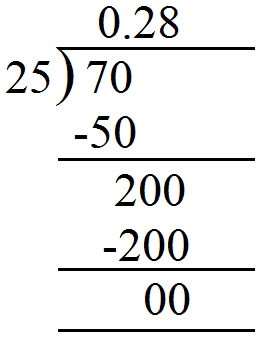
It is a terminating decimal expansion. View full question & answer→Question 602 Marks
Solve for $\text{x}\Big(\frac{2}{5}\Big)^{2\text{x}-2}=\frac{32}{3125}.$
Answer$\text{x}\Big(\frac{2}{5}\Big)^{2\text{x}-2}=\frac{32}{3125}$$\Rightarrow\Big(\frac{2}{5}\Big)^{2\text{x}-2}=\frac{2^5}{5^5}$
$\Rightarrow\Big(\frac{2}{5}\Big)^{2\text{x}-2}=\Big(\frac{2}{5}\Big)^5$
$\Rightarrow2\text{x}-2=5$
$\Rightarrow2\text{x}=7$
$\Rightarrow\text{x}=\frac{7}{2}$
View full question & answer→Question 612 Marks
Multiply:$3\sqrt{8}$ by $3\sqrt{2}$
Answer$3\sqrt{8}$ by $3\sqrt{2}$$3\sqrt{8}\times3\sqrt{2}=3\times3\times\sqrt{8}\times\sqrt{2}$
$=9\times\sqrt{8\times2}$
$=9\times\sqrt{2\times2\times2\times2}$
$=(9\times2\times2)=36$
View full question & answer→Question 622 Marks
Simplify:$\big(-3+\sqrt{5}\big)\big(-3-\sqrt{5}\big)$
Answer$\big(-3+\sqrt{5}\big)\big(-3-\sqrt{5}\big)$$=(-3)^2-\big(\sqrt{5}\big)^2$
$=9-5$
$=4$
View full question & answer→Question 632 Marks
Give an example of two irrational numbers whose sum as well as product is rational.
AnswerLet the two irrational numbers be $2+\sqrt{3}$ and $2-\sqrt{3}.$
Sum of these irrational numbers $=\big(2+\sqrt{3}\big)+\big(2-\sqrt{3}\big)=4,$ which is rational
Product of these irrational numbers $=\big(2+\sqrt{3}\big)\big(2-\sqrt{3}\big)=2^2-\big(\sqrt{3}\big)^2=4-3=1,$ which is rational
View full question & answer→Question 642 Marks
Examine whether the following numbers are rational or irrational.$\sqrt[3]{5}\times\sqrt[3]{25}$
Answer$\sqrt[3]{5}\times\sqrt[3]{25}$$=\sqrt[3]{5\times25}$
$=\sqrt[3]{125}$
$=5,$ which is an integer
Hence, $\sqrt[3]{5}\times\sqrt[3]{25}$ is rational.
View full question & answer→Question 652 Marks
Simplify:$\big(3-\sqrt{11}\big)\big(3+\sqrt{11}\big)$
Answer$\big(3-\sqrt{11}\big)\big(3+\sqrt{11}\big)$$=(3)^2-\big(\sqrt{11}\big)^2$
$=9-11$
$=-2$
View full question & answer→Question 662 Marks
Multiply:$16\sqrt{6}$ by $4\sqrt{2}$
Answer$16\sqrt{6}$ by $4\sqrt{2}$$16\sqrt{6}\div4\sqrt{2}=\frac{16\sqrt{6}}{4\sqrt{2}}=\frac{4\sqrt{6}}{\sqrt{2}}=\frac{4\sqrt{6}\times\sqrt{2}}{\sqrt{2}\times\sqrt{2}}$
$=\frac{4\sqrt{6\times2}}{2}=\frac{4\sqrt{2\times3\times2}}{2}$
$=\frac{4\times2\sqrt{3}}{2}=4\sqrt{3}$
View full question & answer→Question 672 Marks
Examine whether the following numbers are rational or irrational.$\sqrt{7}-2$
AnswerLet us assume, to the contrary, that $\sqrt{7}-2$ is rational. Then, $\sqrt{7}-2=\frac{\text{p}}{\text{q}},$ where p and q are coprime and $\text{q}\neq0.$$\Rightarrow\sqrt{7}=\frac{\text{p}}{\text{q}}+2$
$\Rightarrow\sqrt{7}=\frac{\text{p}+2\text{q}}{\text{q}}$
Since, p and q are are integers.$\Rightarrow\frac{\text{p}+2\text{q}}{\text{q}}$ is rational.
So, $\sqrt{7}$ is also rational. But this contradicts the fact that $\sqrt{7}$ is irrational. This contradiction has arisen because of our incorrect assumption that $\sqrt{7}-2$ is rational. Hence, $\sqrt{7}-2$ is irrational.
View full question & answer→Question 682 Marks
Prove that:$\sqrt{\text{x}^{-1}\text{y}}\times\sqrt{\text{y}^{-1}\text{z}}\times\sqrt{\text{z}^{-1}\text{x}}=1.$
Answer$\text{L.H.S}=\sqrt{\text{x}^{-1}\text{y}}\times\sqrt{\text{y}^{-1}\text{z}}\times\sqrt{\text{z}^{-1}\text{x}}=1.$$=\sqrt{\frac{\text{y}}{\text{x}}}\times\sqrt{\frac{\text{z}}{\text{y}}}\times\sqrt{\frac{\text{x}}{\text{z}}}$
$=\sqrt{\frac{\text{y}}{\text{x}}\times\frac{\text{z}}{\text{y}}\times\frac{\text{x}}{\text{z}}}$
$=\sqrt1$
$=1$
$=\text{R.H.S}$
View full question & answer→Question 692 Marks
Is the product of a rational and an irrational number always irrational? Give an example.
AnswerYes, the product of a rational and an irrational number is always an irrational number.
Example: 2 is a rational number and $\sqrt{3}$ is an irrational number.
Now, $2\times\sqrt{3}=2\sqrt{3},$ which is an irrational number.
View full question & answer→Question 702 Marks
Insert a rational and an irrational number between 2 and 2.5
AnswerAs, few rational numbers between 2 and 2.5 are: 2.1, 2.2, 2.3, 2.4, ...
And,
Since, $2=\sqrt{4}$ and $2.5=\sqrt{6.25}$
So, irrational number between 2 ans 2.5 are: $\sqrt{4.1},\sqrt{4.2}, \ ...,\sqrt{5} \ ...$
Hence, a rational and an irrational number can be 2.1 and $\sqrt{5},$ respectively.
Disclaimer: There are infinite rational and irrational numbers between any two rational numbers.
View full question & answer→Question 712 Marks
Multiply:$12\sqrt{15}$ by $4\sqrt{3}$
Answer$12\sqrt{15}$ by $4\sqrt{3}$$12\sqrt{15}\div4\sqrt{3}=\frac{12\sqrt{15}}{4\sqrt{3}}=\frac{3\sqrt{15}}{\sqrt{3}}=\frac{3\sqrt{15}\times\sqrt{3}}{\sqrt{3}\times\sqrt{3}}$
$=\frac{3\sqrt{15\times3}}{3}=\sqrt{3\times5\times3}=3\sqrt{5}$
View full question & answer→Question 722 Marks
Find the value of $(1296)^{0.17}\times(1296)^{0.08}.$
Answer$(1296)^{0.17}\times(1296)^{0.08}$$=(6^4)^{\frac{17}{100}}\times(6^4)^{\frac{8}{100}}$
$=6^{4\times\frac{17}{100}}\times6^{4\times\frac{8}{100}}$
$=6^{\frac{17}{25}}\times6^{\frac{8}{25}}$
$=6^{\frac{17}{25}+\frac{8}{25}}$
$=6^{\frac{25}{25}}$
$=6$
View full question & answer→Question 732 Marks
Find the value of x in the following:$\sqrt[3]{3\text{x}-2}=4$
Answer$\sqrt[3]{3\text{x}-2}=4$$\Rightarrow(3\text{x}-2)^\frac{1}{3}=4$
$\Rightarrow\bigg[(3\text{x}-2)^\frac{1}{3}\bigg]=4^3$
$\Rightarrow3\text{x}-2=64$
$\Rightarrow3\text{x}=66$
$\Rightarrow\text{x}=22$
View full question & answer→Question 742 Marks
Rationalise the denominator of the following:$\frac{1}{2+\sqrt{3}}$
AnswerIf a and b are integers, then$\big(\text{a}+\sqrt{\text{b}}\big)$ and $\big(\text{a}-\sqrt{\text{b}}\big)$ are rationalising factor of each other, as $\big(\text{a}+\sqrt{\text{b}}\big)\big(\text{a}-\sqrt{\text{b}}\big)=\big(\text{a}^2-\text{b}\big),$ which is rational.
Therefore, we have,$=\frac{1}{\big(2+\sqrt{3}\big)}=\frac{1}{2+\sqrt{3}}\times\frac{2-\sqrt{3}}{2-\sqrt{3}}$
$=\frac{2-\sqrt{3}}{(2)^2-\big(\sqrt{3}\big)^2}=\frac{2-\sqrt{3}}{4-3}$
$=\frac{2-\sqrt{3}}{1}=2-\sqrt{3}$
View full question & answer→Question 752 Marks
Simplify:$\big(5+\sqrt{7}\big)\big(2+\sqrt{5}\big)$
Answer$\big(5+\sqrt{7}\big)\big(2+\sqrt{5}\big)$$=5\times2+5\times\sqrt{5}+2\times\sqrt{7}+\sqrt{5}\times\sqrt{7}$
$=10+5\sqrt{5}+2\sqrt{7}+\sqrt{35}$
View full question & answer→Question 762 Marks
Simplify:$\Big(\frac{81}{49}\Big)^{-\frac{3}{2}}$
Answer$\Big(\frac{81}{49}\Big)^{-\frac{3}{2}}$$=\Big(\frac{49}{81}\Big)^{\frac{3}{2}}$
$=\Big(\frac{7^2}{9^2}\Big)^{\frac{3}{2}}$
$=\frac{7^{2\times\frac{3}{2}}}{9^{2\times\frac{3}{2}}}$
$=\frac{7^3}{9^3}$
$=\frac{343}{729}$
View full question & answer→Question 772 Marks
Write the following in decimal form and say what kind of decimal expansion has.$\frac{261}{400}$
Answer$\frac{261}{400}=0.6525$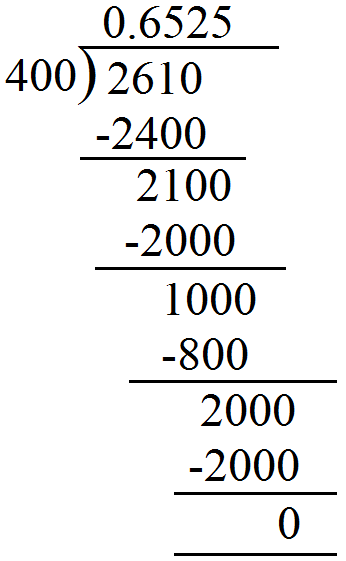
It is a terminating decimal expansion. View full question & answer→Question 782 Marks
Find a rational number between $\frac{1}{9}$ and $\frac{2}{9}$
Answer$\frac{1}{9}$ and $\frac{2}{9}$A rational number lying between $\frac{1}{9}$ and $\frac{2}{9}$ will be
$\frac{1}{2}\Big(\frac{1}{9}+\frac{2}{9}\Big)=\frac{1}{2}\times\frac{1}{3}=\frac{1}{6}$
View full question & answer→Question 792 Marks
Evaluate $\frac{2^{\text{n}}+2^{\text{n}-1}}{2^{\text{n}+1}-2^{\text{n}}}.$
Answer$\frac{2^{\text{n}}+2^{\text{n}-1}}{2^{\text{n}+1}-2^{\text{n}}}$$=\frac{2^{\text{n}-1}(2+1)}{2^{\text{n}}(2-1)}$
$=\frac{2^{\text{n}-1}\times3}{2^{\text{n}}\times1}$
$=\frac{3}{2^{\text{n}-\text{n}+1}}$
$=\frac{3}{2}$
View full question & answer→Question 802 Marks
Rationalise the denominator of the following:$\frac{1}{5+3\sqrt{2}}$
AnswerIf a and b are integers and x is a natural number, then$\big(\text{a}+\text{b}\sqrt{\text{x}}\big)$ and $\big(\text{a}-\text{b}\sqrt{\text{x}}\big)$ are rationalising factor of each other, as $\big(\text{a}+\text{b}\sqrt{\text{x}}\big)\big(\text{a}-\text{b}\sqrt{\text{x}}\big)=\big(\text{a}^2-\text{b}^2\text{x}\big),$ which is rational.
Therefore, we have,$=\frac{1}{\big(5+3\sqrt{2}\big)}=\frac{1}{5+3\sqrt{2}}\times\frac{5-3\sqrt{2}}{5-3\sqrt{2}}$
$=\frac{5-3\sqrt{2}}{(5)^2-\big(3\sqrt{2}\big)^2}=\frac{5-3\sqrt{2}}{25-18}=\Big(\frac{5-3\sqrt{2}}{7}\Big)$
View full question & answer→Question 812 Marks
Rationalise the denominator of the following:$\frac{3-2\sqrt{2}}{3+2\sqrt{2}}$
Answer$\frac{3-2\sqrt{2}}{3+2\sqrt{2}}$$=\frac{3-2\sqrt{2}}{3+2\sqrt{2}}\times\frac{3-2\sqrt{2}}{3-2\sqrt{2}}$
$=\frac{\big(3-2\sqrt{2}\big)^2}{(3)^2-\big(2\sqrt{2}\big)^2}$
$=\frac{(3)^2-2\times3+2\sqrt{2}+\big(2\sqrt{2}\big)^2}{9-4\times2}$
$=\frac{9-12\sqrt{2}+8}{9-8}$
$=\frac{17-12\sqrt{2}}{1}$
$=17-12\sqrt{2}$
View full question & answer→Question 822 Marks
Find a rational number between $-\frac{3}{4}$ and $-\frac{2}{5}$
Answer$-\frac{3}{4}$ and $-\frac{2}{5}$Let:
$\text{x}=-\frac{3}{4}$ and $\text{y}=-\frac{2}{5}$
Rational number lying between x and y.
$\frac{1}{2}(\text{x}+\text{y})=\frac{1}{2}\Big(-\frac{3}{4}-\frac{2}{5}\Big)$
$\frac{1}{2}\Big(\frac{-15-8}{20}\Big)=-\frac{23}{40}$
View full question & answer→Question 832 Marks
Add:$=\big(2\sqrt{2}+5\sqrt{3}-7\sqrt{5}\big)$ and $\big(3\sqrt{3}-\sqrt{2}+\sqrt{5}\big)$
AnswerWe have,$=\big(2\sqrt{2}+5\sqrt{3}-7\sqrt{5}\big)+\big(3\sqrt{3}-\sqrt{2}+\sqrt{5}\big)$
$=\big(2\sqrt{2}-\sqrt{2}\big)+\big(5\sqrt{3}+3\sqrt{3}\big)+\big(-7\sqrt{5}+\sqrt{5}\big)$
$=(2-1)\sqrt{2}+(5+3)\sqrt{3}+(-7+1)\sqrt{5}$
$=\sqrt{2}+8\sqrt{3}-6\sqrt{5}.$
View full question & answer→Question 842 Marks
Examine whether the following number are rational or irrational:$\big(5-\sqrt{5}\big)\big(5+\sqrt{5}\big)$
Answer$\big(5-\sqrt{5}\big)\big(5+\sqrt{5}\big)$$=(5)^2-\big(\sqrt{5}\big)^2$
$=25-5$
$=20$
Thus, the given number is rational.
View full question & answer→Question 852 Marks
Find a rational number between $\frac{3}{8}$ and $\frac{2}{5}$
Answer$\frac{3}{8}$ and $\frac{2}{5}$Let:
$\text{x}=\frac{3}{8}$ and $\text{y}=\frac{2}{5}$
Rational number lying between x and y.
$\frac{1}{2}(\text{x}+\text{y})=\frac{1}{2}\Big(\frac{3}{8}+\frac{2}{5}\Big)$
$=\frac{1}{2}\Big(\frac{15+16}{40}\Big)=\frac{31}{80}$
View full question & answer→Question 862 Marks
Find four rational numbers lying between $\frac{3}{7}$ and $\frac{5}{7}.$
Answern = 4 n + 1 = 4 + 1 = 5$\frac{3}{7}=\frac{3}{7}\times\frac{5}{5}=\frac{15}{35}$
$\frac{5}{7}=\frac{5}{7}\times\frac{5}{5}=\frac{25}{35}$
Thus, rational numbers between $\frac{3}{7}$ and $\frac{5}{7}$ are $\frac{16}{35},\frac{17}{35},\frac{18}{35},\frac{19}{35}.$
View full question & answer→Question 872 Marks
Evaluate:$\frac{2^0+7^0}{5^0}$
Answer$\frac{2^0+7^0}{5^0}=\frac{1+1}{1}\frac{2}{1}=2$
View full question & answer→