Question
Find a unit vector perpendicular to the plane containing the vectors $\vec{\text{a}}=2\hat{\text{i}}+\hat{\text{j}}+\hat{\text{k}}$ and $\vec{\text{b}}=\hat{\text{i}}+2\hat{\text{j}}+\hat{\text{k}.}$

Answer

A vector perpendicular to the plane containing the vector $\vec{\text{a}}$ and $\vec{\text{b}}$ is given by $\vec{\text{a}}\times\vec{\text{b}}=\pm\vec{\text{c}}$ (say)
$\vec{\text{a}}\times\vec{\text{b}}=\begin{vmatrix}\hat{\text{i}}&\hat{\text{j}}&\hat{\text{k}}\\\text{a}_1&\text{b}_1&\text{c}_1\\\text{a}_2&\text{b}_2&\text{c}_2 \end{vmatrix}$
$\vec{\text{c}}=\begin{vmatrix}\hat{\text{i}}&\hat{\text{j}}&\hat{\text{k}}\\2&1&1\\1&2&1 \end{vmatrix}$
$\vec{\text{c}}=\hat{\text{i}}(1-2)-\hat{\text{j}}(2-1)+\hat{\text{k}}(4-1)$
$\vec{\text{c}}=-\hat{\text{i}}-\hat{\text{j}}+3\hat{\text{k}}$
$\hat{\text{c}}=\frac{\vec{\text{c}}}{|\vec{\text{c}}|}$
$=\frac{-\hat{\text{i}}-\hat{\text{j}}+3\hat{\text{k}}}{\sqrt{(-1)^2+(-1)^2+(3)^2}}$
$=\frac{-\hat{\text{i}}-\hat{\text{j}}+3\hat{\text{k}}}{\sqrt{1+1+9}}$
$=\frac{1}{\sqrt{11}}\big(-\hat{\text{i}}-\hat{\text{j}}+3\hat{\text{k}}\big)$
Unit vector perpendicular to the plane of $\vec{\text{a}}$ and $\vec{\text{b}}=\pm\frac{1}{\sqrt{11}}\big(-\hat{\text{i}}-\hat{\text{j}}+3\hat{\text{k}}\big).$

Need a full question paper?

Generate a complete, print-ready paper with questions like this in minutes — across 16+ boards, with answer keys.
Start Generating Free

Similar questions

A plane passes through the point (1, -2, 5) and is perpendicular to the line joining the origin to the point $2\hat{\text{i}}+\hat{\text{j}}-\hat{\text{k}}.$ Find the vector and cartesian forms of the equation of the plane.
Show that the function f: R → {x ∈ R: –1 < x < 1} defined by $f(\text{x})=\frac{\text{x}}{1+|\text{x}|},\text{x}\in\text{R}$ is one-one and onto function.
If $\text{x}=\text{a}\sin\text{t}\ \text{and}\ \text{y}=\text{a}(\cos\text{t}+\log\tan\frac{\text{t}}{2}),$ find $\frac{\text{d}^2\text{y}}{\text{dx}^2}$
Refer to Question 8. If the grower wants to maximize the amount of nitrogen added to the garden, how many bags of each brand should be added? What is the maximum amount of nitrogen added?
Find the area between the curves $y = x$ and $y = x^2$​​​​​​​.
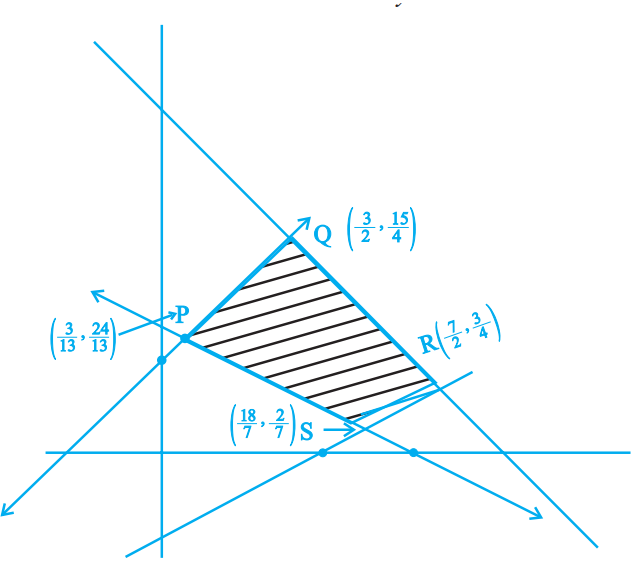
In the feasible region (shaded) for a LPP is shown. Determine the maximum and minimum value of Z = x + 2y.
The contents of urns $I, II, III$ are as follows:
Urn $I : 1$ white, $2$ black and $3$ red balls
Urn $II : 2$ white, $1$ black and $1$ red balls
Urn $III : 4$ white, $5$ black and $3$ red balls.
One urn is chosen at random and two balls are drawn. They happen to be white and red. What is the probability that they come from Urns $I, II, III?$
Find the angle between the following pairs of lines:
$\frac{\text{x}+4}{3}=\frac{\text{y}-1}{5}=\frac{\text{z}+3}{4}$ and $\frac{\text{x}+1}{1}=\frac{\text{y}-4}{1}=\frac{\text{z}-5}{2}$
If $\text{f}\text{(x)}=\begin{cases}\frac{2^\text{z+2}-16}{4^\text{x}-16}, &\text{if x} \neq 2\\\text{k}, & \text{x} = 2\end{cases}$
is continuous at x = 2, Find k.
Show that $\begin{vmatrix}\text{x}+1&\text{x}+2&\text{x}+\text{a}\\\text{x}+2&\text{x}+3&\text{x}+\text{b}\\\text{x}+3&\text{x}+4&\text{x}+\text{c}\end{vmatrix}=0$ where a, b, c are in A.P.