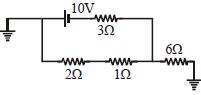
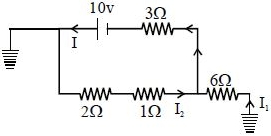
b $\mathrm{R}_{\mathrm{eq}}=[(2+1) \| 6]+3=5 \,\Omega$
$I=\frac{10}{5}=2 \,A$
$I_{1}=\frac{3}{9} \times 2=\frac{2}{3} \,A$
Download our app
and get started for free
Experience the future of education. Simply download our apps or reach out to us for more information. Let's shape the future of learning together!No signup needed.*
The resistances of the platinum wire of a platinum resistance thermometer at the ice point and steam point are $8 \Omega$ and $10 \Omega$ respectively. After inserting in a hot bath of temperature $400^{\circ} \mathrm{C}$, the resistance of platinum wire is:
For a wire $\frac{R}{l}=\frac{1}{2}$ and length of wire is $l=5\, cm .$ If potential difference $1\, V$ is applied across it, current through wire will be: $( R =$ Resistance $)$ (in $A$)
A hollow cylindrical conductor has length of $3.14\,m$, while its inner and outer diameters are $4\,mm$ and $8\,mm$ respectively. The resistance of the conductor is $n \times 10^{-3}\,\Omega$.If the resistivity of the material is $2.4 \times 10^{-8}\,\Omega\,m$. The value of $n$ is $..........$
An electrical circuit consists of ten $100 \,\Omega$ resistors. Out of these $10$ resistors, a group of $n _1$ resistors are connected in parallel and another group of $n _2$ resistors are separately connected in parallel. These two groups are then connected in series and this combination is connected to a voltage source of $100 \,V$. If the net current though the circuit is $2.5 \,A$. The values of $n _1$ and $n _2$ are