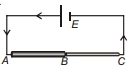
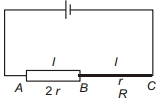
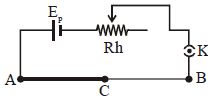
In the following diagram, the lengths of wires $A B$ and $B C$ are equal, but the radius of wire $A B$ is double that of $B C$. The ratio of potential gradient on wires $A B$ and on $B C$ will be (wires are made of same material)
Medium


Download our appand get started for free
Experience the future of education. Simply download our apps or reach out to us for more information. Let's shape the future of learning together!No signup needed.*
Similar Questions
- 1Ten $60 \,W , 220 \,V$ bulbs are connected in series to $220 \,V$ supply. Power consumed in the circuit is ......... $W$View Solution
- 2In previous problem, if the cell had been connected in parallel (instead of in series) which of the above graphs would have shown the relationship between total current $I$ and $n$?View Solution
- 3What will happen when a $40\, watt$, $220\, volt$ lamp and $100\, watt$, $220\, volt$ lamp are connected in series across $40\, volt$ supplyView Solution
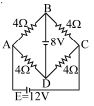
- 4The given figure shows $a$ network of resistances and $a$ battery. Which of the two batteries is getting charged?View Solution
- 5A conducting wire of length $ l$ area of cross-section $A$ and electric resistivity $\rho$ is connected between the terminals of a battery. $A$ potential difference $V$ is developed between its ends, causing an electric current.If the length of the wire of the same material is doubled and the area of cross-section is halved, the resultant current would beView Solution
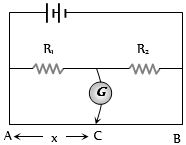
- 6The resistance of platinum wire at $0^{\circ}\,C$ is $2\,\Omega$ and $6.8\,\Omega$ at $80^{\circ} \,C$. The temperature coefficient of resistance of the wire is :View Solution
- 7A piece of fuse wire melts when a current of $15\, ampere$ flows through it. With this current, if it dissipates $22.5\, W$, the resistance of fuse wire will be .............. $\Omega$View Solution
- 8View SolutionThe brightness of a bulb will be reduced, if a resistance is connected in
- 9A potentiometer consists of two wires $AC$ and $CB$ of same material and of equal lengths but diameters in the ratio $3 : 1.$ Then the potential gradients on the two wires will be in the ratio :-View Solution
- 10In the shown arrangement of the experiment of the meter bridge if $AC$ corresponding to null deflection of galvanometer is $x$, what would be its value if the radius of the wire $AB$ is doubledView Solution