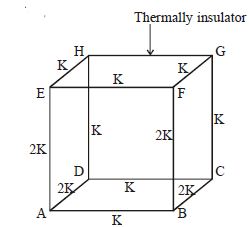
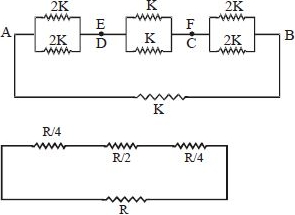
Find effective thermal resistance between $A$ & $B$ of cube made up of $12$ rods of same dimensions and shown given thermal conductivity. [ $l =$ length of rod, $a =$ cross section area of rod]
Advanced


Download our appand get started for free
Experience the future of education. Simply download our apps or reach out to us for more information. Let's shape the future of learning together!No signup needed.*
Similar Questions
- 1As per the given figure, two plates $A$ and $B$ of thermal conductivity $K$ and $2 K$ are joined together to form a compound plate. The thickness of plates are $4.0 \,cm$ and $2.5 \,cm$ respectively and the area of cross-section is $120 \,cm ^{2}$ for each plate. The equivalent thermal conductivity of the compound plate is $\left(1+\frac{5}{\alpha}\right) K$, then the value of $\alpha$ will be_______View Solution

- 2On investigation of light from three different stars $A, B$ and $C$ , it was found that in the spectrum of $A$ the intensity of red colour is maximum, in $B$ the intensity of blue colour is maximum and in $C$ the intensity of yellow colour is maximum. From these observations it can be concluded thatView Solution
- 3View SolutionAir is bad conductor of heat or partly conducts heat, still vacuum is to be placed between the walls of the thermos flask because
- 4View SolutionThe cause of Fraunhoffer lines is
- 5View SolutionThe quantity of heat which crosses unit area of a metal plate during conduction depends upon
- 6View SolutionWhen fluids are heated from the bottom, convection currents are produced because
- 7The ratio of radiant energies radiated per unit surface area by two bodies is $16 : 1$ , the temperature of hotter body is $1000K$ , then the temperature of colder body will be ....... $K$View Solution
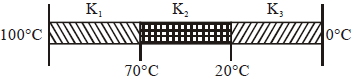
- 8Three rods of identical cross-section and lengths are made of three different materials of thermal conductivity $K _{1}, K _{2},$ and $K _{3}$, respectively. They are joined together at their ends to make a long rod (see figure). One end of the long rod is maintained at $100^{\circ} C$ and the ther at $0^{\circ} C$ (see figure). If the joints of the rod are at $70^{\circ} C$ and $20^{\circ} C$ in steady state and there is no loss of energy from the surface of the rod, the correct relationship between $K _{1}, K _{2}$ and $K _{3}$ isView Solution
- 9If between wavelength $\lambda $and $\lambda + d\lambda $, ${e_\lambda }$and ${a_\lambda }$ be the emissive and absorptive powers of a body and ${E_\lambda }$ be the emissive power of a perfectly black body, then according to Kirchoff's law, which is trueView Solution
- 10A composite rod made of three rods of equal length and cross-section as shown in the fig. The thermal conductivities of the materials of the rods are $K/2, 5K$ and $K$ respectively. The end $A$ and end $B$ are at constant temperatures. All heat entering the face Agoes out of the end $B$ there being no loss of heat from the sides of the bar. The effective thermal conductivity of the bar isView Solution
