The quantity of heat which crosses unit area of a metal plate during conduction depends upon
Easy
Download our app for free and get started
(b) $\frac{{dQ}}{{dt}} = KA\frac{{d\theta }}{{dl}}$
==> $\frac{{dQ}}{{dt}} \propto \frac{{d\theta }}{{dl}}$ (Temperature gradient)

Download our appand get started for free
Experience the future of education. Simply download our apps or reach out to us for more information. Let's shape the future of learning together!No signup needed.*
Similar Questions
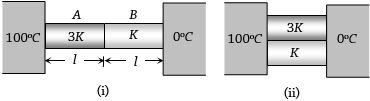
- 1Two conducting rods $A$ and $B$ of same length and cross-sectional area are connected $(i)$ In series $(ii)$ In parallel as shown. In both combination a temperature difference of $100^o C$ is maintained. If thermal conductivity of $A$ is $3K$ and that of $B$ is $K$ then the ratio of heat current flowing in parallel combination to that flowing in series combination isView Solution
- 2A black body at a temperature of $127°C$ radiates heat at the rate of $1 cal/cm^2 × sec$. At a temperature of $527°C$ the rate of heat radiation from the body in ($cal/cm^2 × sec$) will beView Solution
- 3A black body radiates $ 20\,W$ at temperature ${227^o}C$. If temperature of the black body is changed to ${727^o}C$ then its radiating power will be ..... $W$View Solution
- 4A cylindrical steel rod of length $0.10 \,m$ and thermal conductivity $50 \,Wm ^{-1} K ^{-1}$ is welded end to end to copper rod of thermal conductivity $400 \,Wm ^{-1} K ^{-1}$ and of the same area of cross-section but $0.20 \,m$ long. The free end of the steel rod is maintained at $100^{\circ} C$ and that of the copper rod at $0^{\circ} C$. Assuming that the rods are perfectly insulated from the surrounding, the temperature at the junction of the two rods is ................... $^{\circ} C$View Solution
- 5The coefficient of linear expansion of brass and steel are ${\alpha _1}$ and ${\alpha _2}$. If we take a brass rod of length ${l_1}$ and steel rod of length ${l_2}$ at $0°C$, their difference in length $({l_2} - {l_1})$ will remain the same at a temperature ifView Solution
- 6If the radius of a star is $R$ and it acts as a black body, what would be the temperature of the star, in which the rate of energy production is Q? ( $\sigma$ stands for Stefan's constant.)View Solution
- 7The area of a hole of heat furnace is ${10^{ - 4}}{m^2}$. It radiates $1.58 \times {10^5}$ calories of heat per hour. If the emissivity of the furnace is $0.80$ , then its temperature is....... $K$View Solution
- 8A black body is at a temperature of $5760\ K$. The energy of radiation emitted by the body at wavelength $250\ nm$ is $U_1$, at wavelength $500\ nm$ is $U_2$ and that at $1000\ nm$ is $U_3$. Wien's constant, $b = 2.88 \times 10^6\ nm\ K$. Which of the following is correct?View Solution
- 9The top of a lake gets frozen at a place where the surrounding air is at a temperature of $-20\,^oC$. ThenView Solution
- 10In a certain planetary system, it is observed that one of the celestial bodies having a surface temperature of $200 \;K$, emits radiation of maximum intensity near the wavelength $12\; \mu m$. The surface temperature (in $K$) of a nearby star which emits light of maximum intensity at a wavelength $\lambda= 4800\;\mathring A$ isView Solution