Question
  1. Find equivalent capacitance between A and B in the combination given below. Each capacitor is of 2 μF capacitance.
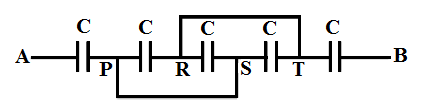
  1. If a dc source of 7 V is connected across AB, how much charge is drawn from the source and what is the energy stored in the network?
Answer

Capacitors  $C_2$, $C_3$ $\text{and}$ $C_4 $$\ \ \text{are in parallel}$$\therefore C_{234}=C_2+C_3+C_4$
$\therefore C_{234}=6\mu F$
Capacitors $C_1$,$​​​​C_{234}$ $\text{and}$  $C_5$ are in series$\frac{1}{C_{eq}}=\frac{1}{C_1}+\frac{1}{C_{234}}+\frac{1}{C_5}=\frac{1}{2}+\frac{1}{6}+\frac{1}{2}$
$=\frac{7}{6}\mu F$
$C_{equivalent}=\frac{6}{7}\mu F$
Charge drawn from the source$Q=C_{eq}V,$
$=\frac{6}{7}\times7\mu C=6\mu C$
Energy stored $U=\frac{Q^2}{2C}$$=\frac{6\times6\times10^{-12}\times7}{2\times6\times10^{-6}}\text{J}$
$=21\mu \text{J}$.

Need a full question paper?

Generate a complete, print-ready paper with questions like this in minutes — across 16+ boards, with answer keys.

Start Generating Free

Similar questions

  1. Using the phenomenon of polarisation, show how transverse nature of light can be demonstrated.
  2. Two polaroids $P_1$ and $P_2$ are placed with their pass axes perpendicular to each other. Unpolarised light of intensity Io is incident on $P_1$. A third polaroid $P_3$ is kept in between $P_1$ and $P_2$ such that its pass axis makes an angle of $30^\circ $ with that of $P_1$. Determine the intensity of light transmitted through $P_1, P_2$ and $P_3$.
An inductor 200 mH, capacitor 500 µF, resistor 10Ω are connected in series with a100 V, variable frequency a.c. source. Calculate the
  1. Frequency at which the power factor of the circuit is unity.
  2. Current amplitude at this frequency.
  3. Q-factor.
A ceiling fan has a diameter (of the circle through the outer edges of the three blades) of 120cm and rpm 1500 at full speed. Consider a particle of mass 1g sticking at the outer end of a blade. How much force does it experience when the fan runs at full speed? Who exerts this force on the particle? How much force does the particle exert on the blade along its surface?
State Lenz’s law. Illustrate, by giving an example, how this law helps in predicting the direction of the current in a loop in the presence of a changing magnetic flux.
In a given coil of self-inductance of 5 mH, current changes from 4 A to 1 A in 30 ms. Calculate the emf induced in the coil.
  1. Show using a proper diagram how unpolarised light can be linearly polarised by reflection from a transparent glass surface.
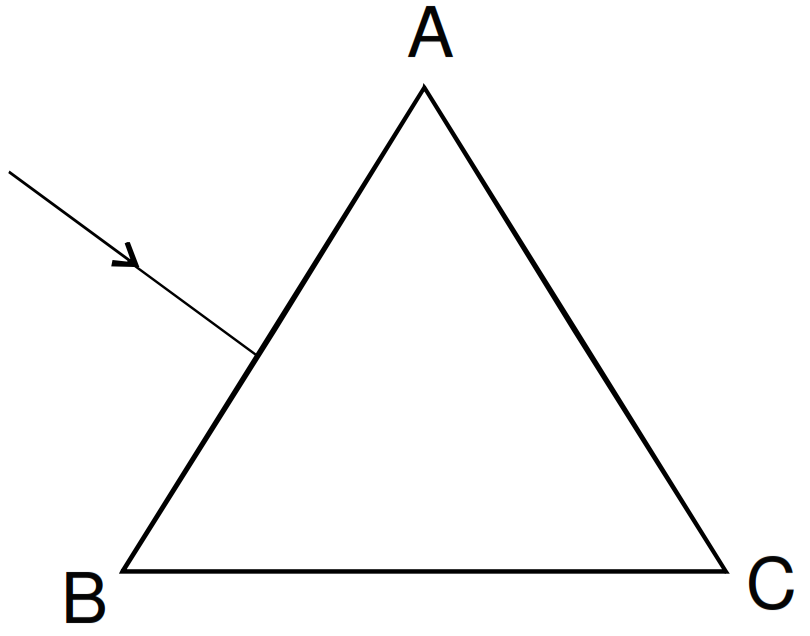
  2. The figure shows a ray of light falling normally on the face $AB$ of an equilateral glass prism having refractive index $\frac{3}{2},$ placed in water of refractive index $\frac{4}{3}.$ Will this ray suffer total internal reflection on striking the face $AC$? Justify your answer.
State the law of radioactive decay.
Plot a graph showing the number $(N)$ of undecayed nuclei as a function of time $(t)$ for a given radioactive sample having half life $T_\frac12.$
Depict in the plot the number of undecayed nuclei at $(i) t = 3 T_\frac12$ and $(ii) t = 5 T_\frac12.$
Define the term ‘decay constant’ of a radioactive sample. The rate of disintegration of a given radioactive nucleus is $10000$ disintegrations/ s and $5,000$ disintegrations/ s after $20hr$. and $30hr$. respectively from start. Calculate the half life and initial number of nuclei at $t = 0.$
A $40\ cm$ wire having a mass of $3.2g$ is stretched between two fixed supports $40.05\ cm$ apart. In its fundamental mode, the wire vibrates at $220\ Hz$. If the area of cross-section of the wire is $1.0mm^2$, find its Young's modulus.
A small flat search coil of area $5 \ cm^2$ with $140$ closely wound turns is placed between the poles of a powerful magnet producing magnetic field $0.09 T$ and then quickly removed out of the field region. Calculate
$a.$ change of magnetic flux through the coil, and
$b.$ emf induced in the coil.
In Exercise $4.11$ obtain the frequency of revolution of the electron in its circular orbit. Does the answer depend on the speed of the electron? Explain.