Question
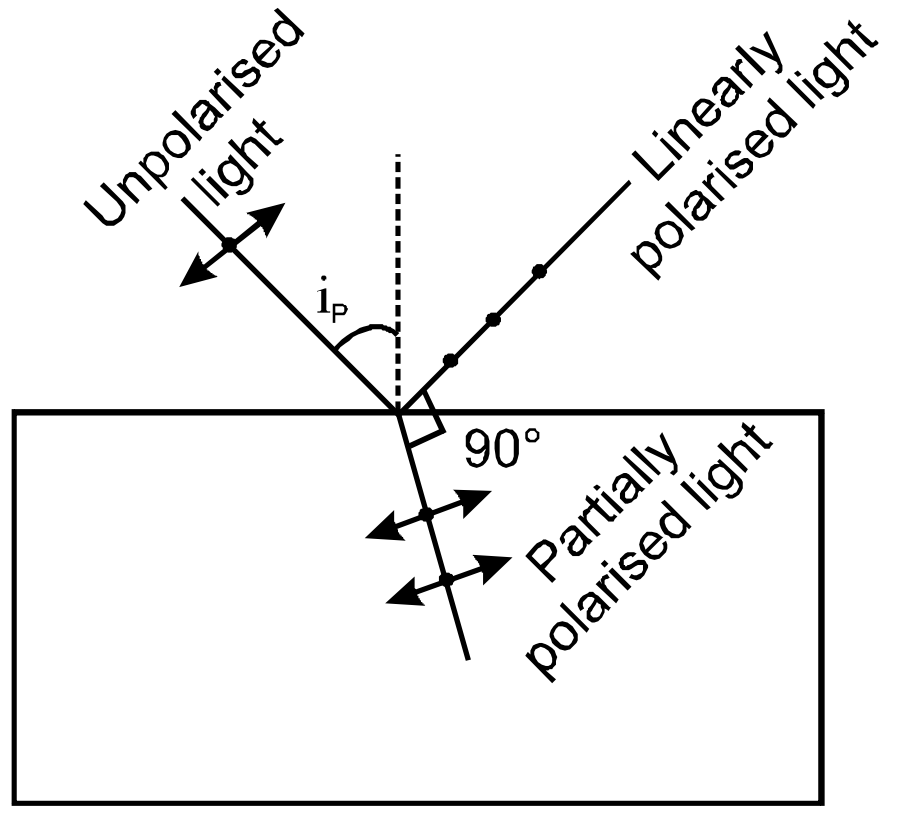
  1. Show using a proper diagram how unpolarised light can be linearly polarised by reflection from a transparent glass surface.
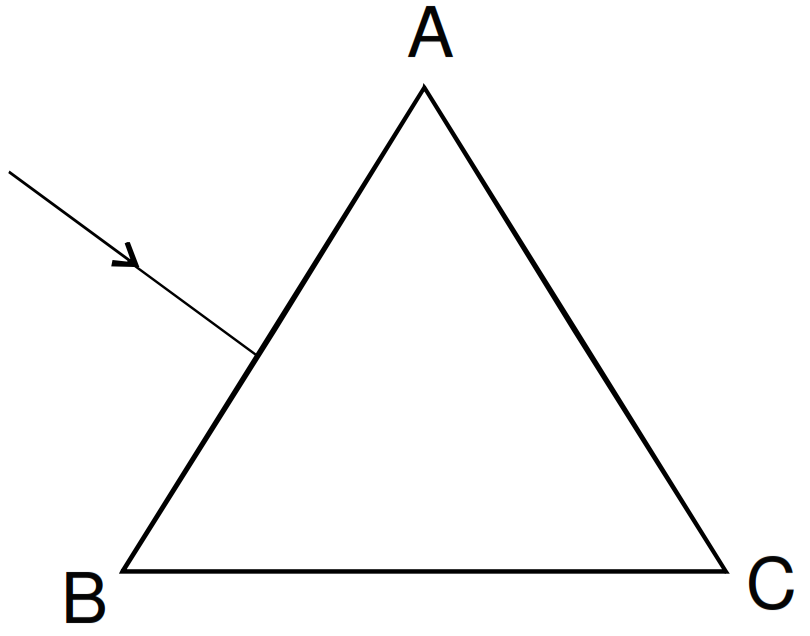
  2. The figure shows a ray of light falling normally on the face $AB$ of an equilateral glass prism having refractive index $\frac{3}{2},$ placed in water of refractive index $\frac{4}{3}.$ Will this ray suffer total internal reflection on striking the face $AC$? Justify your answer.
Answer

  1.  

When unpolarised light ray is incident at an angle such that the angle between reflected of refracted rays is $90^\circ ,$ then reflected ray is linearly polarised. In that case incident angle is called polarising angle or Brewster angle $(i_P$ or $i_B)$.
  1. For Total internal reflection $\Big(\frac{1}{\sin\text{i}_{\text{c}}}=\mu_{\text{DR}}\Big)$
$\sin\text{i}_{\text{c}}=\Big(\frac{1}{\sin\text{i}_{\text{c}}}=\mu_{\text{DR}}\Big)$
$\sin\text{i}_{\text{c}}=\mu_{\text{wg}}$
$\sin\text{i}_{\text{c}}=\frac{4}{3}\div\frac{3}{2}$
$=\frac{4}{3}\times\frac{2}{3}$
$\sin\text{i}_{\text{c}}=\frac{8}{9}=0.88$
Now, in this case
$\sin\text{i}=\sin60^\circ=\frac{\sqrt{3}}{2}=0.867$
$\because\ \sin\text{i}<\sin\text{i}_{\text{c}}$
$\text{So,}\ \text{i}<\text{i}_{\text{c}}$
So, ray will not suffer Total internal reflection.

Need a full question paper?

Generate a complete, print-ready paper with questions like this in minutes — across 16+ boards, with answer keys.

Start Generating Free

Similar questions

Write the summary of experimental studies of the photoelectric effect.
###
Write the characteristics of photoelectric effect.
One end of a cylindrical glass rod $(\mu=1.5)$ of radius 1.0cm is rounded in the shape of a hemisphere. The rod is immersed in water $\Big(\mu=\frac{4}{3}\Big)$ and an object is placed in the water along the axis of the rod at a distance of 8.0cm from the rounded edge. Locate the image of the object.
Compare and explain three distinguishing features observed in Young’s double slit interference pattern with those seen for a coherently illuminated single slit producing diffraction pattern.
Accepting the relation $\frac{v_s}{v_p}=\frac{ N _s}{N_s}$ for ideal transformer, and using thé formula of power; derive $\frac{I_p}{I_s}=\frac{v_s}{v_p}=\frac{N_s}{ N _p}$ and from that explain the types of the transformers.
In the given circuit, the potential difference across the inductor L and resistor R are 200V and 150V respectively and the rms. value of current is 5A. Calculate (i) the impedance of the circuit and (ii) the phase angle between the voltage and the current.
A simple pendulum consists of a 50cm long string connected to a 100g ball. The ball is pulled aside so that the string makes an angle of 37° with the vertical and is then released. Find the tension in the string when the bob is at its lowest position.
A solid sphere is set into motion on a rough horizontal surface with a linear speed v in the forward direction and an angular speed $\frac{\text{v}}{\text{R}}$ in the anticlockwise direction as shown in figure. Find the linear speed of the sphere:
  1. When it stops rotating.
  2. When slipping finally ceases and pure rolling starts.
A resistance of R draws current from a potentiometer. The potentiometer wire $, AB, $ has a total resistance of $R_o. A$ voltage $V$ is supplied to the potentiometer. Derive an expression for the voltage across $R$ when the sliding contact is in the middle of potentiometer wire.
Draw a labelled ray diagram of a refracting telescope. Define its magnifying power and write the expression for it.
Write two important limitations of a refracting telescope over a reflecting type telescope.
A candle flame 1.6cm high is imaged in a ball bearing of diameter 0.4cm. If the ball bearing is 20cm away from the flame, find the location and the height of the image.