Question
  1. Find equivalent capacitance between A and B in the combination given below. Each capacitor is of 2 μF capacitance.
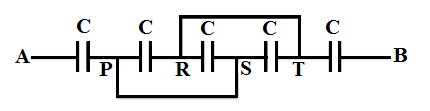
  1. If a dc source of 7 V is connected across AB, how much charge is drawn from the source and what is the energy stored in the network?
Answer

Capacitors  $C_2$$C_3$ $\text{and}$ $C_4 $$\ \ \text{are in parallel}$

$\therefore C_{234}=C_2+C_3+C_4$

$\therefore C_{234}=6\mu F$

Capacitors $C_1$,$​​​​C_{234}$ $\text{and}$  $C_5$ are in series

$\frac{1}{C_{eq}}=\frac{1}{C_1}+\frac{1}{C_{234}}+\frac{1}{C_5}=\frac{1}{2}+\frac{1}{6}+\frac{1}{2}$

$=\frac{7}{6}\mu F$

$C_{equivalent}=\frac{6}{7}\mu F$

Charge drawn from the source

$Q=C_{eq}V,$

$=\frac{6}{7}\times7\mu C=6\mu C$

Energy stored $U=\frac{Q^2}{2C}$

$=\frac{6\times6\times10^{-12}\times7}{2\times6\times10^{-6}}\text{J}$

$=21\mu \text{J}$.

Need a full question paper?

Generate a complete, print-ready paper with questions like this in minutes — across 16+ boards, with answer keys.

Start Generating Free

Similar questions

A wheel of mass 10kg and radius 20cm is rotating at an angular speed of 100rev/min when the motor is turned off. Neglecting the friction at the axle, calculate the force that must be applied tangentially to the wheel to bring it to rest in 10 revolutions.
A plane electromagnetic wave travels in vacuum, along the Y-direction. Write down the:
  1. Ratio of the magnitudes,
  2. The direction, of its electric and magnetic field vectors.
  1. In a typical nuclear reaction, e.g.  

$^{2}_{1}\text{H} +^{2}_{1}\text{H}\rightarrow^{3}_{2}\text{He} + \text{n} + 3.27\text{MeV}$ 

although number of nucleons is conserved, yet energy is released. How? Explain.

  1. Show that nuclear density in a given nucleus is independent of mass number A.
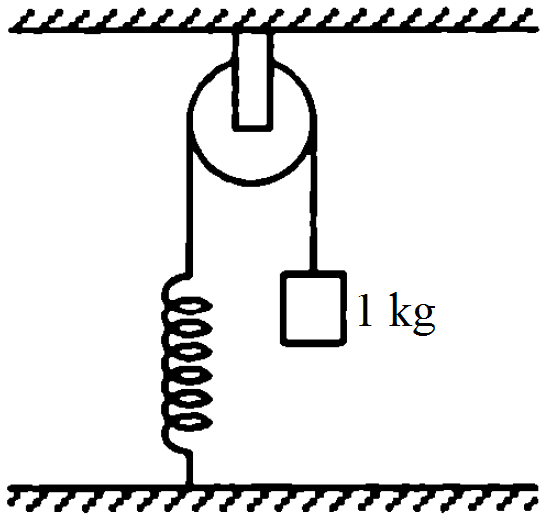
The pulley shown in figure has a radius of 20cm and moment of inertia 0.2kg-m2. The string going over it is attached at one end to a vertical spring of spring constant 50N/m fixed from below, and supports a 1kg mass at the other end. The system is released from rest with the spring at its natural length. Find the speed of the block when it has descended through 10cm. Take g = 10m/s2.

The magnifying power of a simple microscope is given by $1+\frac{\text{D}}{\text{f}},$ where D is the least distance for clear vision. For farsighted persons, D is greater than the usual. Does it mean that the magnifying power of a simple microscope is greater for a farsighted person as compared to a normal person? Does it mean that a farsighted person can see an insect more clearly under a microscope than a normal person?
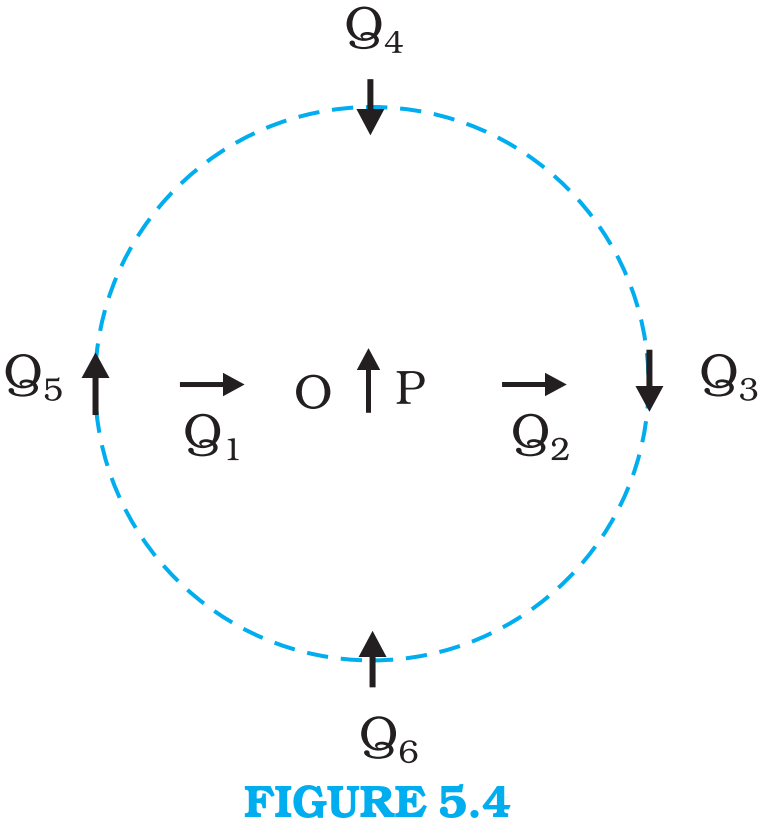
Figure 5.4 shows a small magnetised needle $P$ placed at a point $O$. The arrow shows the direction of its magnetic moment. The other arrows show different positions (and orientations of the magnetic moment) of another identical magnetised needle $Q$.
(a) In which configuration the system is not in equilibrium?
(b) In which configuration is the system in (i) stable, and (ii) unstable equilibrium?
(c) Which configuration corresponds to the lowest potential energy among all the configurations shown?
Image
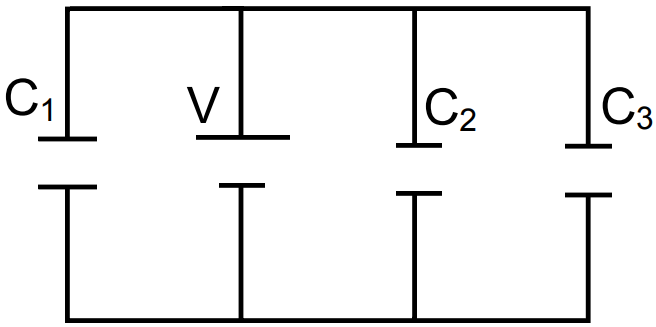
Find the charges on the three capacitors connected to a battery as shown in figure. Take $\text{C}_1=2.0\mu\text{F},\ \text{C}_2=4.0\mu\text{F},\ \text{C}_3=6.0\mu\text{F}$ and V = 12 volts.

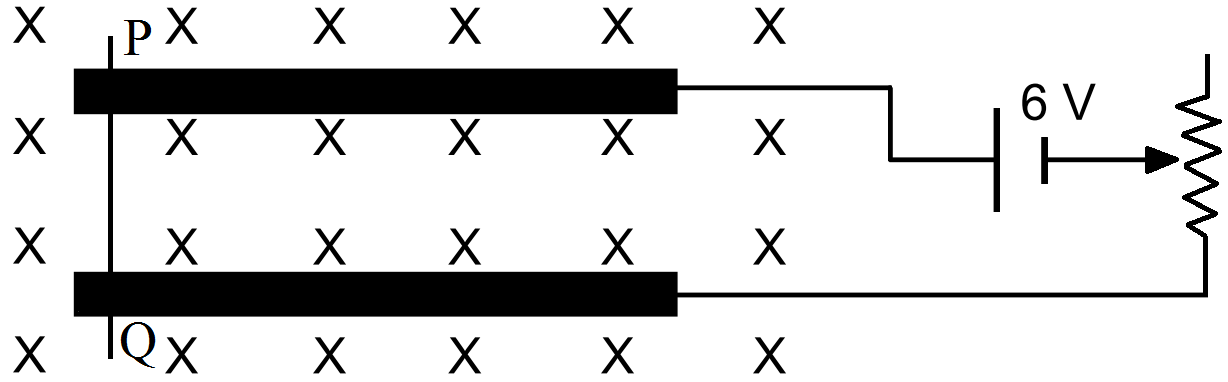
A metal wire PQ of mass 10g lies at rest on two horizontal metal rails separated by 4.90cm A vertically-downward magnetic field of magnitude 0.800T exists in the space. The resistance of the circuit is slowly decreased and it is found that when the resistance goes below 20.0Ω, the wire PQ starts sliding on the rails. Find the coefficient of friction.

Draw a plot showing the variation of photoelectric current with collector plate potential for two different frequencies, ν1 > ν2, of incident radiation having the same intensity. In which case will the stopping potential be higher? Justify your answer.
Find the Q-value and the kinetic energy of the emitted α-particle in the $\alpha $-decay of

  1.  $^{226}_{88}\text{Ra}$ and  
  2. $^{220}_{86}\text{Rn}.$

Given

$\text{m}(^{226}_{88}\text{Ra})=226.02540\text{ u}.$ $\text{m}(^{222}_{86}\text{Rn})=222.01750\text{ u}.$

$\text{m}(^{222}_{86}\text{Rn})=220.01137\text{ u}.$ $\text{m}(^{216}_{84}\text{Po})=216.00189\text{ u}.$