Questions · Page 1 of 2

3 Marks Question

🎯

Test yourself on this topic

50 questions · timed · auto-graded

Question 13 Marks
Answer
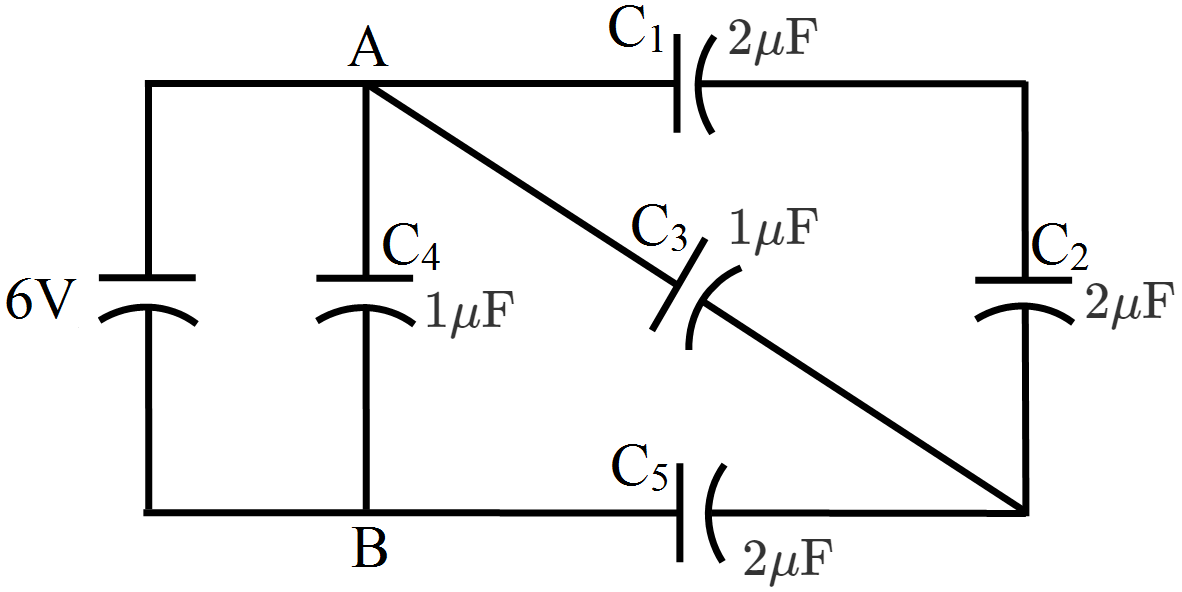
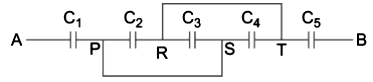
Capacitors  $C_2$$C_3$ $\text{and}$ $C_4 $$\ \ \text{are in parallel}$
$\therefore C_{234}=C_2+C_3+C_4$
$\therefore C_{234}=6\mu F$
Capacitors $C_1$,$​​​​C_{234}$ $\text{and}$  $C_5$ are in series
$\frac{1}{C_{eq}}=\frac{1}{C_1}+\frac{1}{C_{234}}+\frac{1}{C_5}=\frac{1}{2}+\frac{1}{6}+\frac{1}{2}$
$=\frac{7}{6}\mu F$
$C_{equivalent}=\frac{6}{7}\mu F$
Charge drawn from the source
$Q=C_{eq}V,$
$=\frac{6}{7}\times7\mu C=6\mu C$
Energy stored $U=\frac{Q^2}{2C}$
$=\frac{6\times6\times10^{-12}\times7}{2\times6\times10^{-6}}\text{J}$
$=21\mu \text{J}$.
View full question & answer
Question 23 Marks
A parallel plate capacitor with air between the plates has a capacitance of 8 pF (1pF = 10–12 F). What will be the capacitance if the distance between the plates is reduced by half, and the space between them is filled with a substance of dielectric constant 6?
Answer
Capacitance between the parallel plates of the capacitor, C = 8 pF
Initially, distance between the parallel plates was d and it was filled with air. Dielectric constant of air, k = 1
Capacitance, C, is given by the formula,
$\text{C}=\frac{\text{k}\in_0\text{A}}{\text{d}}$
$=\frac{\in_0\text{A}}{\text{d}} \dots\dots(1)$
Where,
A = Area of each plate
0 = Permittivity of free space
If distance between the plates is reduced to half, then new distance, $\text{d}^{-\text{TM}}=\frac{\text{d}}{2}$  Dielectric constant of the substance filled in between the plates, k'= 6 Hence, capacitance of the capacitor becomes
$\text{C}'=\frac{\text{k}'\in_0\text{A}}{\text{d}}=\frac{6\in_0\text{A}}{\frac{\text{d}}{2}} \dots\dots(2)$
Taking ratios of equations (i) and (ii), we obtain
C' = 2 × 6C
= 12 C
= 12 × 8 = 96pF
Therefore, the capacitance between the plates is 96 pF.
View full question & answer
Question 33 Marks
A spherical conductor of radius 12 cm has a charge of 1.6 × 10⁻⁷C distributed uniformly on its surface. What is the electric field:
  1. Inside the sphere
  2. Just outside the sphere
  3. At a point 18 cm from the centre of the sphere?
Answer
Radius of the spherical conductor, r = 12 cm = 0.12 m

Charge is uniformly distributed over the conductor, q = 1.6 × 10-7 C

  1. Electric field inside a spherical conductor is zero. This is because if there is field inside the conductor, then charges will move to neutralize it.
  2. Electric field E just outside the conductor is given by the relation,

$\text{E}=\frac{\text{q}}{4\pi\in_0\text{r}^2}$

Where,

0 = Permittivity of free space

$\frac{1}{4\pi\in_0}=9\times10^9\text{Nm}^2\text{C}^{-1}$

$\therefore\text{E}=\frac{1.6\times10^{-7}\times9\times10^{-9}}{(0.12)^2}$

= 105 NC-1

Therefore, the electric field just outside the sphere is 105 NC-1.

  1. Electric field at a point 18 m from the centre of the sphere = E1

Distance of the point from the centre, d = 18 cm = 0.18 m

$\text{E}_1=\frac{\text{q}}{4\pi\in_0\text{d}^2}$

$=\frac{9\times10^9\times1.6\times10^{-7}}{18\times10^{-2}}$

= 4.4 × 104 N/C

Therefore, the electric field at a point 18 cm from the centre of the sphere is 4.4 × 104 N/C.

View full question & answer
Question 43 Marks
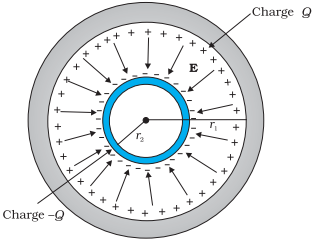
A spherical capacitor consists of two concentric spherical conductors, held in position by suitable insulating supports (2.36). Show

that the capacitance of a spherical capacitor is given by $\text{C}=\frac{{4}\pi\in_{0}\text{r}_1\text{r}_2}{\text{r}_1-\text{r}_2}$

where r1 and r2 are the radii of outer and inner spheres, respectively.

Answer
Radius of the outer shell = r1
Radius of the inner shell = r2
The inner surface of the outer shell has charge +Q.
$\text{V}=\frac{\text{Q}}{{4}\pi\in_0\text{r}_2}-\frac{Q}{{4}\pi\in_0\text{r}_1}$
The outer surface of the inner shell has induced charge −Q. Potential difference between the two shells is given by,
Where,
0 = Permittivity of free space
$\text{V}=\frac{\text{Q}}{{4}\pi\in_0}\bigg[\frac{1}{\text{r}_2}-\frac{1}{\text{r}_1}\bigg]$
$\text{V}=\frac{\text{Q}(\text{r}_1-\text{r}_2)}{{4}\pi\in_0\text{r}_1\text{r}_2}$
Capacitance of the given system is given by,
$\text{C}\frac{\text{charge}(\text{Q})}{\text{potential difference}(\text{V})}$
$=\frac{{4}\pi\in_0\text{r}_1\text{r}_2}{\text{r}_1-\text{r}_2}$
Hence, proved.
View full question & answer
Question 53 Marks
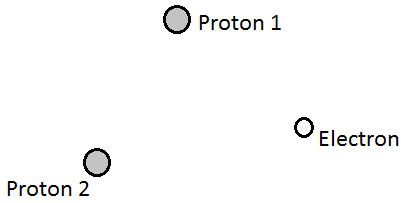
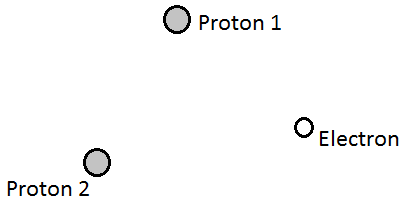
If one of the two electrons of a H2 molecule is removed, we get a hydrogen molecular ion $\text{H}^+_2​.$ In the ground state of an $\text{H}^+_2​,$ the two protons are separated by roughly 1.5 Å, and the electron is roughly 1 Å from each proton. Determine the potential energy of the system. Specify your choice of the zero of potential energy.
Answer
The system of two protons and one electron is represented in the given figure.

Charge on proton 1, q1 = 1.6 x 10⁻¹⁹ C

Charge on proton 2, q2 = 1.6 x 10⁻¹⁹ C

Charge on electron, q3 = -1.6 x 10⁻¹⁹ C

Distance between protons 1 and 2, d1 = 1.5 x 10⁻¹⁰ m

Distance between proton 1 and electron, d2 = 1 x 10⁻¹⁰ m

Distance between proton 2 and electron, d3 = 1 x 10⁻¹⁰ m

The potential energy at infinity is zero.

Potential energy of the system,

$\text{V}=\frac{\text{q}_1\text{q}_2}{4\pi\in_0\text{d}_1}+\frac{\text{q}_2\text{q}_3}{4\pi\in_0\text{d}_1}$

View full question & answer
Question 63 Marks
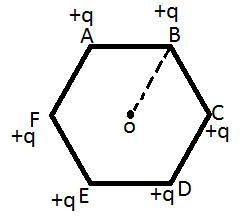
A regular hexagon of side 10 cm has a charge 5 µC at each of its vertices. Calculate the potential at the centre of the hexagon.
Answer
The given figure shows six equal amount of charges, q, at the vertices of a regular hexagon.

Where,
Charge, q = 5 µC = 5 × 10-6 C
Side of the hexagon, l = AB = BC = CD = DE = EF = FA = 10 cm
Distance of each vertex from centre O, d = 10 cm
Electric potential at point O,
$\text{V}=\frac{6\times q}{4\pi\in_0\text{d}}$
Where,
0 = Permittivity of free space
$\frac{1}{4\pi\in_0}=9\times10^9\text{NC}^{-2}\text{m}^{-2}$
$\therefore\text{V}=\frac{6\times9\times10^9\times5\times10^{-6}}{0.1}$
=  2.7 ×10V
Therefore, the potential at the centre of the hexagon is 2.7 × 106 V.
View full question & answer
Question 73 Marks
In a hydrogen atom, the electron and proton are bound at a distance of about 0.53 $\mathring{\text{A}}$:
  1. Estimate the potential energy of the system in eV, taking the zero of the potential energy at infinite separation of the electron from proton.
  2. What is the minimum work required to free the electron, given that its kinetic energy in the orbit is half the magnitude of potential energy obtained in (a)?
  3. What are the answers to (a) and (b) above if the zero of potential energy is taken at 1.06 Å separation?
Answer
The distance between electron-proton of a hydrogen atom, d = 0.53 $\mathring{\text{A}}$

Charge on an electron, q1 = -1.6 x 10⁻¹⁹ C

Charge on a proton, q2 = +1.6 x 10⁻¹⁹ C

  1. Potential at infinity is zero.

Potential energy of the system, p-e = Potential energy at infinity - Potential energy at distance, d

$=0-\frac{\text{q}_1\text{q}_2}{4\pi\in_0\text{d}}$

Where,

$\in_0$ is the permittivity of free space

$\frac{1}{4\pi\in_0}=9\times10^9\text{Nm}^2\text{C}^{-2}$

$\therefore\text{Potential energy}=0-\frac{9\times10^9\times\big(1.6\times10^{-19}\big)^2}{0.53\times10^{-10}}=-43.7\times10^{-19}\text{J}$

Since 1.6x 10⁻¹⁹ J = 1 eV,

$\therefore\text{Potential energy}=-43.7\times10^{-19}=\frac{-43.7\times10^{-19}}{1.6\times10^{-19}}=-27.2\ \text{eV}$

Therefore, the potential energy of the system is -27.2 ev.

  1. Kinetic energy is half of the rnagnitude of potential energy.

Kinetic energy $=\frac{1}{2}\times(-27.2)=13.6\ \text{eV}$

Total energy = 13.6 - 27.2 = 13.6 eV

Therefore, the rninimum work required to free the electron is 13.6 eV.

  1. When zero of potential energy is taken, d= 1.06 A

$\therefore$ Potential energy of the system = Potential energy at d1 - Potential energy at d

$=\frac{\text{q}_1\text{q}_2}{4\pi\in_0\text{d}_1}-27.2\ \text{eV}$

$=\frac{9\times10^9\times(1.6\times10^{-19})^2}{1.06\times10^{-10}}-27.2\ \text{eV}$

= 21.73 × 10-19 J - 27.2 eV

= 13.58 eV - 27.2 eV

= -13.6 eV

View full question & answer
Question 83 Marks
In a parallel plate capacitor with air between the plates, each plate has an area of 6 × 10⁻³ m2 and the distance between the plates is 3 mm. Calculate the capacitance of the capacitor. If this capacitor is connected to a 100 V supply, what is the charge on each plate of the capacitor?
Answer
Area of each plate of the parallel plate capacitor, A = 6 × 10⁻³ m2
Distance between the plates, d = 3 mm = 3 × 10⁻³ m
Supply voltage, V = 100 V
Capacitance C of a parallel plate capacitor is given by,
$\text{C}=\frac{\in_0\text{A}}{\text{d}}$
Where,
$\in_0$ = Permittivity of free space
= 8.854 × 10-12 N-1m-2C-2
$\therefore\text{C}=\frac{8.854\times10^{-12}\times6\times10^{-3}}{3\times10^{-3}}$
= 17.71 × 10-12 F
= 17.71pF
Potential V is related with the charge q and capacitance C as
$\text{V}=\frac{\text{q}}{\text{C}}$
$\therefore\text{q}=\text{VC}$
= 100 × 17.71 × 10-12
= 1.771 × 10⁻⁹ C
Therefore, capacitance of the capacitor is 17.71 pF and charge on each plate is 1.771 × 10-9.
View full question & answer
Question 93 Marks
Two charged conducting spheres of radii a and b are connected to each other by a wire. What is the ratio of electric fields at the surfaces of the two spheres? Use the result obtained to explain why charge density on the sharp and pointed ends of a conductor is higher than on its flatter portions.
Answer
Let a be the radius of a sphere A, QA be the charge on the sphere, and CA be the capacitance of the sphere. Let b be the radius of a sphere B, QB be the charge on the sphere, and CB be the capacitance of the sphere. Since the two spheres are connected with a wire, their potential (V) will become equal.

Let EA be the electric field of sphere A and EB be the electric field of sphere B. Therefore, their ratio,

$\frac{\text{E}_{\text{A}}}{\text{E}_{\text{B}}}=\frac{\text{Q}_{\text{A}}}{{4}\pi\in_{0} \text{a}^2}\times\frac{\text{b}^2{4}\pi\in_{0}}{\text{Q}_{\text{B}}}$

$\frac{\text{E}_{\text{A}}}{\text{E}_{\text{B}}}=\frac{\text{Q}_\text{A}}{\text{Q}_\text{B}}\times \frac{\text{b}^{2}}{\text{a}^{2}} \ \ ...(1)$

However, $\frac{\text{Q}_\text{A}}{\text{Q}_\text{B}}=\frac{\text{C}_\text{A}\text{V}}{\text{C}_\text{B}\text{V}}$

And, $\frac{\text{C}_\text{A}}{\text{C}_\text{B}}=\frac{\text{a}}{\text{b}}$

$\therefore \ \frac{\text{Q}_\text{A}}{\text{Q}_\text{B}}=\frac{\text{a}}{\text{b}}\ \ ...(2)$

Putting the value of (2) in (1), we obtain

$\therefore \ \frac{\text{E}_\text{A}}{\text{E}_\text{B}}=\frac{\text{a}}{\text{b}}\frac{\text{b}^{2}}{\text{a}^{2}}=\frac{\text{b}}{\text{a}}$

Therefore, the ratio of electric fields at the surface is $\frac{\text{b}}{\text{a}}$.

View full question & answer
Question 103 Marks
Explain what would happen if in the capacitor given in Exercise 2.8, a 3 mm thick mica sheet (of dielectric constant = 6) were inserted between the plates,
  1. While the voltage supply remained connected.
  2. After the supply was disconnected.
Answer
Dielectric constant of the mica sheet, k = 6

  1. Initial capacitance, C = 1.771 × 10-11

New capacitance, Cr = kC = 6 × 1.771 × 10-11 = 106 pF

Supply voltage, V = 100 V

New charge q1 = C' = 6 × 1.7717 × 10-9 = 1.06 × 10-8 Cs

Potential across the plates remains 100 V.

  1. Dielectric constant, k = 6

Initial capacitance C' = kC = 6 × 1.771 × 10-11 = 106 pF

If supply voltage is removed, then there will be no effect on the amount of charge in the plates.

Charge = 1.771 ×10⁻⁹ C

Potential across the plates is given by,

$\therefore\text{V}'=\frac{\text{q}}{\text{C}'}$

$=\frac{1.771\times10^{-9}}{106\times10^{-12}}$

= 16.7 V

View full question & answer
Question 113 Marks
A long charged cylinder of linear charged density λ is surrounded by a hollow co-axial conducting cylinder. What is the electric field in the space between the two cylinders?
Answer
Charge density of the long charged cylinder of length L and radius r is $\lambda.$
Another cylinder of same length surrounds the pervlous cylinder. The radius of this cylinder is R.
Let E be the electric field produced in the space between the two cylinders.
Electric flux through the Gaussian surface is given by Gauss's theorem as,
$\phi=\text{E}(2\pi\text{d})\text{L}$
Where, d = Distance of a point from the common axis of the cylinders
Let q be the total charge on the cylinder.
It can be written as
$\therefore\phi=\text{E}(2\pi\text{dL})=\frac{\text{q}}{\in_0}$
Where,
q = Charge on the inner sphere of the outer cylinder
$\in_0$ = Permittivity of free space
$\text{E}(2\pi\text{dL})=\frac{\lambda\text{L}}{\in_0}$
$\text{E}=\frac{\lambda}{2\pi\in_0\text{d}}$
Therefore, the electric field In the space between the two cylinders is $\frac{\lambda}{2\pi\in_0\text{d}}.$
View full question & answer
Question 123 Marks
A cylindrical capacitor has two co-axial cylinders of length 15cm and radii 1.5cm and 1.4cm. The outer cylinder isearthed and the inner cylinder is given a charge of 3.5µC. Determine the capacitance of the system and the potential of the inner cylinder. Neglect end effects (i.e., bending of field lines at the ends).
Answer
Length of a co-axial cylinder, I = 15cm= 0.15m

Radius of outer cylinder, r= 1.5cm = 0.015m

Radius of inner cylinder, r2 = 1.4cm = 0.014m

Charge on the inner cylinder, q = 3.5µC = 3.5 x 10⁻⁶ c

Capacitance of a co-axial cylinder of radii r1 and r2 is given by the relation,

$\text{C}=\frac{{2}\pi\in_{0}\text{I}}{\log\frac{\text{r}_1}{\text{r}_2}}$

Where,

$\in_0$ = Permittivity of free space = 8.85 × 10⁻¹² N-1 m-2 C2

$\therefore\ \text{C}=\frac{{2}\pi\times{8.85}\times{10}^{-12}\times{0.15}}{{2.3026}\log_{10}\bigg(\frac{0.15}{0.14}\bigg)}$

$=\frac{{2}\pi\times{8.85}\times{10}^{-12}\times{0.15}}{{2.3026}\times{0.0299}}={1.2}\times{10}^{-10}\text{F}$

Potential difference of the inner cylinder is given by,

$\text{V}=\frac{\text{q}}{\text{C}}$

$=\frac{3.5\times10^{-6}}{1.2\times10^{-10}}={2.92}\times{10}^{4}\text{V}$

View full question & answer
Question 133 Marks
A spherical conducting shell of inner radius r1 and outer radius r2 has a charge Q.
  1. A charge q is placed at the centre of the shell. What is the surface charge density on the inner and outer surfaces of the shell?
  2. Is the electric field inside a cavity (with no charge) zero, even if the shell is not spherical, but has any irregular shape? Explain
Answer
  1. Charge placed at the centre of a shell is +q. Hence, a charge of magnitude -q will be induced to the inner surface of the shell. Therefore, total charge on the inner surface of the shell is -q.

Surface charge density at the inner surface of the shell is given by the relation,

$\sigma_1=\frac{\text{Total charge}}{\text{Inner surface area}}=\frac{-\text{q}}{4\pi\text{r}^2_1} \dots\dots(1)$

A charge of +q is induced on the outer surface of the shell. A charqe of magnitude Q is placed on the outer surface of the shell. Therefore, total charge on the outer surface of the shell is Q + q. Surface charge density at the outer surface of the shell,

$\sigma_2=\frac{\text{Total charge}}{\text{Outer surface area}}=\frac{-\text{Q+q}}{4\pi\text{r}^2_2} \dots\dots(2)$

  1. Yes

The electric field intensity inside a cavity is zero, even if the shell is not spherical and has any irregular shape. Take a closed loop such that a part of it is inside the cavity along a field line while the rest is inside the conductor. Net work done by the field in carrying a test charge over a closed loop is zero because the field inside the conductor is zero. Hence, electric field is zero, whatever is the shape.

View full question & answer
Question 143 Marks
What is the area of the plates of a 2F parallel plate capacitor, given that the separation between the plates is 0.5 cm? [You will realise from your answer why ordinary capacitors are in the range of μF or less. However, electrolytic capacitors do have a much larger capacitance (0.1F) because of very minute separation between the conductors.]
Answer
Capacitance of a parallel capacitor, V = 2F

Distance between the two plates, d = 0.5cm = 0.5 × 10-2m Capacitance of a parallel plate capacitor is given by the relation,

Where,

$\in_{0}= \text{Permittivity of free space} = {8.85}\times{10}^{-12}\text{C}^{2}\text{N}^{-1}\text{m}^{-2}$

$\therefore\ \text{A} = \frac{2\times0.5\times10^{-2}}{8.85\times10^{-12}}$

$={1130}\text{km}^{2}$

Hence, the area of the plates is too large. To avoid this situation, the capacitance is taken in the range of μF.

View full question & answer
Question 153 Marks
Three capacitors of capacitances 2 pF, 3 pF and 4 pF are connected in parallel.
  1. What is the total capacitance of the combination?
  2. Determine the charge on each capacitor if the combination is connected to a 100 V supply.
Answer
  1. Capacitances of the given capacitors are

C= 2 pF

C2 = 3 pF

C3 = 4 pF

For the parallel combination of the capacitors, equivalent capacitor r C is given by the algebraic sum,

C' = 2 + 3 + 4 = 9 pF

Therefore, total capacitance of the combination is 9 pF.

  1. Supply voltage, V = 100 V

The voltage through all the three capacitors is same = V = 100 V

Charge on a capacitor of capacitance C and potential difference V is given by the relation,

q = vc ......(1)

For C = 2 pF,

Charge = VC = 100 × 2 = 200 pc = 2 × 10⁻¹⁰ C

For C = 3 pF,

Charge = VC = 100 × 3 = 300 pc = 3 × 10-10 C

For C = 4 pF,

Charge = VC = 100 × 4 = 400 pc = 4 × 10-10 C

View full question & answer
Question 163 Marks
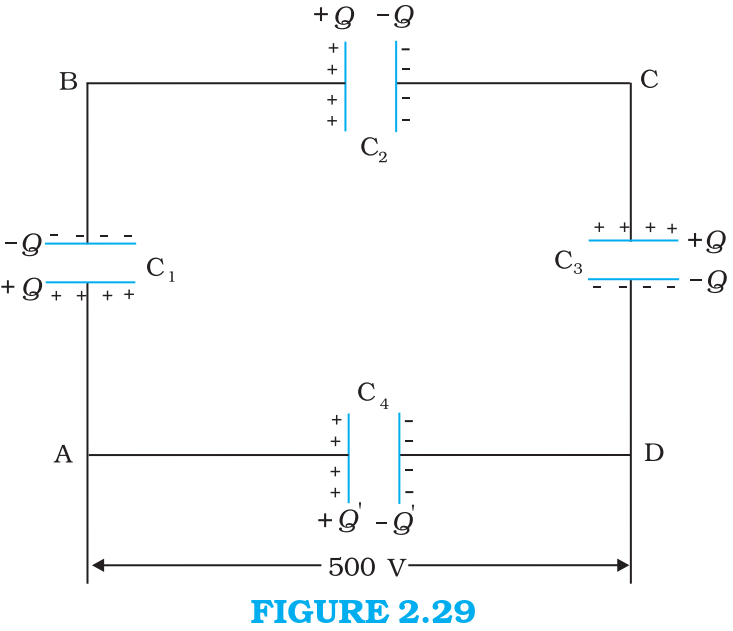
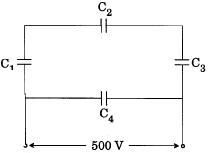
A network of four $10 \mu F$ capacitors is connected to a $500 V$ supply, as shown in Fig. 2.29. Determine (a) the equivalent capacitance of the network and (b) the charge on each capacitor. (Note, the charge on a capacitor is the charge on the plate with higher potential, equal and opposite to the charge on the plate with lower potential.)
Image
Answer
(a) In the given network, $C_1, C_2$ and $C_3$ are connected in series. The effective capacitance $C ^{\prime}$ of these three capacitors is given by
$
\frac{1}{C^{\prime}}=\frac{1}{C_1}+\frac{1}{C_2}+\frac{1}{C_3}
$
For $C_1=C_2=C_3=10 \mu F , C^{\prime}=(10 / 3) \mu F$. The network has $C^{\prime}$ and $C_4$ connected in parallel. Thus, the equivalent capacitance $C$ of the network is
$
C=C^{\prime}+C_4=\left(\frac{10}{3}+10\right) \mu F =13.3 \mu F
$

(b) Clearly, from the figure, the charge on each of the capacitors, $C_1$, $C_2$ and $C_3$ is the same, say $Q$. Let the charge on $C_4$ be $Q^{\prime}$. Now, since the potential difference across $AB$ is $Q / C_1$, across $BC$ is $Q / C_2$, across $CD$ is $Q / C_3$, we have
$
\frac{Q}{C_1}+\frac{Q}{C_2}+\frac{Q}{C_3}=500 V \text {. }
$
Also, $Q^{\prime} / C_4=500 V$.
This gives for the given value of the capacitances,
$
\begin{array}{l}
Q=500 V \times \frac{10}{3} \mu F =1.7 \times 10^{-3} C \text { and } \\
Q^{\prime}=500 V \times 10 \mu F =5.0 \times 10^{-3} C
\end{array}
$
View full question & answer
Question 173 Marks
(a) A comb run through one's dry hair attracts small bits of paper. Why?
What happens if the hair is wet or if it is a rainy day? (Remember, a paper does not conduct electricity.)
(b) Ordinary rubber is an insulator. But special rubber tyres of aircraft are made slightly conducting. Why is this necessary?
(c) Vehicles carrying inflammable materials usually have metallic ropes touching the ground during motion. Why?
(d) A bird perches on a bare high power line, and nothing happens to the bird. A man standing on the ground touches the same line and gets a fatal shock. Why?
Answer
(a) This is because the comb gets charged by friction. The molecules in the paper gets polarised by the charged comb, resulting in a net force of attraction. If the hair is wet, or if it is rainy day, friction between hair and the comb reduces. The comb does not get charged and thus it will not attract small bits of paper.
(b) To enable them to conduct charge (produced by friction) to the ground; as too much of static electricity accumulated may result in spark and result in fire.
(c) Reason similar to (b).
(d) Current passes only when there is difference in potential.
View full question & answer
Question 183 Marks
(a) Determine the electrostatic potential energy of a system consisting of two charges $7 \mu C$ and $-2 \mu C$ (and with no external field) placed at ( $-9 cm , 0,0)$ and $(9 cm , 0,0)$ respectively.
(b) How much work is required to separate the two charges infinitely away from each other?
(c) Suppose that the same system of charges is now placed in an external electric field $E=A\left(1 / r^2\right) ; A=9 \times 10^5 NC ^{-1} m ^2$. What would the electrostatic energy of the configuration be?
Answer
(a) $U=\frac{1}{4 \pi \varepsilon_0} \frac{q_1 q_2}{r}=9 \times 10^9 \times \frac{7 \times(-2) \times 10^{-12}}{0.18}=-0.7 J$.
(b) $W=U_2-U_1=0-U=0-(-0.7)=0.7 J$.
(c) The mutual interaction energy of the two charges remains unchanged. In addition, there is the energy of interaction of the two charges with the external electric field. We find,
$
q_1 V\left( r _1\right)+q_2 V\left( r _2\right)=A \frac{7 \mu C }{0.09 m }+A \frac{-2 \mu C }{0.09 m }
$
and the net electrostatic energy is
$
\begin{array}{r}
q_1 V\left( r _1\right)+q_2 V\left( r _2\right)+\frac{q_1 q_2}{4 \pi \varepsilon_0 r_{12}}=A \frac{7 \mu C }{0.09 m }+A \frac{-2 \mu C }{0.09 m }-0.7 J \\
=70-20-0.7=49.3 J
\end{array}
$
View full question & answer
Question 193 Marks
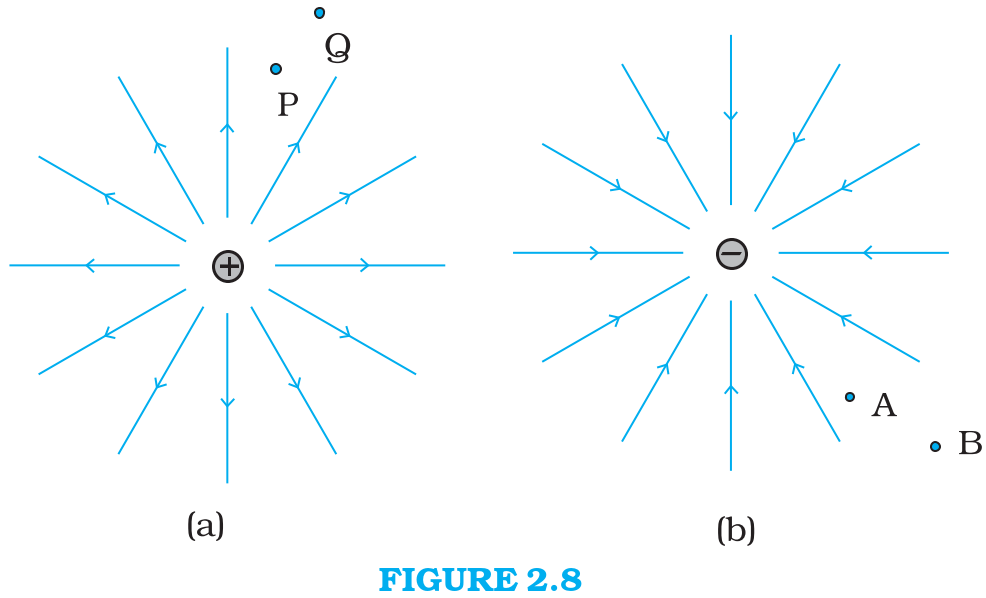
Figures 2.8 (a) and (b) show the field lines of a positive and negative point charge respectively.
Image
(a) Give the signs of the potential difference $V_{ P }-V_{ Q } ; V_{ B }-V_{ A }$.
(b) Give the sign of the potential energy difference of a small negative charge between the points $O$ and $P ; A$ and $B$.
(c) Give the sign of the work done by the field in moving a small positive charge from $Q$ to $P$.
(d) Give the sign of the work done by the external agency in moving a small negative charge from $B$ to $A$.
(e) Does the kinetic energy of a small negative charge increase or decrease in going from $B$ to $A$ ?
Answer
(a) As $V \propto \frac{1}{r}, V_P>V_Q$. Thus, $\left(V_P-V_Q\right)$ is positive. Also $V_B$ is less negative than $V_A$. Thus, $V_B>V_A$ or $\left(V_B-V_A\right)$ is positive.
(b) A small negative charge will be attracted towards positive charge. The negative charge moves from higher potential energy to lower potential energy. Therefore the sign of potential energy difference of a small negative charge between $G$ and $P$ is positive.
Similarly, (P.E. $)_{ A }>$ (P.E. $B _{ B }$ and hence sign of potential energy differences is positive.
(c) In moving a small positive charge from $Q$ to $P$, work has to be done by an external agency against the electric field. Therefore, work done by the field is negative.
(d) In moving a small negative charge from B to A work has to be done by the external agency. It is positive.
(e) Due to force of repulsion on the negative charge, velocity decreases and hence the kinetic energy decreases in going from B to A.
View full question & answer
Question 203 Marks
Two charges $3 \times 10^{-8} C$ and $-2 \times 10^{-8} C$ are located $15 cm$ apart. At what point on the line joining the two charges is the electric potential zero? Take the potential at infinity to be zero.
Answer
Let us take the origin $O$ at the location of the positive charge. The line joining the two charges is taken to be the $x$-axis; the negative charge is taken to be on the right side of the origin (Fig. 2.7).
Image
Let $P$ be the required point on the $x$-axis where the potential is zero. If $x$ is the $x$-coordinate of $P$, obviously $x$ must be positive. (There is no possibility of potentials due to the two charges adding up to zero for $x<0$.) If $x$ lies between $O$ and $A$, we have
$
\frac{1}{4 \pi \varepsilon_0}\left[\frac{3 \times 10^{-8}}{x \times 10^{-2}}-\frac{2 \times 10^{-8}}{(15-x) \times 10^{-2}}\right]=0
$
where $x$ is in $cm$. That is,
$
\frac{3}{x}-\frac{2}{15-x}=0
$
which gives $x=9 cm$.
If $x$ lies on the extended line OA, the required condition is
$
\frac{3}{x}-\frac{2}{x-15}=0
$
which gives
$
x=45 cm
$
Thus, electric potential is zero at $9 cm$ and $45 cm$ away from the positive charge on the side of the negative charge. Note that the formula for potential used in the calculation required choosing potential to be zero at infinity.
View full question & answer
Question 213 Marks
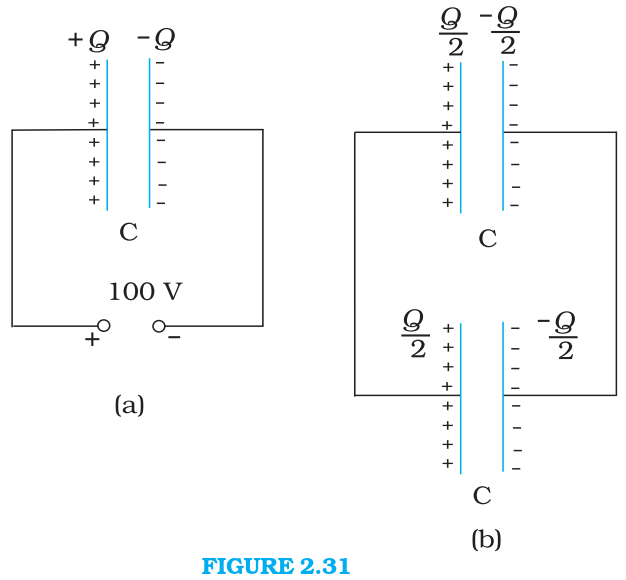
(a) A $900 pF$ capacitor is charged by $100 V$ battery [Fig. 2.31(a)]. How much electrostatic energy is stored by the capacitor? (b) The capacitor is disconnected from the battery and connected to another $900 pF$ capacitor [Fig. 2.31(b)]. What is the electrostatic energy stored by the system?
Image
Answer
(a) The charge on the capacitor is
$
\text { Q }=C V=900 \times 10^{-12} F \times 100 V =9 \times 10^{-8} C
$
The energy stored by the capacitor is
$
\begin{aligned}
& =(1 / 2) CV ^2=(1 / 2) Q V \\
= & (1 / 2) \times 9 \times 10^{-8} C \times 100 V =4.5 \times 10^{-6} J
\end{aligned}
$

(b) In the steady situation, the two capacitors have their positive plates at the same potential, and their negative plates at the same potential. Let the common potential difference be $V ^{\prime}$. The charge on each capacitor is then $Q^{\prime}=C V^{\prime}$. By charge conservation, $Q^{\prime}=Q / 2$. This implies $V^{\prime}=V / 2$. The total energy of the system is $=2 \times \frac{1}{2} Q^{\prime} V^{\prime}=\frac{1}{4} Q V=2.25 \times 10^{-6} J$
Thus in going from (a) to (b), though no charge is lost; the final energy is only half the initial energy. Where has the remaining energy gone?
There is a transient period before the system settles to the situation (b). During this period, a transient current flows from the first capacitor to the second. Energy is lost during this time in the form of heat and electromagnetic radiation.
View full question & answer
Question 223 Marks
Three circuits, each consisting of a switch ‘S’ and two capacitors, are initially charged, as shown in the figure. After the switch has been closed, in which circuit will the charge on the left-hand capacitor (i) increase, (ii) decrease and (iii) remain same? Give reasons.

Answer
VL = 3𝑉 VR = 3𝑉 (L: Left, R: Right)
VL = 6𝑉 VR = 3𝑉  
VL = 2𝑉 VR= 3𝑉  

Reasons:

  1. No change – (potential same on both capacitors as (VL = VR).
  2. Charge on left hand capacitor will decrease (VL > VR).
  3. Charge on left hand capacitor will increase (VR > VL).
View full question & answer
Question 233 Marks
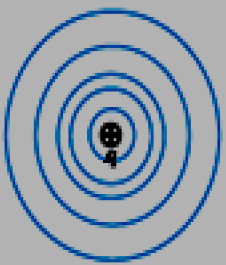
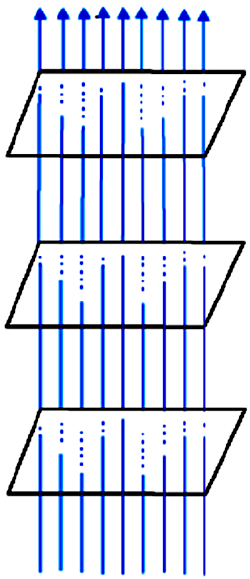
Define an equipotential surface. Draw equipotential surface:

  1. In the case of a single point charge and,
  2. In a constant electric field in Z-direction.

Why the equipotential surfaces about a single charge are not equidistant?

  1. Can electric field exist tangential to an equipotential surface? Give reason.
Answer
Surface with a constant value of potential at all points on the surface.

  1.  

  1. $\text{V} \propto\frac{1}{\text{r}}/$
  1. No If the field lines are tangential, work will be done in moving a charge on the surface which goes against the definition of equipotential surface.
View full question & answer
Question 243 Marks
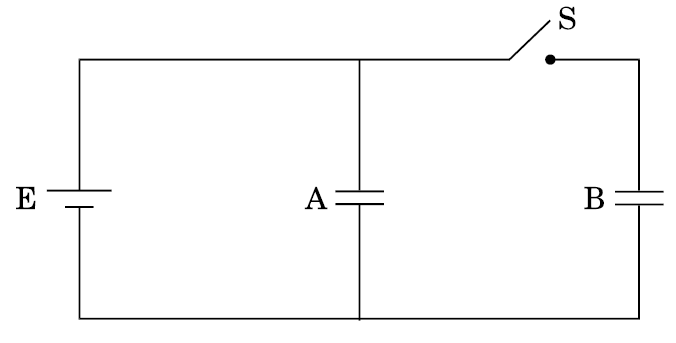
Two identical parallel plate capacitors A and B are connected to a battery of V volts with the switch S closed. The switch is now opened and the free space between the plates of the capacitors is filled with a dielectric of dielectric constant K. Find the ratio of the total electrostatic energy stored in both capacitors before and after the introduction of the dielectric.

Answer
Energy stored $=\frac{1}{2}CV^2=(\frac{1}{2}\frac{Q^2}{C})$

Net capacitance with switch S closed = C + C = 2C

$\therefore$  Energy stored $=\frac{1}{2}\times2C\times V^2=CV^2$

After the switch S is opened, capacitance of each capacitor = KC

$\therefore$ Energy stored in capacitor A $=\frac{1}{2}KCV^2$

For capacitor B,

Energy stored $=\frac{1}{2}\frac{Q^2}{KC}=\frac{1}{2}\frac{C^2V^2}{KC}=\frac{1}{2}\frac{CV^2}{K}$

$\therefore$ Total Energy stored $=\frac{1}{2}{KCV^2}+\frac{1}{2}\frac{CV^2}{K}=\frac{1}{2}{CV^2}\bigg({K+\frac{1}{K}}\bigg)$

$=\frac{1}{2}{CV^2}\bigg({\frac{K^2+1}{K}}\bigg)$

$\therefore$ Required ratio $=\frac{\frac{1}{2}\text{KCV}^2}{\frac{1}{2}\text{CV}^2\Big(\frac{\text{K}^2+1}{\text{K}}\Big)}=\frac{\text{K}^2}{\text{K}^2+1}$

View full question & answer
Question 253 Marks
Deduce the expression for the electrostatic energy stored in a capacitor of capacitance 'C' and having charge 'Q'.
How will the (i) energy stored and (ii) the electric field inside the capacitor be affected when it is completely filled with a dielectric material of dielectric constant 'K'?
Answer
Potential difference between the plates of capacitor
V = q/C
Work done to add additional charge dq on the capacitor
dw = V x dq

= (q/C) x dq

 $\therefore$Total energy stored in the capacitor

$\text{U} = \int\text{dw} = \int_{0}^{Q}\frac{\text{q}}{\text{c}}\text{dq} = \frac{1}{2}\frac{\text{Q}^{2}}{\text{c}}$

When battery is disconnected:

  1. Energy stored will be decreased or energy stored = 1/K times the initial energy.
  2. Electric field would decrease or E’ = E/K.

Alternate Answer

When battery is connected:

  1. Energy stored will increase or become K times the initial energy.
  2. Electric field will not change.
View full question & answer
Question 263 Marks
A network of four capacitors each of 12 μF capacitance is connected to a 500 V supply as shown in the figure. Determine (a) equivalent capacitance of the network and (b) charge on each capacitor. 

Answer
  1. $\frac{1}{\text{C}} = \frac{1}{\text{C}_{1}} + \frac{1}{\text{C}_{2}} + \frac{1}{\text{C}_{3}}$

$\frac{1}{\text{C}} = \frac{1}{12} + \frac{1}{12} +\frac{1}{12} = \frac{1}{4}$

$\text{C} = 4\mu\text{F}\text{ or simply C}_\text{s} = \frac{\text{C}}{3} = \frac{12}{3}\mu\text{F} = 4 \mu\text{F}$

Equivalent capacitance

$\text{C}_{eq} = \text{C} + \text{C}_{4} = 4 +12 = 16 \mu\text{F}$

  1. Calculation of charge on each capacitor:

Charge on capacitor C4

$\text{Q}_{4} = \text{C}_{4}\text{V} = 12 \times500\mu\text{C} = 6000\mu\text{C} = 6 \times10^{-3}\text{C}$

Charge on capacitors C1, C2 and C3

$\text{Q}_{123} =4 \mu\text{F}\times500\text{V} = 2 \times10^{-3}\text{C}. $

View full question & answer
Question 273 Marks
A parallel plate capacitor is charged by a battery. After some time the battery is disconnected and a dielectric slab of dielectric constant K is inserted between the plates. How would (i) the capacitance, (ii) the electric field between the plates and (iii) the energy stored in the capacitor, be affected? Justify your answer.
Answer
Original capacitance $\text{C}_{o} = \frac{\text{Q}}{\text{V}_{o}} = \varepsilon_{0}\frac{\it{\text{A}}}{\text{d}}$

When a dielectric is inserted:

  1. Capacitance

$\bigg( = \text{K}\in_{o}\frac{\it{\text{A}}}{\text{d}}\bigg)\text{ increases}$

  1. Electric Field.

$ = \bigg(\frac{\sigma - \sigma\text{P}}{\in_{o}}\bigg)\text{decreases}$

  1. Energy stored

$\bigg(\text{W} = \frac{1}{2}\text{KC}_{o}\cdot\frac{\text{Q}^{2}}{\text{C}_{o}\text{K}^{2}} =\frac{1}{2}\frac{\text{Q}^{2}}{\text{C}_{o}}\cdot\frac{1}{\text{k}}\bigg)\text{decrease}.$

View full question & answer
Question 283 Marks
Explain the underlying principle of working of a parallel plate capacitor. If two similar plates, each of area A having surface charge densities $+\sigma$ and $ -\sigma$ are separated by a distance d in air, write expressions for.
  1. the electric field at points between the two plates.
  2.  the potnetial difference between the plates.
  3. the capacitance of the capacitor so formed.
Answer
Principle:

  1. When an uncharged, grounded conducting plate is placed near a charged conducting plate a charge, of the opposite sign, gets induced on the
  2. This reduces the potential of first plate, without any change in the charge present in it.

$\text{E} = \frac{\sigma}{\varepsilon_\circ}$

$\text{V}= \frac{\sigma}{\varepsilon_\circ}\text{d}$

$\text{C} =\frac{\varepsilon_\circ}{\text{d}}\text{A}$.

View full question & answer
Question 293 Marks
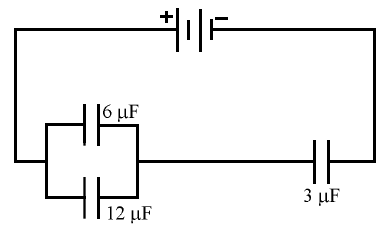
  1. In the following arrangement of capacitors, the energy stored in the 6 μF capacitor is E. Find the value of the following:
  2. Energy stored in 12 μF capacitor.
  3. Energy stored in 3 μF capacitor.
  4. Total energy drawn from the battery.

Answer
  1. $\text{E}=\frac{1}{2}CV^2=\frac{6}{2}\times10^{-6}V^{2}=3\times10^{-6}V^2$

$\therefore V^2=\frac{E}{3\times10^{-6}}$

Energy stored in $12\mu f$ capacitor $=\frac{1}{2}CV^2$

$=\frac{1}{2}\times12\times10^{-6}\times\frac{E}{3\times10^{-6}}$

= 2E

  1. Charge on $6\mu f$ capacitor, Q$=\sqrt{2EC}\big[\because E= \frac{1}{2}\frac{Q^2}{C}\big]$

$=2\sqrt{3E}\times10^{-3}C$

Charge on $12\mu f$ capacitor, Q$=\sqrt{2CE}$

$=\sqrt{2\times12\times10^{-6}\times2E}$

$=4\sqrt{3E}10^{-3}C$

Charge on $3\mu f$ apacitor, Q = Q1+ Q2

$=6\sqrt{3E}10^{-3}$

Energy stored in $3\mu f$ capacitor $=\frac{1}{2}\frac{Q^2}{C}=\frac{1}{2}\frac{36\times3E\times10^{-6}}{3\times10^{-6}}$

= 18E

Alternate Answer

  1. capacitance of parallel combination = $18\mu f$

Charge on parallel combination, Q = CV

$=18\times10^{-6}V$

Charge on $3\mu f=\text{Q}=3\times10^{-6}V_1$

$=18\times10^{-6}V=3\times10^{-6}V_1$

$=V_1=6V$

$\therefore$ Energy stored in $3\mu f$ capacitor $=\frac{1}{2}CV_1^2$

$=\frac{1}{2}\times3\times10^{-6}\times\frac{E\times36}{3\times10^{-6}}$

= 18 E

  1. Total energy drawn = E + 2E + 18E = 21E
View full question & answer
Question 303 Marks
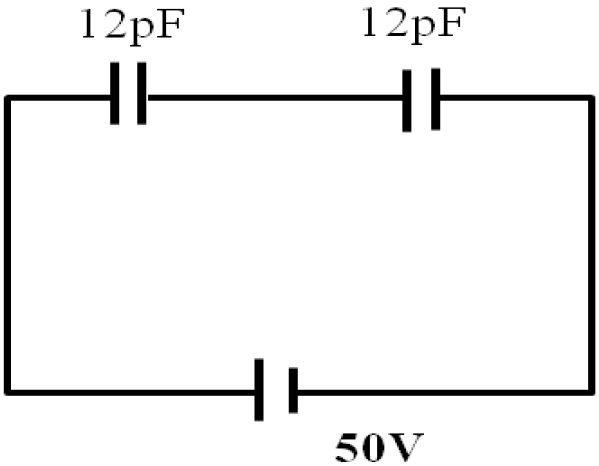
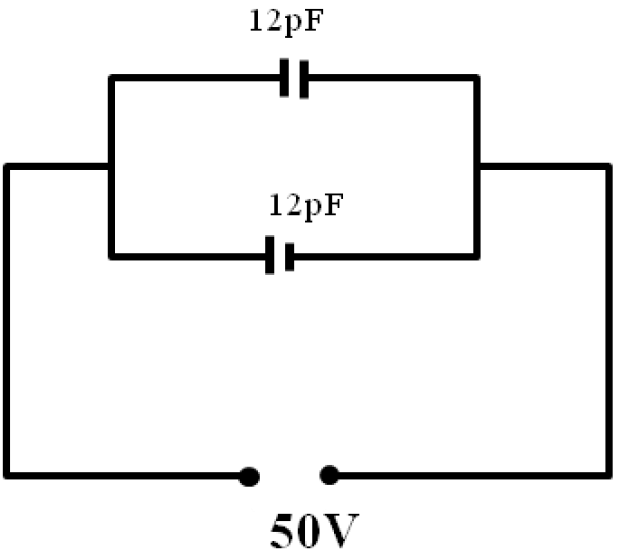
Two identical capacitors of 12 pF each are connected in series across a battery of 50 V. How much electrostatic energy is stored in the combination? If these were connected in parallel across the same battery, how much energy will be stored in the combination now?
Also find the charge drawn from the battery in each case.
Answer

In series combination: $\frac{1}{C_S}=\Bigg(\frac{1}{12}+\frac{1}{12}\Bigg)(pF)^{-1}$

$\therefore C_s=6\times10^{-12}pF$

$U_S=\frac{1}{2}CV^2$

$U_S=\frac{1}{2}\times6\times 10^{-12}\times50\times50\text{ }\text{J}$

$\therefore U_s=75\times10^{-10}\text{ }\text{J}$

$q_s=C_ sV$

$6\times50$

$300\times10^{-12} C=3\times{10}^{-10}C$


In parallel combination: ${C}_{p}=(12+12)pF$

$\therefore{C}_{p}=24\times10^{-12}F$

$U_s=\frac{1}{2}\times24\times10^{-12}\times2500\text{ }\text{J}$

$=3\times10^{-8}\text{ }\text{J}$

$q_p=C{p} V$

$q_p=24\times10{}^{-12}\times50\text{ }\text{C}$

$q_p=1.2\times10^{-9}\text{ }\text{C}$

View full question & answer
Question 313 Marks
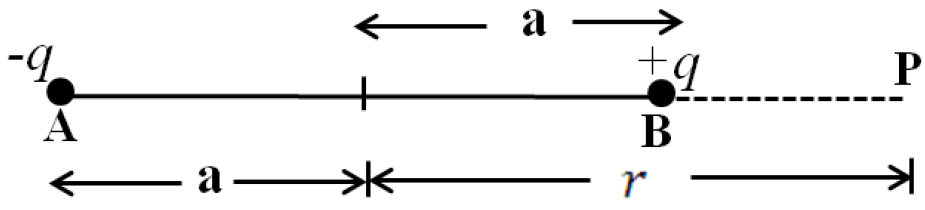
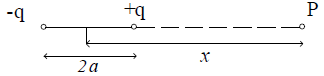
  1. Derive the expression for the electric potential due to an electric dipole at a point on its axial line.
  2. Depict the equipotential surfaces due to an electric dipole.
Answer
Potential due to charge at $ {A},{V}_{\text{A}}=\frac{1}{4{\pi}\in_0}\frac{-q}{(r+a)}$

Potential due to charge at $ {B},{V}_{B}=\frac{1}{4{\pi}\in_0}\frac{+q}{(r-a)}$

$ \therefore{\text{potential at point}}\text{ }P,V={V_B}+{V_A}$

$ \therefore{\text{ Net potential at}}\text{ }\text{P}=\frac{q}{4{\pi}\in_0}\bigg[\frac{-1}{(r+a)}+\frac{1}{(r-a)}\bigg]$

$V=\frac{q\times{2a}}{{4{\pi}\in_0}(r^2-a^2)}$

View full question & answer
Question 323 Marks
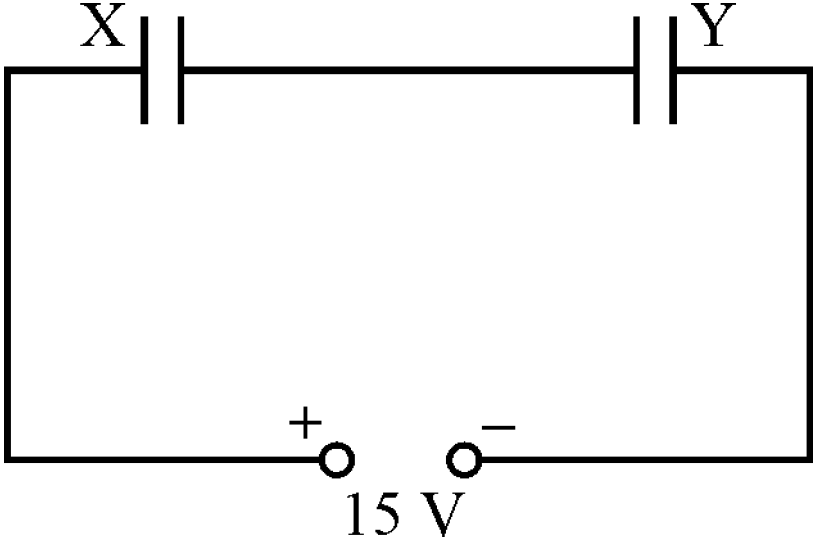
Two parallel plate capacitors X and Y have the same area of plates and same separation between them. X has air between the plates while Y contains a dielectric medium of $\varepsilon_{\text{r}} = 4.$

  1. Calculate capacitance of each capacitor if equivalent capacitance of the combination is $4\mu\text{f}.$
  2. Calculate the potential difference between the plates of X and Y.
  3. Estimate the ratio of electrostatic energy stored in X and Y.
Answer
  1. Let $\text{C}_{x} = \text{C}$

$\text{C}_{y} = 4\text{C } \text{as it has a dielectric medium of } \varepsilon_{r} = 4 .$

For series combination of two capacitors

$\frac{1}{\text{C}} =\frac{1}{\text{C}_{x}} + \frac{1}{\text{C}_{y}}$

$\Rightarrow\frac{1}{4\mu\text{F}} = \frac{1}{\text{C}} + \frac{1}{4\text{C}}$

$\frac{1}{4\mu\text{F}} = \frac{5}{4\text{C}}$

$\Rightarrow\text{C} = 5\mu\text{F}$

Hence $\text{C}_{X} = 5\mu\text{F}$

$\text{C}_{y} = 20 \mu\text{F}$

  1. Total charge Q = CV

$ = 4 \mu\text{F}\times15 \text{V} = 60 \mu\text{C}$

$\text{V}_{x} = \frac{\text{Q}}{\text{C}_{x}} = \frac{60\mu\text{C}}{5\mu\text{F}} = 12 \text{V}$

$\text{V}_{y} = \frac{\text{Q}}{\text{C}_{y}} = \frac{60\mu\text{C}}{20\mu\text{F}} = 3 \text{V}$

  1. $\frac{{\text{E}}_{\text{x}}}{\text{E}_{\text{y}}} = \frac{^\frac{\text{Q}^{2}}{2{C}_{\text{X}}}}{\frac{\text{Q}^{2}}{2\text{C}_{Y}}} = \frac{\text{C}_{\text{y}}}{\text{C}_{\text{x}}} = \frac{20}{5} = 4:1$
View full question & answer
Question 333 Marks
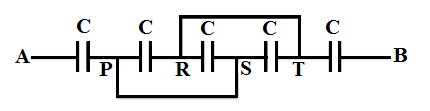
  1. Find equivalent capacitance between A and B in the combination given below. Each capacitor is of 2 μF capacitance.

  1. If a dc source of 7 V is connected across AB, how much charge is drawn from the source and what is the energy stored in the network?
Answer
Capacitors  $C_2$$C_3$ $\text{and}$ $C_4 $$\ \ \text{are in parallel}$

$\therefore C_{234}=C_2+C_3+C_4$

$\therefore C_{234}=6\mu F$

Capacitors $C_1$,$​​​​C_{234}$ $\text{and}$  $C_5$ are in series

$\frac{1}{C_{eq}}=\frac{1}{C_1}+\frac{1}{C_{234}}+\frac{1}{C_5}=\frac{1}{2}+\frac{1}{6}+\frac{1}{2}$

$=\frac{7}{6}\mu F$

$C_{equivalent}=\frac{6}{7}\mu F$

Charge drawn from the source

$Q=C_{eq}V,$

$=\frac{6}{7}\times7\mu C=6\mu C$

Energy stored $U=\frac{Q^2}{2C}$

$=\frac{6\times6\times10^{-12}\times7}{2\times6\times10^{-6}}\text{J}$

$=21\mu \text{J}$.
View full question & answer
Question 343 Marks
Two capacitors of unknown capacitances C1 and C2 are connected first in series and then in parallel across a battery of 100 V. If the energy stored in the two combinations is 0.045 J and 0.25 J respectively, determine the value of C1 and C2. Also calculate the charge on each capacitor in parallel combination.
Answer
Energy stored in a capacitor

$\text{E} = \frac{1}{2}\text{CV}^{2}$

in series combination

$0.045 =\frac{1}{2}\frac{\text{c}_{1}\text{c}_{2}}{\text{c}_{1}\text{c}_{2}}(100)^{2}$

$ = > \frac{\text{c}_{1}\text{c}_{2}}{\text{c}_{1} + \text{c}_{2}} = 0.09\times10^{-4}$.....(i)

In parallel combination

$0.25 = \frac{1}{2}(\text{c}_{1} +\text{c}_{2})(100)^{2}$

$= > \text{c}_{1} + \text{c}_{2} =0.5\times10^{-4}$.....(ii)

On simplifying (i) & (ii)

C1C2 = 0.045 × 10⁻⁸

(C1 – C2)2 = (C1 + C2)2 – 4C1C2

= (0.5 × 10⁻⁴)2 – 4 × 0.045 × 10–8

= 0.25 × 10⁻⁸ – 0.180 × 10⁻⁸

(C1 – C2)2 = 0.07 × 10⁻⁸

(C1 – C2)2 = 2.6 × 10–5 = 0.26 × 10⁻⁴ .....(iii)

From (ii) and (iii) we have

 => C1 = 0.38 × 10⁻⁴ F and C2 = 0.12 × 10⁻⁴ F

Charges on capacitor C1 and C2 in parallel combination.

Q1 = C1V = (0.38 × 10–4 × 100) = 0.38 × 10⁻²C

Q2 = C2V = (0.12 × 10–4 × 100) = 0.12 × 10⁻² C

$\text{E} = \frac{1}{2}\text{CV}^{2}$

and $0.045 = \frac{1}{2}\bigg(\frac{\text{c}_{1}\text{c}_{2}}{\text{c}_{1} +\text{c}_{2}}\bigg)(100 )^{2}$

$0.25 = \frac{1}{2}(\text{c}_{1} +\text{c}_{2})(100)^{2}$

but is unable to calculate C1 and C2,

Q1 = C1V = C1(100) and Q2 = C2V = C2(100).

View full question & answer
Question 353 Marks
A parallel plate capacitor is charged by a battery. After sometime the battery is disconnected and a dielectric slab with its thickness equal to the plate separation is inserted between the plates. How will (i) the capacitance of the capacitor, (ii) potential difference between the plates and (iii) the energy stored in the capacitor be affected?
Justify your answer in each case.
Answer
  1. Capacltance $\text{C} = \frac{\text{K}\varepsilon_{0}\text{A}}{\text{d}},$ Hence capacitance Increases K times.
  2. Potential difference $\text{V} = \frac{\text{V}_{o}}{\text{K}},$Hence potential difference decreases by a factor K.
  3. Energy stored E $ =\frac{1}{2}\text{CV}^{2},$ As capacitance becomes K times & potential difference becomes 1/K times therefore energy stored becomes 1/K times.

Alternate Answer

Energy stored = Q2/2C. As capacitance increases by a factor K, the energy stored will decrease by the same factor.

View full question & answer
Question 363 Marks
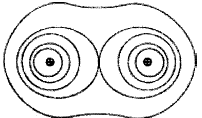
  1. Depict the equipotential surfaces for a system of two identical positive point charges placed a distance ‘d’ apart.
  2. Deduce the expression for the potential energy of a system of two point charges q1 and q2 brought from infinity to the points$\overrightarrow{\text{r}_{1}}$  and $\overrightarrow{\text{r}_{2}}$ respectively in the presence of external electric field $\overrightarrow{\text{E}}.$
Answer
Equipotential surfaces for a system of two identical positive charges:

Expression for the potential energy of a system of two point charges in external field:

Work done in bringing the charge q1 from infinity to r1

Work done = q1 V(r1)

Work done in bringing the charge q1 from infinity to r2.

Work done against the external electric field = q2V (r2)

Work done = work done against the external electric field + Work done on q2 against the field due to q1

$ = \text{q}_{2}\text{V}(\text{r}_{2}) + \frac{\text{q}_{1}\text{q}_{2}}{4\pi\varepsilon_{0}\text{r}_{12}}$

Potential energy of the system
= the total work done in assembling the configuration

$ = \text{q}_{1}\text{V}(\text{r}_{1}) + \text{q}_{2}\text{V}(\text{r}_{2}) + \frac{\text{q}_{1}\text{q}_{2}}{4\pi\varepsilon_{0}\text{r}_{12}}.$

View full question & answer
Question 373 Marks
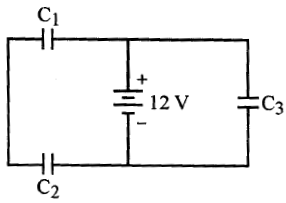
Three identical capacitors C1, C2 and C3 of capacitance 6 µF each are connected to a 12 V battery as shown.

Find:

  1. charge on each capacitor.
  2. equivalent capacitance of the network.
  3. energy stored in the network of capacitors.
Answer
  1. Charge on capacitors C1 and C2.

$\text{Q}_{1} = 36\mu\text{C} $ ; 

charge on capacitor C3

$\text{Q}_{3} = 72\mu\text{C}$

  1. Equivalent capacitance.

$\text{C} = \frac{\text{C}_{1}{\text{C}_{2}}}{\text{C}_{1}+\text{C}_{2}} + \text{C}_{3}$

$\frac{6\times6}{6+6}+6 = 9\mu\text{F}$

  1. Energy stored in Network.

$\text{W} =\frac{1}{2}\text{CV}^{2}$

$ =\frac{1}{2}\times9\times10^{-6}\times\big(12\big)^{2}\text{J}$

$ =648\times10^{-6}\text{J} = 648\mu\text{J}$

$ = 6.48\times10^{-4}\text{J}$

View full question & answer
Question 383 Marks
Deduce an expression for the electric potential due to an electric dipole at any point on its axis. Mention one contrasting feature of electric potential of a dipole at a point as compared to that due to a single charge.
Answer
 

Potential at P due to +q

$\text{V}_{+q} = \frac{1}{4\pi\varepsilon_{\circ}}$ $\frac{q}{\times-a}$

Potential at P due to -q

$\text{V}_{-q} = \frac{1}{4\pi\varepsilon_{\circ}}$ $\frac{-q}{\times+a}$

$\therefore$ Potential at P due to the dipole

$\text{V} = \frac{1}{4\pi\varepsilon_{\circ}}$ $\frac{q\big(2\text{a}\big)}{(\text{X}^{2}-\text{a}^{2})}$

for a <<x , we have

$\therefore \text{v}\cong\frac{1}{4\pi\varepsilon_\circ}$ $\frac{q\big(2\text{a}\big)}{\text{X}^{2}}$

For a single charge V  $\alpha\frac{1}{\text{X}^{2}}$ 

View full question & answer
Question 393 Marks

A parallel plate capacitor, each with plate area A and separation d, is charged to a potential difference V. The battery used to charge it is then disconnected. A dielectric slab of thickness d and dielectric constant K is now placed between the plates. What change, if any, will take place in.

  1.  Charge on the plates.
  2. Electric field intensity between the plates.
  3. Capacitance of the capacitor.
Answer
  1. No change.

As the battery is disconnected.

  1. Decreases OR becomes $\frac{1}{\text{k}}$ times Due to polarisation of the dielectric.
  2. Increases OR becomes k times.

As the electric field, and therefore, the p.d., between the plates decreases.

View full question & answer
Question 403 Marks
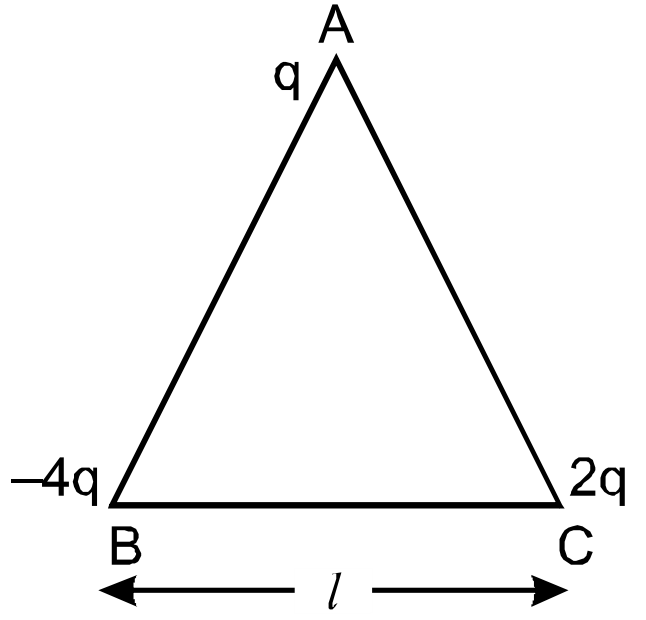
  1. Three point charges q, -4q and 2q are placed at the vertices of an equilateral triangle ABC of side ‘l’ as shown in the figure. Obtain the expression for the magnitude of the resultant electric force acting on the charge q.

  1. Find out the amount of the work done to separate the charges at infinite distance.
Answer
  1.  

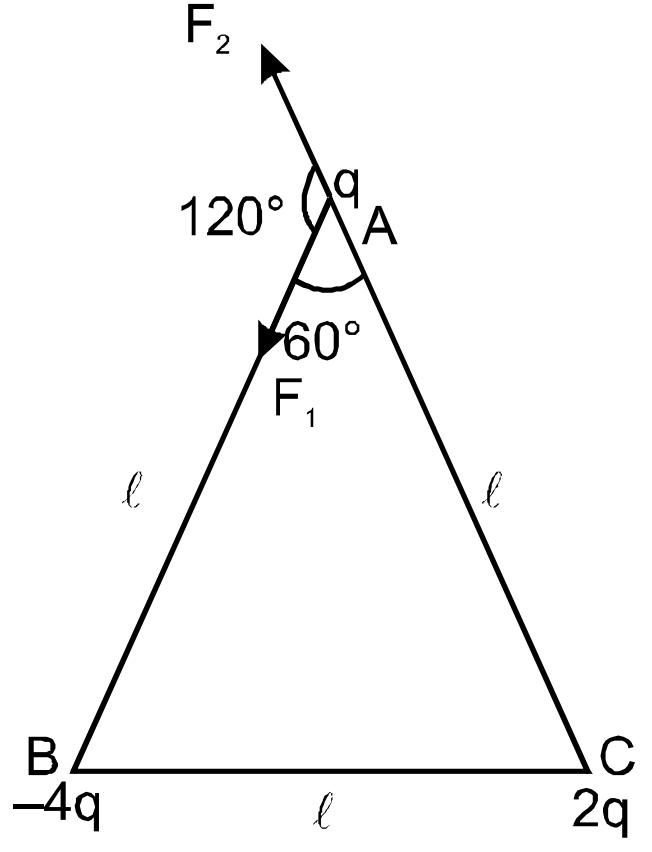
Force on q due to -4q.

$\text{F}_1=\frac{\text{K(4q)(q)}}{\text{l}^2}$ (along A - B)

$\text{F}_1=\frac{\text{4Kq}^2}{\text{l}^2}$ (along A - B)

Force on q due to 2q.

$\text{F}_2=\frac{\text{K(2q)(q)}}{\text{l}^2}$ (along C - A)

$\text{F}_2=\frac{2\text{Kq}^2}{\text{l}^2}$ (along C - A)

Angle between F1 of F2 $(\theta=120^\circ):$

$\therefore$ Resultat Force:

$\text{F}=\sqrt{\text{F}^2_1+\text{F}^2_2+2\text{F}_1\text{F}_2\cos120^\circ}$

$\text{F}=\sqrt{(2\text{F}_2)^2+(\text{F}_2)^2+2(2\text{F}_2)\text{F}_2\Big(-\frac{1}{2}\Big)}$ $(\because\ \text{F}_1=2\text{F}_2)$

$=\sqrt{5\text{F}^2_2-2\text{F}^2_2}=\sqrt{3}\text{F}_2$

$\therefore\ \text{F}=\sqrt{3}\times\frac{2\text{Kq}^2}{\text{l}^2}$

Direction $\tan\alpha=\frac{\text{F}_2\sin\theta}{\text{F}_1+\text{F}_2\cos\theta}$

$=\frac{\text{F}_2\times\frac{\sqrt{3}}{2}}{2\text{F}_2+\text{F}_2\big(-\frac{1}{2}\big)}$

So, resultant forces is making angle.

$\alpha=\tan^{-1}\Big(\frac{1}{\sqrt{3}}\Big)$ with the line AB.

  1. Workdone to gather the charges from infinity = potential energy of system (U)

$\text{U}=\frac{\text{Kq(2q)}}{\text{l}}+\frac{\text{Kq(-4q)}}{\text{l}}+\frac{\text{K(2q)(-4q)}}{\text{l}}$

$=\frac{\text{Kq}^2}{\text{l}}(2-4-8)=-10\frac{\text{Kq}^2}{\text{l}}$

$\therefore$ Workdone to separate the charges to infinity $=\frac{10\text{Kq}^2}{\text{l}}$

View full question & answer
Question 413 Marks
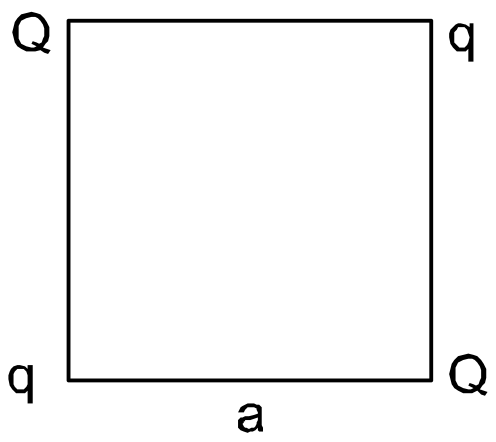
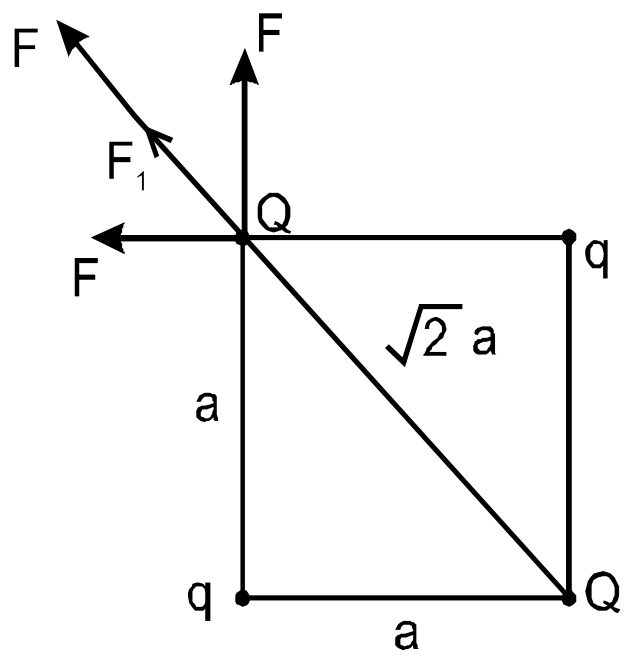
Four point charges Q, q, Q and q are placed at the corners of a square of side ‘a’ as shown in the figure.

Find the:

  1. Resultant electric force on a charge Q.
  2. Potential energy of this system.
Answer
  1.  

Force on Q due to Q:

$\text{F}_1=\frac{\text{KQ}^2}{(\sqrt{2}\text{a})^2}=\frac{\text{KQ}^2}{2\text{a}^2}$ (direction is shown in figure)

Force on Q due to single 'q':

$\text{F}=\frac{\text{KQq}}{\text{a}^2}$ (direction is same as F1)

Resultant Force on Q due to both 'q':

$\text{F}_2=\sqrt{2}\text{F}=\frac{\sqrt{2}\text{KQq}}{\text{a}^2}$

$\therefore$ Resulatant electric force on Q:

$\text{F}=\text{F}_1+\text{F}_2$

$\text{F}=\frac{\text{KQ}^2}{2\text{a}^2}+\frac{\sqrt{2}\text{KQq}}{\text{a}^2}$

$\text{F}=\frac{\text{KQ}}{\text{a}^2}\Big(\frac{\text{Q}}{2}+\sqrt{2}\text{q}\Big)$

$\text{F}=\frac{\text{KQ}}{\text{a}^2}\Big(\frac{\text{Q}+2\sqrt{2}\text{q}}{2}\Big)$

Directed outwards along the line joing charges Q and Q. (Show in figure)

  1. Potential Energy of system:

$\text{U}=\frac{\text{KQq}}{\text{a}}+\frac{\text{KQq}}{\text{a}}+\frac{\text{KQ}^2}{\sqrt{2}\text{a}}+\frac{\text{KQq}}{\text{a}}+\frac{\text{Kq}^2}{\sqrt{2}\text{a}}+\frac{\text{KQq}}{\text{a}}$

$=\frac{4\text{KQq}}{\text{a}}+\frac{\text{KQ}^2}{\sqrt{2}\text{a}}+\frac{\text{Kq}^2}{\sqrt{2}\text{a}}$

$\text{P.E.}=\frac{\text{K}}{\text{a}}\Big[4\text{Qq}+\frac{\text{Q}^2}{\sqrt{2}}+\frac{\text{q}^2}{\sqrt{2}}\Big]$​​​​​​​

View full question & answer
Question 423 Marks
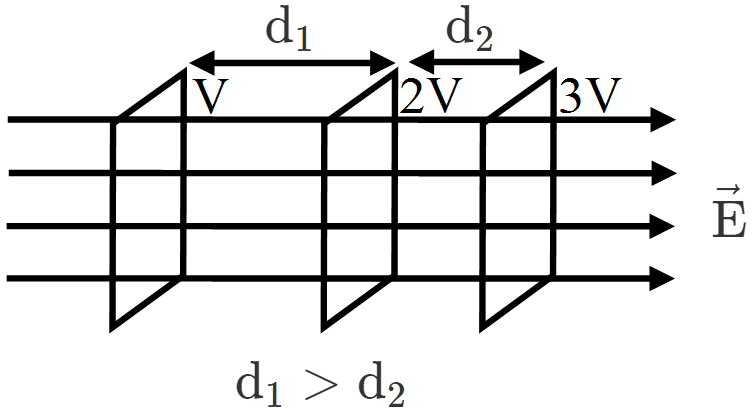
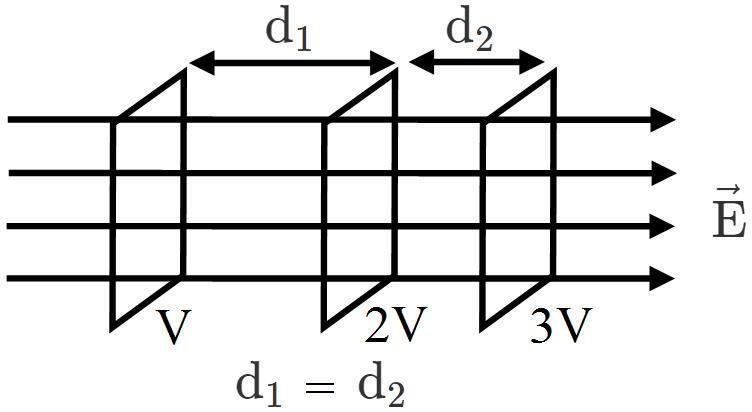
  1. Draw the equipotential surfaces corresponding to a uniform electric field in the z-direction.
  2. Derive an expression for the electric potential at any point along the axial line of an electric dipole.
Answer
  1. For constant electric field vector E

For increasing electric field

Difference: For constant electric field, the equipotential surfaces are equidistant for the same potential difference between these surfaces; while for increasing electric field, the separation between these surfaces decreases, in the direction of the increasing field, for the same potential difference between them.

  1. Suppose P is a point on the axial position of the dipole. Length of dipole = 2a

Suppose point P is at the distance 'r' from the center of the dipole.

We know that potential at a point is given as, $\text{V}=\frac{1}{4\pi\in_0}.\frac{\text{Q}}{\text{r}}$

So, the potential at P due to q is, $\text{V}_\text{q}=\frac{1}{4\pi\in_0}.\frac{\text{q}}{\text{a}+\text{r}}$

Potential at P due to -q is, $\text{V}_\text{-q}=\frac{1}{4\pi\in_0}.\frac{\text{-q}}{\text{a}-\text{r}}$

The total potential at P is,

$\text{V}=\text{V}_\text{q}+\text{V}_{-\text{q}}$

$=\frac{1}{4\pi\in_0}.\frac{\text{q}}{(\text{a}+\text{r})}+\frac{1}{4\pi\in_0}.\frac{-\text{q}}{(\text{r-a})}$

$=\frac{\text{q}}{4\pi\in_0}\Big[\frac{1}{(\text{a+r})}+\frac{1}{(\text{a-r})}\Big]$

$\text{V}=\frac{\text{q}}{4\pi\in_0}.\frac{2\text{a}}{(\text{a}^2-\text{r}^2)}$

View full question & answer
Question 433 Marks
A charge of +2.0 × 10⁻⁸C is placed on the positive plate and a charge of -1.0 × 10⁻⁸C on the negative plate of a parallel-plate capacitor of capacitance $1.2\times10^{-3}\mu\text{F}.$ Calculate the potential difference developed between the plates.
Answer
$\text{q}_1=+2.0\times10^{-8}\text{c}$

$\text{q}_2=-1.0\times10^{-8}\text{c}$

$\text{C}=1.2\times10^{-3}\mu\text{F}=1.2\times10^{-9}\text{F}$

$\text{net q}=\frac{\text{q}_1-\text{q}_2}{2}=\frac{3.0\times10^{-8}}{2}$

$\text{V}=\frac{\text{q}}{\text{c}}=\frac{3\times10^{-8}}{2}\times\frac{1}{1.2\times10^{-9}}=12.5\text{V}$

View full question & answer
Question 443 Marks
If one of the two electrons of a H2 molecule is removed, we get a hydrogen molecular ion $\text{H}^+_2​.$ In the ground state of an $\text{H}^+_2​,$ the two protons are separated by roughly 1.5 Å, and the electron is roughly 1 Å from each proton. Determine the potential energy of the system. Specify your choice of the zero of potential energy.
Answer
The system of two protons and one electron is represented in the given figure.

Charge on proton 1, q1 = 1.6 x 10⁻¹⁹ C

Charge on proton 2, q2 = 1.6 x 10⁻¹⁹ C

Charge on electron, q3 = -1.6 x 10⁻¹⁹ C

Distance between protons 1 and 2, d1 = 1.5 x 10⁻¹⁰ m

Distance between proton 1 and electron, d2 = 1 x 10⁻¹⁰ m

Distance between proton 2 and electron, d3 = 1 x 10⁻¹⁰ m

The potential energy at infinity is zero.

Potential energy of the system,

$\text{V}=\frac{\text{q}_1\text{q}_2}{4\pi\in_0\text{d}_1}+\frac{\text{q}_2\text{q}_3}{4\pi\in_0\text{d}_1}$

View full question & answer
Question 453 Marks
In a hydrogen atom, the electron and proton are bound at a distance of about 0.53 $\mathring{\text{A}}$:
  1. Estimate the potential energy of the system in eV, taking the zero of the potential energy at infinite separation of the electron from proton.
  2. What is the minimum work required to free the electron, given that its kinetic energy in the orbit is half the magnitude of potential energy obtained in (a)?
  3. What are the answers to (a) and (b) above if the zero of potential energy is taken at 1.06 Å separation?
Answer
The distance between electron-proton of a hydrogen atom, d = 0.53 $\mathring{\text{A}}$

Charge on an electron, q1 = -1.6 x 10⁻¹⁹ C

Charge on a proton, q2 = +1.6 x 10⁻¹⁹ C

  1. Potential at infinity is zero.

Potential energy of the system, p-e = Potential energy at infinity - Potential energy at distance, d

$=0-\frac{\text{q}_1\text{q}_2}{4\pi\in_0\text{d}}$

Where,

$\in_0$ is the permittivity of free space

$\frac{1}{4\pi\in_0}=9\times10^9\text{Nm}^2\text{C}^{-2}$

$\therefore\text{Potential energy}=0-\frac{9\times10^9\times\big(1.6\times10^{-19}\big)^2}{0.53\times10^{-10}}=-43.7\times10^{-19}\text{J}$

Since 1.6x 10⁻¹⁹ J = 1 eV,

$\therefore\text{Potential energy}=-43.7\times10^{-19}=\frac{-43.7\times10^{-19}}{1.6\times10^{-19}}=-27.2\ \text{eV}$

Therefore, the potential energy of the system is -27.2 ev.

  1. Kinetic energy is half of the rnagnitude of potential energy.

Kinetic energy $=\frac{1}{2}\times(-27.2)=13.6\ \text{eV}$

Total energy = 13.6 - 27.2 = 13.6 eV

Therefore, the rninimum work required to free the electron is 13.6 eV.

  1. When zero of potential energy is taken, d= 1.06 A

$\therefore$ Potential energy of the system = Potential energy at d1 - Potential energy at d

$=\frac{\text{q}_1\text{q}_2}{4\pi\in_0\text{d}_1}-27.2\ \text{eV}$

$=\frac{9\times10^9\times(1.6\times10^{-19})^2}{1.06\times10^{-10}}-27.2\ \text{eV}$

= 21.73 × 10-19 J - 27.2 eV

= 13.58 eV - 27.2 eV

= -13.6 eV

View full question & answer
Question 463 Marks
A metal sphere of radius R is charged to a potential V:
  1. Find the electrostatic energy stored in the electric field within a concentric sphere of radius 2R.
  2. Show that the electrostatic field energy stored outside the sphere of radius 2R equals that stored within it.
Answer
$\text{Q}=\text{CV}=4\pi\in_0\text{R}\times\text{V}$

$\text{E}=\frac{1}2{}\frac{\text{q}^2}{\text{C}}$ $[\therefore$ 'C' in a spherical shell $=4\pi\in_0\text{R}]$

$\text{E}=\frac{1}{2}\frac{16\pi^2\in_0^2\times\text{R}^2\times\text{V}^2}{4\pi\in_0\times2\text{R}}=2\pi\in_0\text{RV}^2$ $[$'C' of bigger shell $=4\pi\in_0\text{R}]$

View full question & answer
Question 473 Marks
Find the total energy stored in the capacitors in the given network.

Answer
The equivalent capacitance of C1 and C2 in series,

$\text{C}'=\frac{\text{C}_1\text{C}_2}{\text{C}_2+\text{C}_2}=\frac{2\times2}{2+2}=1\mu\text{F}$

C′ is in parallel with C3, so equivalent capacitance of C1, C2 and C3 is:

$\text{C}''=1+1=2\mu\text{F}$

C′′ is in series with C4; their equivalent capacitance,

$\text{C}'''=\frac{\text{C}_4\text{C}}{\text{C}_4+\text{C}''}=\frac{2\times2}{2+2}=1\mu\text{F}$

This is in parallel with C5; So equivalent capacitance across AB is $\text{C}_{\text{AB}}=1+1=2\mu\text{F},$

Energy stored $\text{V}'=\frac{1}{2}\text{C}_{\text{AB}}\text{V}^2=\frac{1}{2}\times2\times10^{-6}\times(6)^2=36\times10^{-6}\text{J}$

View full question & answer
Question 483 Marks
A large conducting plane has a surface charge density $1.0\times10^{-4}\text{Cm}^{-2}.$ Find the electrostatic energy stored in a cubical volume of edge 1.0cm in front of the plane.
Answer
$\sigma=1\times10^{-4}\text{c/m}^2$

$\text{a}=1\text{cm}=1\times10^{-2}\text{m}$

$\text{a}^3=10^{-6}\text{m}$

The energy stored in the plane $=\frac{1}{2}\frac{\sigma^2}{\in_0}=\frac{1}{2}\frac{(1\times10^{-4})^2}{8.85\times10^{-12}}$

$=\frac{10^4}{17.7}=564.97$

The necessary electro static energy stored in a cubical volume of edge 1cm infront of the plane $=\frac{1}{2}\frac{\sigma^2}{\in_0}\text{a}^3=265\times10^{-6}=5.65\times10^{-4}\text{J}$

View full question & answer
Question 493 Marks
Prove that a closed equipotential surface with no charge within itself must enclose an equipotential volume.
Answer
Let us assume that in a closed equipotential surface with no charge the potential is changing from position to position. Let the potential just inside the surface is different to that of the surface causing in a potential gradient $\Big(\frac{\text{dV}}{\text{dr}}\Big)$ It means $\text{E}\neq0$ electric field comes into existence, which is given by as $\text{E}=-\frac{\text{dV}}{\text{dr}}$ It means there will be field lines pointing inwards or outwards from the surface. These lines cannot be again on the surface, as the surface is equipotential. It is possible only when the other end of the field lines are originated from the charges inside. This contradicts the original assumption. Hence, the entire volume inside must be equipotential.
View full question & answer
Question 503 Marks
Prove that, if an insulated, uncharged conductor is placed near a charged conductor and no other conductors are present, the uncharged body must be intermediate in potential between that of the charged body and that of infinity.
Answer
If we analyse the equation, $\text{E}=-\frac{\text{dV}}{\text{dr}}$, then we observe that electric potential decreases along the direction of electric field.
Now, consider any path from the charged conductor to the uncharged conductor along the electric field. The potential will continually decrease along this path. A second path from the uncharged conductor to infinity will again continually lower the potential further. Therefore, we can say that the uncharged body must be intermediate in potential between that of the charged body and that of infinity.
View full question & answer